
Is That Popular Diet Plan a Healthy Choice?
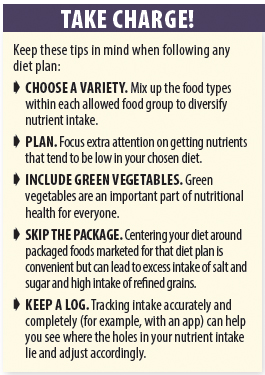
The recommended dietary pattern includes a combination of vegetables, fruits, non-fat and reducedfat dairy, whole grains, fish, poultry, lean meats, and plant oils. “Consuming a variety of foods across all the food groups is important to ensuring you get all the nutrients you need,” says Susan B. Roberts, PhD, senior scientist and director of the Energy Metabolism Lab at the HNRCA. Many popular diet plans run contrary to this advice, as they limit entire food groups. If you follow or are considering following one of these plans, it’s important choose your foods carefully to avoid potential shortfalls in nutrients.
Keto.
Carbohydrate-rich foods like whole grains, legumes, most fruits, and many vegetables are often avoided in ketogenic diets. Limiting carbohydraterich foods rules out unhealthy refined grains, starches, and sweets—which is a plus. But it may also result in insufficient intake of dietary fiber and whole plant foods. Getting plenty of fiber and phytonutrients is important for your gut microbiome, cardiovascular health, weight management, regularity, and more. Very low-carb diets can also be low in vitamins A, B6, E, K, thiamin, and folate; minerals magnesium, calcium, iron, iodine, and potassium; and potentially beneficial phytochemicals. Additionally, ketogenic diets are often high in red and processed meats and low in mono- and polyunsaturated fats.
What to Do: Keto dieters should aim to include a variety of vegetables and fruits more often, especially plant foods high in fiber and with a high density of nutrients per calorie, like leafy green vegetables and broccoli. Additionally, choosing seafood and seeking healthy sources of plant fats, such as nuts and seeds, in place of red and processed meats and preparing foods with liquid plant oils will increase intake of healthy unsaturated fats and decrease intake of saturated fats.
Paleo.
These diet plans typically limit or exclude dairy, grains, and legumes. Like Keto diets, a plus is the avoidance of refined grains, starches, and sugars. Paleo diet plans are often high in saturated fat and low in fiber, calcium, and vitamin K. Plant foods like legumes and whole grains are often replaced with red and processed meats.
What to Do: As with ketogenic diets, Paleo dieters should aim to regularly include a variety of fruits, nuts, seeds, and vegetables, including green vegetables, to insure sufficient intake of vitamin K, fiber, and calcium. Like Keto, Paleo dieters may also benefit from replacing some saturated fat with healthy unsaturated fats from nuts, seeds, seafood, and liquid plant oils.
Vegan.
Vegan dietary patterns exclude all foods of animal origin, including dairy and eggs. Diet composition within the remaining food groups is up to the individual. Because plant-based foods can be highly or minimally processed, this means some vegans have healthy diets and some don’t. According to a recent meta-analysis, vegans have lower intake of riboflavin, niacin, vitamin B12, vitamin D, iron, calcium, and iodine. These nutrients are found in the highest concentration in animal-sourced foods. Some vegans also eat high amounts of refined starches and grains.
What to Do: Adequate intake of most nutrients can be achieved on a vegan diet with careful planning. Vegans should consume foods rich in zinc and iron, like legumes, whole grains, and seeds and include nutrient dense foods like broccoli and tofu. Vitamin C aids in iron absorption, so pair iron-containing foods with vitamin C-rich choices like citrus, strawberries, and red peppers. For vitamins D, B12, riboflavin, and niacin, vegans may want to consider adding nutritional yeast and fortified foods, such as fortified (whole grain, low-sugar) breakfast cereals and soy or oat milk. Refined grains and starches should be minimized.
The best way to nourish your body is to consume a variety of foods from each food group. Popular diets may require some additional planning to ensure they provide adequate amounts of all essential nutrients. “Popularity alone isn’t a good reason to choose a diet,” says Roberts, “but diets that are healthy, satisfying, and enjoyable can enable long term sustainability and health through nutrition.”
The post Is That Popular Diet Plan a Healthy Choice? appeared first on University Health News.
Read Original Article: Is That Popular Diet Plan a Healthy Choice? »
