
Take Steps to Limit Vision Loss from Age-Related Macular Degeneration
It’s not unusual to experience vision changes as you age, but some changes are normal while others signal the presence of an eye disease. Age-related macular degeneration (AMD), which is the leading cause of vision loss for Americans over age 50, is an example of the latter. AMD occurs when the macula is damaged and function is impaired. The macula, which is the center part of the retina at the back of the eye, gives you a clear view of objects that are in the middle of your visual field. Your macula helps you focus, read fine print, recognize familiar faces, and read street signs when driving, among other things. “Early detection of AMD can help prevent and reverse vision loss,” says Kyle Kovacs, MD, assistant professor of ophthalmology at Weill Cornell Medical College.
The Types of AMD
There are two types of AMD: dry and wet. Dry AMD refers to the slow atrophy (wasting away) of the retina that is caused by the formation of drusen, which are waste products that form deposits underneath the retina. The other form is wet, or exudative, AMD. “With wet AMD there are abnormal blood vessels that develop underneath the retina. These blood vessels are very fragile and can leak, bleed, and ultimately lead to scar tissue forming in and under the retina. This leads to vision impairment,” explains Dr. Kovacs. Wet AMD often results from dry AMD progression, although some patients initially present with wet AMD. The average age of onset of wet AMD is late 70s and early 80s, but Dr. Kovacs notes that AMD is a complex disease related to both genetics and environment, so anyone over age 50 may have either wet or dry AMD.
Are You at risk?
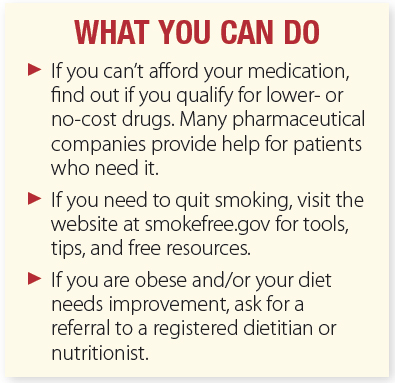
Advancing age, a family history of AMD, and certain genetic factors are nonmodifiable risk factors for AMD. Risk factors that you can do something about include smoking, an unhealthy diet, high blood pressure, high LDL cholesterol, and obesity.
“Smoking is one of the few modifiable risk factors for AMD, and we know that smoking significantly increases the risk of not only developing AMD, but also progressing to the advanced forms of AMD,” says Dr. Kovacs. Make sure your diet contains plenty of vegetables and at least two servings of fish (not fried) each week, and minimize your consumption of processed foods and foods that are rich in saturated fat, such as red and processed meats.
Diagnostics and Imaging
It’s important to have your eye exam conducted by an ophthalmologist, a medical doctor who specializes in eye health. “AMD is detected by a special examination of the retina called a dilated fundus exam, and this is usually performed in conjunction with specialized photos,” explains Dr. Kovacs. People with a strong family history of AMD should get a dilated retinal exam starting at age 50. If the eyes appear to be healthy, Dr. Kovacs says a yearly exam is sufficient. If there are signs of dry AMD, he recommends a complete, dilated exam every six months.
Treating AMD
Doctors generally do not treat dry AMD, which progresses slowly. There is some evidence that the advanced (but not early) stage of dry AMD may be slowed by taking a supplement called AREDS2 that includes several nutrients that have antioxidant properties. Other studies have shown the importance of diet in preventing development of the advanced forms of AMD—specifically the Mediterranean diet, which includes whole grains, fruits, vegetables, seafood, beans, and nuts.
There are five different medication options to slow or stop worsening of wet AMD. They are all members of the class of drugs called VEGF inhibitors, and they are all injected into the eye after it has been numbed. “All of these medications target a molecule that drives the growth and leakiness of the abnormal blood vessels under the retina,” says Dr. Kovacs. “While the goal of the injections is to preserve and maintain vision—which is successful in 95 percent of patients—up to 40 percent of patients actually experience an improvement in vision.”
If you notice any changes in your vision, make an appointment with an ophthalmologist as soon as you can. If you do have AMD or any other eye disease, the sooner you find out, the sooner you can take action to preserve your vision.
The post Take Steps to Limit Vision Loss from Age-Related Macular Degeneration appeared first on University Health News.
Read Original Article: Take Steps to Limit Vision Loss from Age-Related Macular Degeneration »
