
EN on Foods Say Hey to Swiss Chard

Add colorful chard to liven up your next meal. © onfilm | Getty Images
Despite its name, Swiss chard is not from Switzerland, but is native to the Mediterranean region, specifically Sicily. More suited to the name Sicilian beet, this leafy green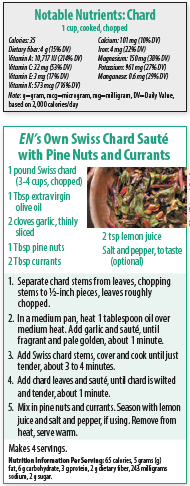 has collected a history of monikers—silver beet, strawberry spinach, and Roman Kale—due to many cases of mistaken identity with other greens, like spinach and kale. We do know however, that chard was honored by ancient Greeks and Romans for its medicinal uses, treating such ailments as tumors and ulcers, and today as one of the healthiest plant foods.
The Facts. Along with beets, spinach, and quinoa, chard (Beta vulgaris) is part of the chenopod, or goosefoot, family, so named for the shape of its leaves. Stems of green, white, red, or yellow brace deeply green voluminous leaves that grow over two feet high. When different colors are grown together, it’s known as rainbow chard. These vibrant colors are a sign of antioxidant-rich phytonutrients. Nutrient-dense, one cup of cooked chard packs over 700 percent DV (DV=Daily Value, based on 2,000 calories/day) of bone-healthy vitamin K, 214 percent of vision-protecting vitamin A, and 53 percent of immunity-supporting vitamin C.
The Findings. Pleasing on the plate, chard’s colorful stems and veins reveal it as a source of a variety of phytonutrients. A study in the journal Critical Reviews in Food Science and Nutrition (2021), identified 192 plant compounds, including flavonoids and betalains, a source of anti-inflammatory, antimicrobial, anti-cancer, and antidiabetic support. They are used as pharmaceuticals and dietary supplements (Plants, 2020). Research shows that chard leaves have the highest content of fiber, magnesium, sodium, flavonoids, and vitamin C, while stems are high in potassium (Critical Reviews in Food Science and Nutrition, 2021).
The Finer Points. Swiss chard graces the produce aisle all year, but peak season is June through August. Look for crisp, brightly colored leaves, veins, and stems with no cracks, wilts, or discolorations. Store unwashed and refrigerated in an airtight plastic bag up to five days. To prepare, wash under running water and remove stems from the leaves. Chop stems into bite-sized pieces, and chop or keep leaves whole. Enjoy chard’s vibrant color, pungent, and slightly bitter flavor—raw, boiled, steamed, roasted, or sautéed—with a touch of olive oil, lemon juice, and seasoning, or add to most any side dish, soup, or sauce.
The post EN on Foods Say Hey to Swiss Chard appeared first on University Health News.
