
Supplements Aren’t Always Safe
Most American adults take some kind of dietary supplement every day, according to the National Institutes of Health. It might be a multivitamin, an herbal tincture, a capsule of fish oil, or another product taken with the hope that it will provide significant health benefits, such as improving memory, digestion, or lung function, protecting your heart, or strengthening your immune system.
But the reality is that dietary supplements carry plenty of potential risks, notes Jenna Rosenfeld, RD, CDN, CNSC, a registered dietitian at Weill Cornell. “Serious risks occur when supplements contain doses stronger than advertised or contain ingredients that aren’t listed on the label,” she explains.
Don’t be misled by the claim that a supplement is “all-natural”; just because a substance comes from a plant doesn’t guarantee its safety. For example, red yeast rice contains the same active ingredient found in lovastatin, a prescription drug used to treat high LDL cholesterol that can cause damage to the muscles and the liver, especially if taken in high doses.
Supplements also may enhance or inhibit the effects of some medications. For instance, many supplements, including ginkgo biloba, garlic, red clover, saw palmetto, green tea extract, St. John’s wort, licorice root, and ginseng, can alter the effects of warfarin, an anticlotting drug taken by millions.
Lack of Regulation
Prescription medications must undergo testing and meet regulation standards before they gain the approval of the U.S. Food and Drug Administration (FDA)—but there are no such rules for dietary supplements. Supplements can be sold without receiving any sort of approval, although the FDA can recall supplements if they’re proven to be unsafe.
Studies have shown that the majority of supplements contain more or less of the ingredient(s) advertised, as well as markedly different doses than labeled. And some supplements contain potentially harmful ingredients that do not appear on the label; for example, some tests have found lead, mercury, or arsenic in certain supplements.
Exercise Caution
Dietary supplements have been linked to many adverse health events. One study found that, on average, 23,000 emergency room visits per year were due to side effects from supplement use.
Many weight-loss pills have been taken off the market because they contain ingredients that have been linked to an increased risk of stroke, pulmonary hypertension, and heart attack. Liver damage is also a serious risk: One study found that one in five cases of chemical-induced liver damage is caused by a dietary supplement.
Supplement Safety
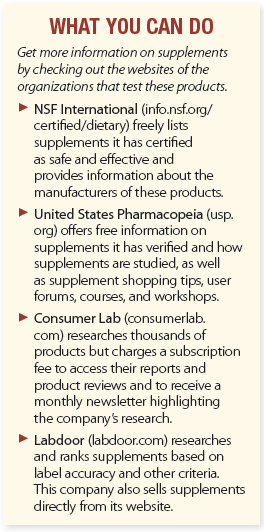
Carefully read the label on any supplement before purchasing it. If you’d like some help, there are organizations that routinely analyze supplements.
“These organizations test for purity and accuracy of labeling ingredients and doses,” Rosenfeld says. “If the supplement passes their tests, they provide their own stamp of verification on the supplement. However, be aware that some unscrupulous companies may print labels with a near-identical image of these seals of approval.” You can get information on a variety of supplements from the organizations’ websites (see What You Can Do).
Be Honest with Your Doctor
The safest strategy is to check with your doctor before you start taking a supplement so he or she can advise you about potentially harmful interactions it may have with your prescription or over-thecounter medications. Your doctor also may be able to inform you about possible side effects that can occur.
If you already take supplements but you haven’t told your doctor, it’s time to be honest. Your doctor can create the safest, most effective treatment plan for you and protect you from potential dangers only if he or she has all of the relevant information.
The post Supplements Aren’t Always Safe appeared first on University Health News.
