
Memory Maximizers: January 2022
Learning a Second Language May Improve Cognition
 When you picture brain-training activities, your first thoughts might be of crossword puzzles, chess, computer games, or a challenging novel. But studying a second language may be just as beneficial as any other traditional brain-boosting activity. In a British study of older adults who took Spanish lessons, researchers found that the volunteers showed similar improvements in certain important cognitive skills as did their peers who engaged in an online brain-training program. A third group, the control group, did neither activity. After 16 weeks, the Spanish lesson group showed similar improvements as the brain-training group in working memory and executive function—the ability to manage conflicting or frequently changing information and still stay focused and make good decisions. The brain-training group also showed improvements in processing speed; however, that was to be expected, since that was the nature of the computer activities they worked on every day. The foreign language group reported more enjoyment at the end of the study than either of the other groups. The researchers noted that cognitive improvement could be seen after just 16 weeks, suggesting that you don’t need to become fluent in a language in order to reap cognitive benefits. They also pointed out that foreign language classes can be more enriching than certain other activities, as they encourage socialization and can provide individuals a skill that they may use when traveling or encountering speakers of other languages in their own community. The study was published in Aging Neuropsychology and Cognition.
Two Servings of Fish Per Week May Help Preserve Memory
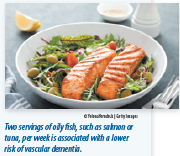 Fish has long been considered “brain food,” and a new study offers further proof. Researchers in France found that eating fish—including salmon, tuna, and sardines—at least twice a week is associated with a lower risk of developing vascular brain disease later in life. Vascular brain disease is a group of conditions that affect blood flow in the brain. One complication is vascular dementia, a condition in which memory, reasoning, and other functions become impaired due to insufficient blood flow throughout the brain. The study was published in Neurology, the medical journal of the American Academy of Neurology, and involved 1,623 adults ages 65 and older with no history of dementia, stroke, or cardiovascular disease. Brain scans were taken to look for three different markers of vascular brain disease. The study participants also filled out questionnaires about their diets, including how frequently they ate fish. Among those who ate no fish, 31 percent had markers of severe underlying vascular brain disease, compared to 23 percent of those who ate three servings a week and 18 percent of those who ate four or more servings of fish per week. This observational study doesn’t prove that eating more fish can prevent vascular dementia and other related conditions. However, it does underscore previous research that supports the consumption of fatty fish and the healthy fatty acids they contain in order to bolster brain and heart health.
The post Memory Maximizers: January 2022 appeared first on University Health News.
