
Protect Your Hips with Exercise
Your hips are weight-bearing joints. They not only keep your upper body balanced and mobile, but they also help keep your lower body aligned and flexible as well. But hip pain doesn’t have to be a necessary part of aging. With a little tender loving care, your hips may stay supple and flexible throughout your lifetime. Here’s how to keep your hips in good shape.
About the Hips
“The hip is a joint made of the femur (ball) and the acetabulum (socket),” explains Brittany Popkin, a physical therapist with the Weill Cornellaffiliated Hospital for Special Surgery. “On top of these bones are ligaments and muscles controlled by our neuromuscular system (responsible for communication between our brain and body). During movements, activities, and exercise, your body demands strength and motor control from the hip bones, ligaments, and muscles to help with your body’s stability and mobility.”
Hip problems can have a significant effect on your gait and other parts of your body, such as your knees and back. “If you have a problem in one part of the body, there can be compensation patterns above and below to maintain normal function,” Popkin says. “At first you might not realize these compensations are there. A full evaluation of the lumbar spine and lower extremity is needed to assess the source, site, and solution of the hip pain. Interventions can be implemented to decrease these compensations and restore proper movement patterns in the kinetic chain and during gait.”
Exercise Brings Strength
“The most important thing is to ensure you have proper form,” says Popkin. If you are unsure of form, ask a trained medical professional such as a physical therapist or an exercise physiologist.
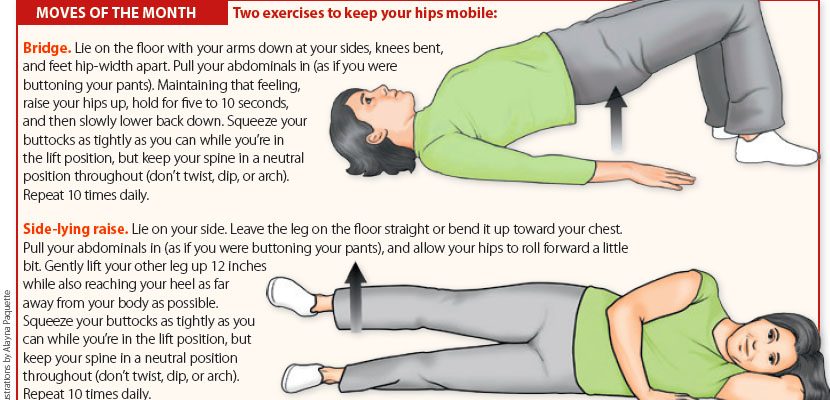
As you age, you can have hip extensor (back of hip), hip abductor (side of hip) and core weakness, says Popkin. “Glute squeezes, bridges, side-lying hip abduction, side stepping with a resistance band, pelvic tilts, front and side planks (modified on knees or full on feet) all target hip and core (trunk) strength. You also can have hip flexor (front of hip), adductor (inside of hip) and piriformis (buttock) tightness. So stretch those muscle groups as well. Proper form and not eliciting pain is very important.”
Combine stretching and strength training with walking, swimming, biking, or an elliptical crosstrainer to protect your hips, Popkin advises. “Avoid prolonged deep flexion activities, such as deep squats or deep lunges— as these positions can irritate the hip—and straight leg raises or repetitive hip flexion in patients with hip pain. Also get up and stretch your legs and hips and/or perform hip-strengthening exercises after every 45-60 minutes you sit, to limit stiffness.”

The post Protect Your Hips with Exercise appeared first on University Health News.
