
Explore These Delicious Ancient Grains
In the world of grains, everything old is new again. Quinoa, an “ancient grain” first cultivated by the Incas some 3,000 years ago, is trending both for its ease of cooking and nutritional oomph. Other ancient grains are also migrating from health-food stores to supermarkets.
“Ancient grains have been in existence for hundreds, if not thousands, of years,” says Rachel Lustgarten, registered dietitian nutritionist with Weill Cornell Medicine. “They have become more popular in the U.S. in recent years. They are thought to have increased health benefits when enjoyed in their whole, unprocessed form.”
As ancient grains have been largely unmodified, they’ve been found to have increased nutritional value as compared to corn, white rice, and modern wheat. Research has linked ancient-grain consumption to health benefits such as lower heart disease risk, improved blood sugar control, and digestive health.
According to the Whole Grains Council (wholegrainscouncil.org), many ancient grains thrive with lower levels of pesticides, fertilizers, and irrigation, making them attractive to consumers who shop with their carbon footprint in mind or prefer a more organic product.
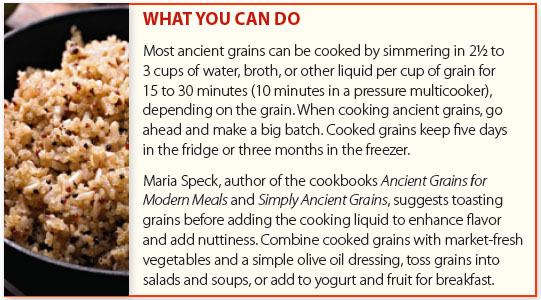
If you’ve hesitated to hop on this food trend because of concerns about cooking length, dither no more. Quinoa, for example, boils up in about 15 minutes and can be used much like rice. “Grains such as quinoa, bulgur, barley, and farro are delicious and easy to cook and keep as refrigerator staples,” says Lustgarten. “Cooking these whole grains is particularly easy when using a pressure or slow cooker, but can be mastered on the stovetop in just one or two attempts. Lightly seasoned, ancient grains work well as a side dish to any meal. They also mix well into salads and add fiber, protein, and a hearty texture.”
Gluten-Free Whole Grains
Here are three lesser-known ancient grains (all gluten-free) to add to your menus.
Millet. Most familiar to Americans in birdseed, millet is one of the world’s oldest cultivated crops, consumed by humans across Asia and Africa for 7,500 years. It’s even mentioned in the Christian Bible. “Millet” actually refers to a group of fast-growing annual grasses. Modern science has found that millets are rich in B vitamins and antioxidants and may help control cholesterol and blood sugar.
Millet’s small yellow kernels cook up into dishes between a pilaf and a porridge, depending on how much water you use. Millet dishes pair well with warm spices, scallions, mushrooms, and squash.
Teff. These tiny brown seeds come from Ethiopia, where teff flour is used to make injera flatbreads and accounts for two-thirds of daily protein intake. Teff is also rich in calcium, copper, and manganese. Because teff clings together, it’s good as a savory, polenta-like side dish as well as a breakfast porridge. Slightly sweet, it works well with fruit, nuts, chocolate, and pumpkin.
Amaranth. Another polenta or porridge option, peppery amaranth was first cultivated by the Aztecs and Incas more than 6,000 years ago. Like quinoa, it’s a rare “complete protein” plant food, with all nine essential amino acids. It’s also high in minerals, fiber, antioxidants, and anti-inflammatories that have been linked with lowering cholesterol. It is the only known grain containing vitamin C.
Derivatives of Wheat
Several other ancient grains are rediscovered types of wheat (thus not glutenfree), including:
Farro. Also called emmer wheat, farro helped sustain the Roman legions. Rich in protein and fiber, whole (not “pearled”) farro takes a bit longer to cook; save time by pre-soaking the night before or cracking in a coffee grinder. It can be substituted for rice as a side dish or in a risotto, with Italian seasonings.
Einkorn. The original form of wheat, einkorn was grown in the Fertile Crescent (Iraq, Syria, Lebanon, Jordan, Palestine, Israel, Egypt, and parts of Turkey and Iran) more than 10,000 years ago. Einkorn berries can be used like wheat berries, but contain more protein, fiber, B vitamins, and lutein than modern wheat.
Freekeh. Not a wheat variety but rather a processing technique, freekeh dates to 4,300 years ago in the Middle East: Wheat grains are picked green at their nutritional peak, then roasted for a smoky flavor. Nutty and chewy, freekeh works well in soups, stews, and pilafs and pairs with Middle Eastern flavors.
The post Explore These Delicious Ancient Grains appeared first on University Health News.
Read Original Article: Explore These Delicious Ancient Grains »
