
Virtual Visits Conveniently Expand the Reach of Mental Health Professionals
Modern telecommunication technology allows students to “attend” classes from home, businesses to hold face-to-face meetings, and patients to have virtual checkups with their physicians. All of these innovations have taken on even more importance and been utilized more than ever as the world grapples with the COVID-19 pandemic.
The same is true for people accessing mental health care remotely, a particularly crucial aspect of telemedicine or telehealth these days. “During the COVID-19 pandemic, telehealth services are critical given higher rates of stress and the need to limit infection rates by maintaining social distancing,” says Molly Colvin, PhD, Director of Massachusetts General Hospital’s Learning and Emotional Assessment Program. She adds that telehealth services have provided a vital link between mental health professionals and their patients and their patients’ families this year.
What is Telemental Health?
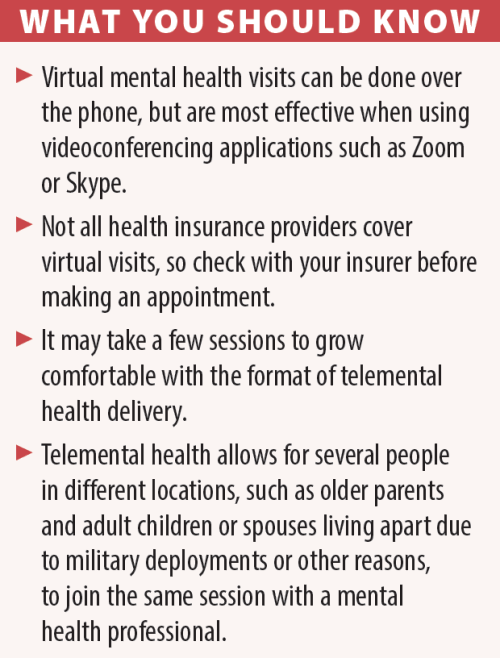
Providing mental health care by using videoconferencing or similar technology means mental health professionals can be in their offices or homes and see their patients in their own homes. It works for one-on-one sessions, as well as group or family therapy, too. A smartphone or a computer with camera and microphone can be used to communicate via Zoom, Skype or other applications. Helpful sessions can also be conducted with an old-fashioned telephone call. The content and interaction between patient and provider during a virtual visit is essentially the same as it would be in an in-person session.
Research suggests that psychotherapy delivered remotely often can be just as effective as in-person sessions in treating depression, anxiety and certain other conditions. The use of telemental health had already been on the rise in the past few years, particularly as insurers began covering such services. There is still some variability in telemental health coverage from state to state and among various health insurance providers. So if you are interested, check with your provider first.
Advantages of Remote Therapy
One of the chief conveniences of telemental health is that the patient can stay home rather than get to a hospital or the office of a mental health professional. This is particularly helpful for people in rural areas who may not have such services nearby or for people with other transportation challenges or responsibilities, such as caregiving. The convenience of virtual visits usually means fewer missed appointments, too.
And of course, when physical distancing is the order of the day, virtual visits comply with those guidelines. But telemental health has a number of other benefits. Dr. Colvin says that many individuals are more comfortable opening up about their thoughts and feelings at home, rather than in an office where they may feel uncomfortable and less likely to share. She works primarily with children and adolescents, who tend to be much more relaxed in their home environment. But that’s true for most people.
“Overall, we have been quite pleased by the quality of telehealth visits,” Dr. Colvin says. “We can connect with children and adolescents in a more personal way by seeing them in their home environments. Many are more relaxed by not having to come to the hospital and adjust to that setting. And for anyone new to mental health care, telehealth services may feel less intimidating and more manageable.”
Challenges of Telemental Health
At the same time, there are some challenges with remote mental health care. For example, poor personal hygiene may be an early sign of depression or cognitive decline, but it’s less evident in a virtual visit. Patients who have hearing loss may have more trouble communicating. And for patients who have difficulty with technology or who simply don’t have the right equipment or internet access, remote sessions aren’t possible or require a financial investment.
“Internet service is not universal,” Dr. Colvin observes. “Privacy may be harder for patients and caregivers to find if they are in their homes. As a provider, I sometimes feel that I need to work harder to monitor and read nonverbal cues and exaggerate my own so that their intention is clear. I also miss being able to play with younger children to establish and maintain rapport. Tests that require writing, drawing, manipulatives, and precise timing are also much harder to administer.”
And as much as virtual visits may set some people at ease, others may take some time to adjust to communicating via computer screen. A 2018 study of rural telemental health services found that while some individuals found the sessions “less personal” at the beginning, once they became acclimated to the process, they found the approach positive and helpful.
“Despite the limitations, my hope is that insurance providers will continue to reimburse for telehealth services following the COVID-19 pandemic so that we can continue them,” Dr. Colvin says. “Telehealth cannot be a full substitute for in-person services, but they should be an important complement to them in the future.”
Looking Ahead
The use of telemental health services may have expanded considerably due to COVID-19, but Dr. Colvin expects remote therapy to remain popular for years to come. The comfort level it provides many individuals new to mental health care and the convenience it offers everyone involved are undeniable. In-person group therapy can be made easier if all members of the group can join a virtual session from their homes, for example. And for patients who need assistance unexpectedly, but urgently, a mental health professional could be just a few clicks away on a computer.
“This is an exciting time to be in psychiatry and psychology,” Dr. Colvin says. “Telehealth services will be a catalyst for tremendous innovation in clinical care. The ability to reach others quickly and easily provides an opportunity to think creatively about different ways of practicing that improve accessibility.”
The post Virtual Visits Conveniently Expand the Reach of Mental Health Professionals appeared first on University Health News.
Read Original Article: Virtual Visits Conveniently Expand the Reach of Mental Health Professionals »
