
Stay Active to Maintain Flexibility
Flexibility is the range of motion through which a joint moves. We sometimes lose flexibility as we age. Keeping moderately active not only may stem flexibility loss but also can improve it. Exercises can keep your joints mobile and strong, which also helps with balance and flexibility.
“Adequate flexibility is necessary for good posture and to allow proper muscle function,” explains Polly deMille, director of sports performance at the Women’s Sports Medicine Center and the Tisch Sports Performance Center, part of the Hospital for Special Surgery, a Weill Cornell Medicine affiliation. “For example, if the muscles in the front of the neck, shoulders, and chest become shortened, the head will be pulled forward and the shoulders and upper back will round. Postural changes can lead to neck, shoulder, and back pain, as well as changing the body’s center of gravity, which can disrupt balance.”
Flexibility also is key to maintaining strength, deMille says. She notes that tight muscles can easily strain when performing a rapid movement that lengthens the muscle, such as lunging to catch something that has been knocked off a counter. If your back and the back of your legs are tight, you’re more likely to pull or tear a muscle.
Exercises for Flexibility
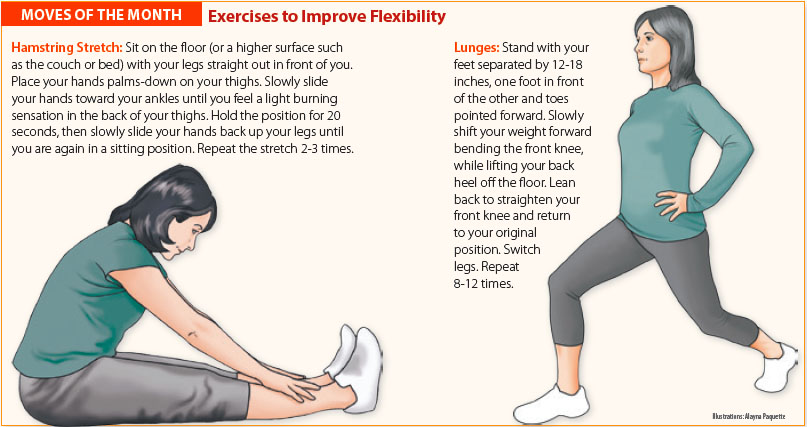
Stretching exercises are the most obvious way to improve flexibility and can increase circulation to the muscles being stretched. But stretching should be done after your cardio, when your muscles are warmed up. “Extend your muscle until you feel a gentle stretch, hold it for three to five breaths or 20-30 seconds; then relax that muscle a little more with each exhale,” deMille says.
Exercises that challenge the major muscle groups to go through their full range of motion under load are beneficial, particularly for the lower body. Squats, lunges, upper body rows, and pushups all build strength in functional movements that we do every day. They will help with flexibility and with lowering risk for frailty and injury.
Yoga, Pilates, and tai chi can improve strength, balance, and flexibility as well. “Any activity that requires moving repetitively through a full range of motion will help maintain or improve flexibility in the muscles involved in that motion,” she says. Swimming, for example, can help maintain or improve range of motion in the shoulders. Squatting or reaching down when gardening can extend the flexibility in your hips and legs. Your flexibility can also benefit from strength training if you are moving through your full range of motion.
Spend at least 150 minutes a week doing moderate intensity exercise, but don’t wait until you have time for a whole routine. “A few minutes here and there add up to overall fitness gains,” deMille says.
The post Stay Active to Maintain Flexibility appeared first on University Health News.
Read Original Article: Stay Active to Maintain Flexibility »
