
Women Benefit from Earlier Colorectal Cancer Screening
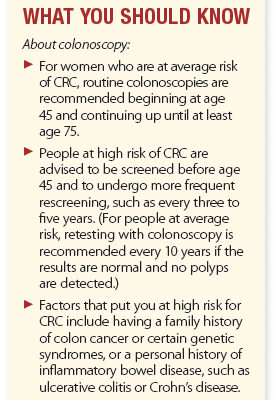
For adults at average risk of colorectal cancer (CRC), the recommended starting age for screening was lowered from 50 to 45 by the American Cancer Society and the U.S. Preventive Services Task Force in May 2021.
“The recommended age for screening was lowered because the data showed the rates of CRC had increased among people under age 50,” explains Carl Crawford, MD, a gastroenterologist at Weill Cornell Medicine. “This change got much media attention, which helped raise awareness about the importance of screening for CRC.”
A recent study provides additional data that supports the need for women to start screening at age 45: Researchers who analyzed data on more than 111,000 women participants in the Nurses’ Health Study II found that women who underwent CRC screening between ages 45 and 49 were less likely to be diagnosed with CRC than women who began screening at age 50 (online May 5, 2022, JAMA Oncology).

Screening Options
A number of screening tests for CRC are available. Many people prefer the noninvasive options that examine stool samples for blood or abnormal DNA, but Dr. Crawford says colonoscopy, which allows the doctor to examine the entire length of the colon (large intestine), is the best screening tool for CRC.
“Colonoscopy will always be the ‘gold standard’ for CRC screening, because we can prevent cancer by finding and removing polyps that might develop into cancer,” says Dr. Crawford. He adds that, during their first colonoscopy, about 20-25 percent of women and 30-35 percent of men have polyps.
For those who don’t want to or can’t undergo a colonoscopy, there are noninvasive options. One test, Cologuard, allows you to collect your stool sample at home and mail it to a lab for testing. It doesn’t require the colon cleanse that is needed for colonoscopy. A similar at-home test is the fecal immunochemical test (FIT), which can detect blood in the stool. Dr. Crawford notes that these tests are designed to pick up very advanced precancerous lesions and blood rather than early-stage polyps.
Another option is a “virtual colonoscopy,” in which a small tube is placed in the rectum to inflate the colon and a computed tomography (CT) scan takes images of the colon. While a colon cleanse is still required, the test is not as invasive as a colonoscopy and often requires no sedation.
If one of these tests comes back positive, the next step is having a colonoscopy to find the abnormal lesion and hopefully remove it at that time.
“Researchers are working to develop other minimally invasive screening tests, such as blood tests and rectal swabs, to look at DNA and other molecules that can predict or detect different stages of polyps and cancers,” notes Dr. Crawford. “The more we can use technology, the better. But there’s still a significant amount of real-world testing that is needed, and all tests still need to be reviewed by a gastroenterologist or trained medical professional.”
Preventive Lifestyle Choices
Undergoing CRC screening is the most effective way to prevent CRC, but lifestyle strategies also can lower your risk.
The evidence that links certain dietary choices to CRC risk is growing. One study showed that, among women, consuming more sugar-sweetened beverages in adulthood and adolescence was associated with an increased risk of early-onset CRC. Another study linked eating patterns higher in fiber, fruits and vegetables, soy foods, and yogurt and lower in alcohol and red meat with a reduced risk of CRC. And several years ago, the International Agency for Research on Cancer classified processed meat as a human carcinogen, based on evidence that consuming processed meat causes CRC. (Processed meat has been preserved through salting, smoking, curing, drying, or canning; examples include bacon, ham, sausage, salami, and cold cuts.)
“The overall diet ‘prescription’ to reduce your CRC risk is to limit saturated fat, sodium, added sugar, and ultraprocessed foods. Increase your consumption of whole foods, including whole grains, vegetables, fruits, and lean proteins, and eat more plant-based foods and fewer animal-based foods,” recommends Dr. Crawford.
Exercise is another important lifestyle choice that can reduce your risk of CRC. If you’re not a fan of formal exercise, remember that any type of physical activity can help, including household chores, gardening, and dancing. Aim for at least 30 minutes of moderate-intensity activity five days a week; if you can’t do 30 minutes, do three 10-minute sessions. Every little bit counts, and it all adds up.
According to Dr. Crawford, how exercise influences cancer risk is “probably multifactorial. Some think exercise reduces cancer risk, in part, due to the weight loss that occurs with exercise. People who are overweight have more adipose tissue (fat). There’s an association between an increase in adipose tissue and insulin resistance, a condition in which the body is unable to use insulin effectively. Insulin is also a growth factor that helps cells divide, so it raises the risk of cancer development.
“Another benefit of exercise is that it releases certain substances that allow for tumor surveillance. This means your immune system is better able to identify abnormal cells and eliminate them before they have a chance to multiply and turn into a polyp.”
Bottom line: You will reduce your risk of colorectal cancer if you make healthy lifestyle choices and you stick to the recommended screening schedule.
The post Women Benefit from Earlier Colorectal Cancer Screening appeared first on University Health News.
Read Original Article: Women Benefit from Earlier Colorectal Cancer Screening »
