
9. Strategies to Help Boost Memory
Although Alzheimer’s and other forms of dementia are not yet entirely preventable, you can take steps to preserve your memory as you age. And the earlier you take those steps, the better. Try some of the suggestions in this chapter to organize information, cement it in your mind, and recall it more easily.
Learn Basic Memory Skills
These simple approaches will help make information easier to retain and recall:
Make an Effort
To remember something, you have to put in some work. Get motivated to remember by considering how the information will be useful to you. For example, memorizing the names of your medications will enable you to discuss them more easily with your doctor at appointments.
Concentrate
Focus on one memory task at a time. You’ll have an easier time fixing the information in your mind.
Get Organized
Always keep your keys, purse, wallet, and other important, frequently used belongings in the same place—like a bowl on the kitchen sink. Use a calendar, smartphone app, or other device to keep track of appointments and other important dates. Buy an automated medication dispenser to help you remember when to take your pills.
Use Mnemonic Strategies and Other Memory Techniques
Organize information into rhymes, acronyms, or other forms that are easier for your brain to encode and recall. For example, make a song out of colleagues’ names that you have trouble remembering. “Susie, Bill, and Ming work in a-ccoun-ting.”
Manage Your Memory
Break the information you want to remember into small pieces so that you don’t overload your memory. Also take breaks during the process of remembering to give your brain a rest.
Associate
Connect new bits of information with things you already know. For example, if you meet someone new who is named Sandra, associate her with the image of a sandy beach to help you remember her name the next time you meet.
Make Sure You Understand the Information You Are Trying To Remember
If you’re trying to teach yourself Photoshop, learn the reason for each step in the photo manipulation process. You’ll be more likely to remember how to do something if you know the reason for it.
Use Cues
Put your empty medicine bottle by the door to remind yourself to refill your prescription. Paste a “sticky note” on the refrigerator to help you remember to buy milk. Use clocks with timers to remind you to turn off the oven.
Train, Rehearse, and Practice
If you have trouble concentrating, practice focusing on one subject or task for 10 minutes without letting your mind wander. The next day, increase your concentration time to 12 or 15 minutes, gradually building your ability to focus and ignore distractions. Or, challenge your power of concentration by reading a book with the television on. Play online brain-training games (such as lumosity.com or seniorbrains.com) to boost your brain’s processing speed. Memorize your favorite poems, or learn to play a new piece on the piano.
Lean on Others
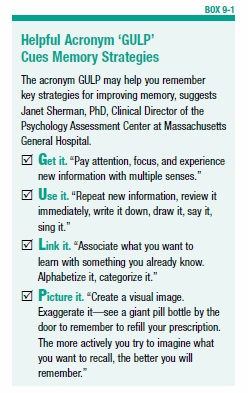
Ask your friends or family to call or email to help you remember important appointments or tasks. For a handy way to remember key memory strategies, see Box 9-1, “Helpful Acronym ‘GULP’ Cues Memory Strategies.”
Train Your Brain
Regularly engaging in training exercises that help you practice specific cognitive abilities (e.g., attention or processing speed) seem to protect against memory loss better than memory strategies alone. Examples of cognitive exercises you might try:
- Strengthen your powers of attention by opening a book to a random page and counting the number of words without touching the page. If you lose count, begin again until you finish the page. Strengthen your ability to concentrate by introducing distractions, such as turning on a TV or music.
- Boost information processing speed by examining a photograph you have not seen before for one minute. Then turn over the photo and jot down as many details from it as you can remember. As your processing speed improves, shorten the time you spend examining each new photo.
- Increase your short-term memory by listening to the Top 10 countdown of popular tunes on your favorite radio station, then trying to remember the song titles in order. As your short-term memory improves, try to remember the names of the artists, as well.
- Exercise your capacity to recall information by reading a medium-length article on any subject while making an effort to remember as many details as you can. Put the article aside and write or recite as much as you can of its contents. Then check the original article to see how you did.
Use Mindfulness Meditation
Research suggests that the ability to pay attention—a key aspect of memory—declines with age. One excellent way to improve your ability to pay attention and remember is to practice mindfulness meditation. This form of meditation involves focusing your awareness on sensory stimuli in the present moment, while ignoring intrusive thoughts and inner chatter.
Mindfulness meditation can slow a racing mind, help you pay attention to information you need to learn, and improve your ability to focus without becoming distracted and jumping from thought to thought. Research suggests it may even help reverse memory loss.
Massachusetts General Hospital neuroscientist Sara Lazar, PhD, has demonstrated that older individuals who meditate have better preserved cortical regions of the brain. These regions, which are responsible for attention, sensory processing, and integrating emotional and cognitive processes, normally thin with age. Yet the regions remain thick in people who practice mindfulness meditation, an indication that performance of cognitive tasks associated with those regions is preserved.
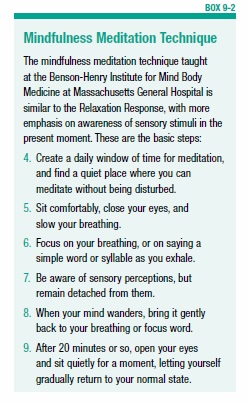
To enjoy the benefits of mindfulness meditation, you need to practice regularly. A daily 20-minute meditation should be sufficient (see Box 9-2, “Mindfulness Meditation Technique”).
Make a Weekly Plan
In a paper organizer, smartphone app, or computer calendar, note your goals, activities, appointments, and chores for each day of the week. A weekly plan will help you stay on track without cluttering your mind with minutiae. Try to write your plan at the same time each week. Divide items into categories, such as “home,” “social activities,” “medical,” and “shopping.” Before you start, check the previous week’s schedule and carry over any tasks you have not completed. Include emails you need to answer, bills that need to be paid, telephone calls you have to make, and so on. Think of tasks you need to accomplish, and projects you want to concentrate on for the week. Include entries such as:
- appointments
- purchases you need to make
- social events
- special dates, such as birthdays or anniversaries
- chores
- exercise activities
- routine maintenance on your car or home
- medical reminders
- meetings and other work responsibilities.
At the beginning of each day, consult your weekly plan. As new tasks arise, get in the habit of recording them into your plan so that important information will be readily accessible. Cross off items you’ve accomplished. Carry the plan with you in your purse or car, so you’ll have it handy to refer to wherever you go.
Make Information Stand Out
Some studies suggest that confusion about previously learned information, rather than the passage of time, weakens memory and interferes with its transfer to long-term storage. To increase your ability to retain a memory, endow it with unique elements or associations so that it stands apart from other information you may be exposed to at the same time. You can use a number of imaginative techniques:
- Take a snapshot: Create a mental “photograph”—a visual record of what you want to remember. Notice as many details as possible—such as that the woman you’ve just met wears her hair in a tight bun, or the car you’d like to buy has all-weather tires.
- Prepare a speech: Pretend you must describe or explain the information you want to remember to someone else. Rehearsing details—especially out loud—will help fix them in your mind.
- Sing it: Make up a song or jingle containing the information you’re trying to remember, such as a shopping list. “I need a dozen eggs, and some tissues for my nose. Ground beef, corn on the cob, and wart pads for my toes.” The rhythm and tune of your jingle will help fix the information in your mind so you can recall it more easily later.
- Create a vivid mental image: For example, to help you remember to buy peanut butter, spaghetti, and olives at the supermarket, try picturing yourself with peanut butter smeared in your hair, a necklace of olives, and a hula skirt made of spaghetti strands. The vivid image should make your shopping list easier to recall.
The post 9. Strategies to Help Boost Memory appeared first on University Health News.
Read Original Article: 9. Strategies to Help Boost Memory »
Powered by WPeMatico
