
Sustainable Weight Loss with Less Effort
Many people struggle with weight loss, sometimes for their entire lives. One plausible reason is that the habit of healthy eating was never fully explored or formed. But if you break down obstacles to success and look to the power of habits, an exciting new opportunity awaits. Consider this strategy from Dana Hunnes, RD, MPH, PhD, Assistant Professor at the UCLA Fielding School of Public Health.
“If you have some favorite plant-based foods, I always urge people to fill their plates with them first and then to use any other high-calorie/animal-based product as a condiment rather than as the focus point of the dish. The reason this can work for weight loss is because you’re not ‘starving’ yourself. You are eating a good amount of food volume, but not too many calories. Also, plant-based items are super healthy for your heart and any other chronic disease you may have or are trying to prevent.”
Habits for Better or Worse
Obviously, habits can better serve our health or spoil it. For example, brushing your teeth every morning and night is good. A midnight snack of leftover fast food, not so much. But learn to harness the unconscious nature of habits for good and you can accelerate success in virtually any domain you desire.
According to a study published in the journal Obesity, researchers identified strategies that may help people who have lost weight keep it off. The study surveyed over 4,700 participants in a weight-loss program who had maintained a weight loss of at least 20 pounds for more than three years. They reported more frequent, habitual, healthy dietary choices, greater self-monitoring, and the employment of psychological coping strategies, such as “thinking about past successes” and “remaining positive in the face of weight regain.” Clearly, those who had a healthy eating habit were more successful at maintaining weight loss.
The Secret Power of Habits
When habits are fully formed, we barely have to think about them. And that’s their inherent power. They become subconscious and stress-less because there’s no willpower involved. For example, you don’t have to think about taking the toothpaste cap off, filling your toothbrush with paste, and moving the brush inside your mouth. It’s basically automatic. And when you hijack a habit to build another one, you’re not wasting precious cognitive energy trying to accomplish a task.
Stacking Habits
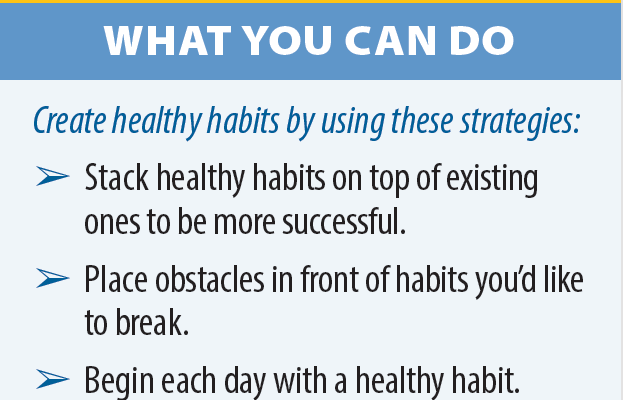
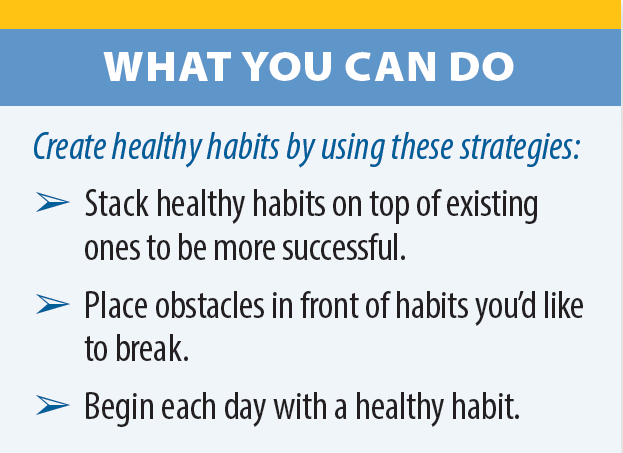
Many people have coffee first thing in the morning. Making the brew is automatic: same coffee, same amount, same process, every day. Add to that habit another goal, such as drinking more water. While the coffee is brewing or dripping, you set out your usual coffee cup. Fill a large pitcher with water and flavor it with fruit or unsweetened tea, if you like. Drink a glass before you enjoy your coffee. Then finish the pitcher by day’s end. Do that for a week or two, and soon drinking more water becomes routine. Similarly, if you find yourself starving in the late afternoon and often default for an easy doughnut fix, use your morning coffee-making time to prep a healthy snack for later in the day. Eventually drinking more water and eating a healthy afternoon snack becomes a habit. Both goals become easier when they are stacked onto existing habits.
On the flip side, breaking a bad habit can be more easily achieved when there’s more friction to completing it. For example, to thwart nighttime TV munchies, don’t buy high-calorie snack foods. When you turn on the TV, perhaps pick up a knitting needle or coloring book, or do your nails instead. Make it more difficult to consume the unwanted food and create a new habit to replace mindless munching.
To hack habits, it’s helpful to assess current habits, both good and bad. Then get creative. Think of ways to hijack existing habits to create new ones, and place obstacles in front of those you’d like to break. And give it time. From repetition often comes affinity. We do come to like that which we may not have appreciated before. For some people, exercising early in the day is a great way to go.
“When you do that you already have one healthy behavior completed,” explains Hunnes. “Setting yourself up for a good day is often half the battle.”
With some patience and persistence, new habits become an effortless reality and the spell of old ones can forever be broken. Slow and steady wins the race.
The post Sustainable Weight Loss with Less Effort appeared first on University Health News.
Read Original Article: Sustainable Weight Loss with Less Effort »
