
2. Easy Ways To Get The Nutrition You Need
Eat Better, Save Money
A common misconception about trying to eat food that is more nutritious is that improving your diet has to cost more. “Healthy food is not necessarily expensive,” says Parke Wilde, PhD, an associate professor at Tufts’ Friedman School who previously worked for the USDA’s Economic Research Service. “It is true that some healthy food is high-priced, but many other healthy options are both tasty and affordable.”
Dr. Wilde cites a 2015 USDA report that identified six changes that could improve consumers’ diet quality; of the changes, none cost more, and most actually saved money, up to $1.19 a day. The greatest cost savings and dietary improvement came from substituting a table-service restaurant meal with one prepared at home, along with switching from fast-food fare to home cooking. These changes don’t have to mean spending hours in the kitchen cooking from scratch, however: Many of the groceries purchased were convenience products, such as frozen vegetables, canned beans, and bottled sauces.
Another change that paid off as much as eating at home more often was skipping weekend splurges. Eating the same on Friday through Sunday as on weekdays saved money—and it improved consumers’ scores on the Healthy Eating Index, a 100-point scale that indicates how closely a person’s diet matches up with recommendations from the Dietary Guidelines for Americans.
Slight improvements in healthy eating were also gained by shifting 10 percent of daily calories to lunch or breakfast and decreasing the share of daily calories consumed as snacks by 10 percent.
More Money for Produce
The USDA researchers also compared how many grocery dollars most Americans spend on various food categories (grains, vegetables, dairy, fruits, protein foods, and other foods) to money spent on those categories for food plans that include everything needed to meet the dietary guidelines. By shifting the share of expenditures on fruits and vegetables from 26 percent to 40 percent (a total of 14 percent), a family of four could buy the quantity and variety of produce needed to meet the guidelines within the same budget. That adjustment would significantly expand the affordable options in the produce aisles, especially dark-green and red-orange veggies—from only 24 budget-friendly choices to more than 100 (see Box 2-1, “How Healthy is Your Food Budget?”).
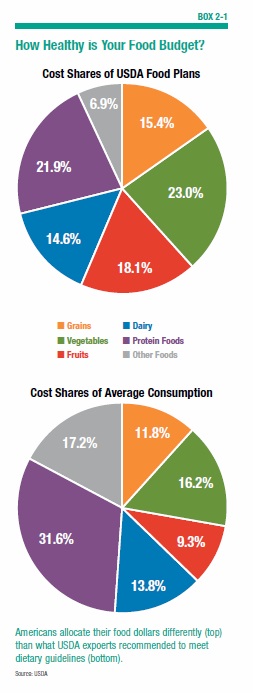
The USDA researchers recommended freeing up that extra 14 percent—about $20 a week—for fruits and vegetables by reducing spending on non-plant protein foods and items high in solid fats, added sugars, and sodium, such as snacks, soft drinks, sweets, and baked goods. “Americans face a variety of challenges when trying to eat a healthy diet,” the experts concluded, “but the total amount consumers currently spend on food is not the primary barrier to healthy eating.”
Your Healthy Pantry and Freezer
Healthy eating starts with smart shopping. Making the right choices at the grocery store can pack your pantry and freezer with affordable ingredients anyone can whip together into creative, nutritious dishes. Start with these pantry, fridge, and freezer essentials, many of them recommended by the National Heart, Lung and Blood Institute:
In the pantry:
- Cooking and salad oils low in saturated fat and high in monounsaturated or polyunsaturated fat
- Cooking-oil spray
- Whole-grain pasta
- Canned beans
- Low-sodium, reduced-fat chicken and vegetable stocks
- Instant or quick-cooking brown rice and other whole grains, such as barley
- Whole-wheat flour
- Vinegars, such as balsamic, red wine, white wine, cider, and sherry vinegar; besides adding extra flavor to dishes (add near the end of cooking for maximum effect), vinegar is essential to making simple, healthy vinaigrettes for dressing your salads.
- Oatmeal and other whole-grain dry cereals. Oatmeal isn’t just for breakfast; oats can be added to meat loaf and other dishes to replace some of the meat.
- Canned tuna, salmon, or mackerel. Make sure you buy fish that’s packed in water instead of oil, with no added salt.
- Nuts
- Canned or single-serving fruits in light syrup or juice
- Canned vegetables; choose “no-salt added” varieties
- Herbs and spices, helpful for reducing sodium intake
On the counter:
- Whole-grain sandwich breads, bagels, pita bread, English muffins
In the fridge:
- Fat-free or low-fat milk, yogurt, and cottage cheese
- Low-fat, whole-wheat flour tortillas
In the freezer:
- Frozen vegetables and vegetable blends
- Frozen fruit and recipe-ready fruit blends
- Pre-portioned seafood, ground turkey, boneless, skinless chicken breasts, and lean meats
13 Simple Ideas for Eating Better
Once you’ve stocked up, getting your meals on a more nutritious track is simply a matter of making some healthy switches—think of it as giving your diet a makeover. Here are 13 easy ways to get started:
- Pick more whole fruit instead of juice. While starting the day with a glass of OJ is fine, when you opt for juice instead of whole fruits, you’re sacrificing fiber while adding calories. A cup of juice contains only half a gram of dietary fiber, compared to three grams in a whole medium orange. And even the healthiest juice contains calories—110 in a cup of OJ—that don’t make you feel “full.”
Look for ways to incorporate more fruit in your meals. Top your breakfast cereal or yogurt with berries. Round out your lunch with an apple or a pear. Turn fruit into dessert.
- Skim saturated fat from your dairy products. What kind of milk are you pouring on your morning cereal? If it’s not already fat-free, you have an easy opportunity for a healthy switch. The fat in milk is mostly saturated (4.5 grams in a single cup), the chief culprit in high LDL cholesterol. You can reduce fat gradually: Start by switching to 2% reduced-fat milk, then try 1% low-fat milk, and then work your way to skim (fat-free) milk.
Think low-fat and fat-free for all your dairy products, such as yogurt and cottage cheese. Low-fat dairy intake has been linked to a reduced risk of diabetes, hypertension, and stroke, less inflammation, improved muscle mass, and less belly fat—and, of course, it’s a good source of calcium needed for strong bones.
- Rediscover oatmeal. Oatmeal is more affordable than boxed breakfast cereals, and it’s 100-percent whole grain. Oats contain soluble fiber shown to lower LDL cholesterol. Beware, though, of sugary toppings and mixes containing much more than just healthy oats. Instead, add flavor with fresh or dried fruit, cocoa powder, nuts, or even nut butters. Cook up a big batch of oatmeal and then package into individual portions, which will keep for up to four days in the fridge or four months in the freezer.
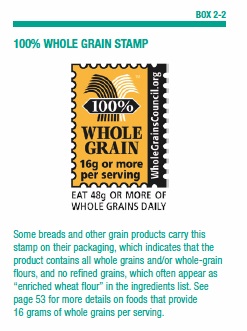
- Switch your sandwiches to whole-grain bread. Look for the Whole Grains Council’s “100% Whole Grain” stamp (see Box 2-2, “100% Whole Grain Stamp”) and check ingredients for terms like “whole wheat” (or other whole grain); “multigrain” or “stone-ground” don’t necessarily mean the bread is made with 100-percent whole grains. Whole grains can help fight the belly fat that’s linked to heart disease and diabetes.
- Skip the extra calories from spreads. Just one tablespoon of regular mayo can top your sandwich with nearly 100 calories and 1.5 grams of saturated fat; a tablespoon of butter adds 102 calories and a whopping 7.3 grams of saturated fat. To add moisture to your sandwiches, top with a slice of tomato or other juicy vegetable instead. Or spread mustard instead of mayo, with only 10 calories per tablespoon.
- Dip smarter. Appetizers can benefit from a makeover, too. To reduce calories and saturated fat, exchange sour cream-based dips in favor of hummus and white-bean dips. Both are tasty ways to work more legumes into your diet; among their many health benefits, legumes such as beans and chickpeas (also called garbanzo beans, the base for hummus) have been associated with improved cholesterol levels and a lower risk of diabetes. For creamy dips, instead of sour cream, try fat-free Greek yogurt.
- Stock up on boneless, skinless chicken breasts. As we’ve noted, these convenient protein sources are a staple in the healthy-eating freezer for entrées ranging from grilled chicken to stir-fries. Ounce for ounce, a skinless chicken breast has only about 60 percent of the calories and a quarter of the saturated fat of a skin-on breast. When shopping, look for smaller breast portions and avoid those “enhanced” with extra sodium.
- Go fish. The American Heart Association recommends eating at least two meals of fish per week, preferably varieties such as salmon that are highest in heart-healthy omega-3 fatty acids. But the benefits of serving fish at least twice a week go beyond the positive nutrients—it’s also the less-healthy entrées you’re not eating because you’re having fish instead. Skip breaded, fried fish and rich sauces, which cancel out the benefits.
- Choose brown rice. Research suggests people who eat more white rice are at greater risk for diabetes—but eating more brown rice (a whole grain) is associated with a reduced risk. You can compensate for brown rice’s longer cooking times by making large batches and freezing them, or by taking advantage of the many precooked brown rice products now available—some precooked “boil-in-bag” options require a mere 10 minutes on the stove, while fully cooked products are ready in less than two minutes in your microwave.
- Make more room for veggies. Even as you’re improving the quality of your grains, don’t do so at the expense of vegetables. Exchange half the grains or other starches on your plate for non-starchy vegetables to increase your vegetable consumption and decrease calories. Americans eat plenty of grains and starches but consistently fall short on vegetables, which also are less-concentrated sources of calories: A half-cup of broccoli contains only 27 calories, while the same amount of white potatoes has 57 calories, and a half-cup of whole-wheat spaghetti has 87 calories.
- Lighten up your mashed potatoes. You can also make potatoes healthier by using buttermilk in mashed potatoes instead of whole milk, butter, and/or cream. Despite its name, buttermilk is actually a healthy substitute for full-fat dairy products; a half-cup of low-fat buttermilk has only 49 calories and less than a gram of saturated fat but provides 142 milligrams of much-needed calcium for your bones.
- Cook with broth instead of cream. Low-sodium, fat-free broth can sub for cream when making sauces, soups, and gravies. You can always thicken the broth with a little cornstarch dissolved in water; one tablespoon of cornstarch adds just 30 calories. For a creamier consistency, add a splash of low-fat or fat-free milk.
- Save dessert for special occasions. You may have grown up ending every dinner with dessert, but think about it: Do you really need a bowl of ice cream, a piece of cake, or a slice of pie every night? Such a daily indulgence can undo all of your smart choices you’ve made throughout the day. Satisfy your sweet tooth with fruit instead, and make other types of desserts a special treat—you’ll enjoy them more.
The Pros and Cons of “Processed Foods”
Eating more healthfully is often seen as synonymous with avoiding “processed foods,” but that’s not necessarily the case. After all, processed foods include:
- “Baby” carrots
- Pasteurized milk
- Prewashed lettuce and spinach
- Canned beans
- Oatmeal
- Frozen and canned fish
- Whole-grain flours
- Frozen fruits and vegetables
“You hear the term ‘processed food’ thrown around a lot these days, but you have to use common sense,” says Alice H. Lichtenstein, DSc, director of Tufts’ HNRCA Cardiovascular Nutrition Laboratory. “For example, pasteurized milk is safer than unpasteurized, even though, technically, it is ‘processed.’ Frozen produce is as or more nutritious than fresh because it’s picked, processed quickly, and frozen at the peak of freshness. And, if the convenience of ripping open a bag of baby carrots makes you more likely to snack on them instead of chips or cookies while preparing dinner, that’s good fallout from processing.”
The US government defines “processed food” as “any food other than a raw agricultural commodity that has been subject to processing, such as canning, cooking, freezing, dehydration, or milling.” Basically, that encompasses anything that has been altered from its original state beyond basic cleaning, brushing off dirt, or removing leaves and stems. However, there are varying degrees of processing; some highly processed foods contain added salt, sugar, fat, additives, and other ingredients that contribute nothing in terms of nutrition. For more on choosing healthy processed foods, see “Dietary Downsides” on page 26.
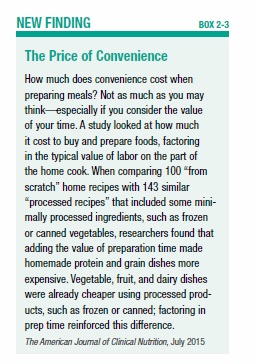
And, when you consider food costs, both in dollars and in preparation time, research indicates that using minimally processed foods is less costly (see Box 2-3, “The Price of Convenience”).
Safety and Nutrients
Apart from the advantages of convenience, processed food may be safer because contaminants have been removed (as in prewashed salad greens) or destroyed (as in pasteurized milk). Many processed foods also last longer without spoiling or becoming unsafe to eat.
Cutting and chopping produce can make nutrients more available to the body by doing some of the work of breaking down cell walls. So can heating, including the heat of canning: The lycopene in canned tomatoes and tomato sauces is more accessible than in fresh, uncooked tomatoes. However, heat depletes some other vitamins, such as vitamin C and some B vitamins.
Freezing makes seafood more readily available, too. Unless you live near a coast, flash-frozen seafood is the best way to meet recommendations to eat fish twice a week.
Frozen vs. Fresh
Freezing not only locks in the nutrients of fruits and vegetables but makes them affordably available all year long.
Several recent studies have confirmed that produce from the frozen-food aisle is at least as nutritious as fresh, and certain nutrients are better preserved in frozen fruits and vegetables than in fresh produce after a few days in your fridge. In one study, researchers bought fresh and frozen blueberries, strawberries, broccoli, green beans, corn, spinach, cauliflower, and green peas from six local supermarkets. Nutrient levels were analyzed in the frozen and fresh produce at the time of purchase and after the fresh produce spent five days in a refrigerator. In most comparisons, day-of-purchase fresh and frozen varieties were nutritionally similar. After five days, however, the fresh produce lost vitamin content, especially vitamins A and C and folate.
Two similar studies sponsored by the British Frozen Food Federation included more than 40 comparison tests of fresh versus frozen produce. In two-thirds of the tests, frozen fruits and vegetables had higher levels of vitamin C, total antioxidant polyphenols, lutein, beta-carotene, and anthocyanins (antioxidant compounds found in foods such as berries) than fresh produce after refrigerated storage.
Dietary Downsides
Not all the news about processed foods is good, of course, or nutrition experts wouldn’t spend so much time warning against them. Foods that have been highly processed often contain added saturated fat, sugars, sodium, and starches, along with a significant boost in calories, which has helped fuel the obesity epidemic and Americans’ worst eating habits.
How can consumers decide which processed foods are healthy choices and which to avoid? Some diet pundits suggest there is some magic maximum number of ingredients beyond which a food becomes overly processed, and that the shorter the ingredients list, the better. But Tufts’ Dr. Lichtenstein says that’s not a useful guideline: “A food that has more ingredients because it has small amounts of many different herbs and spices, for example, is not necessarily less healthy.”
Others advocate avoiding any foods with artificial preservatives or other additives—as some put it, anything that your grandmother wouldn’t recognize as food. However, some additives have beneficial properties.
“In some cases, such additives are good; they can prevent unwanted bacteria, mold, and fungus growth,” Dr. Lichtenstein cautions.
Dr. Lichtenstein acknowledges that making healthy food choices can be a complex process. She suggests focusing on this question when grocery shopping: “Is the food diluted?” That’s the difference, for example, between a bag of plain, frozen broccoli and one with broccoli in a calorie-rich sauce, or between frozen berries and “all-natural” berry sorbet that contains added sugars and juice concentrates. Similarly, buying frozen fish or chicken is smart, but skip products that have been “diluted” with batter or breading.
Ready-to-eat breakfast cereals are another good example. Some cereals contain whole grains (wheat, oats, corn) and/or whole-grain flours, a bit of salt and/or sugar, and possibly some vitamins and minerals, while more highly processed cereals may be “diluted” with several types of added sugar—molasses, high fructose corn syrup, malt syrup, evaporated cane juice, honey, brown sugar syrup, and many others. And, cereals that are high in sugar are often made with enriched flour—another highly processed ingredient.
Skip the Processed Meat
The term “processed” means something different when applied to meats. The American Institute for Cancer Research (AICR) defines processed meat as “meat preserved by smoking, curing or salting, or addition of chemical preservatives,” and says that even small amounts eaten regularly increase the risk of colorectal cancer. The World Health Organization also has announced that foods such as hot dogs, ham, bacon, sausages, and deli meats contribute to the risk of colon, stomach, and other cancers. Processed meat has also been associated with an increased risk of heart disease.
It’s not clear whether nitrates and nitrites added to processed meats as preservatives are solely to blame, so buying deli meats free of these chemicals may not protect you. While the AICR notes that “an occasional hot dog at a baseball game or ham on a holiday is unlikely to increase cancer risk,” the institute advises limiting routine processed meat consumption. Some ideas for reducing your risk, according to the institute, include:
- Replacing packaged deli meats with freshly cooked chicken or fish
- Trying spicy vegetarian sausages instead of bacon, chorizo, or salami
- Replacing sausage in chili and sauces with legumes such as kidney beans, chickpeas, and lentils
- Using herbs and spices such as garlic, fennel seed, and hot pepper flakes to add flavor in place of processed meats.
For more information on foods and cancer risk, visit the AICR’s website at www.aicr.org.
Learn to Love Leftovers
Another way to save money while improving your diet is to make healthy use of leftovers. A 2014 USDA report found that 31 percent—133 billion pounds—of the nation’s available food supply went uneaten, with two-thirds of food waste at the consumer level.
Leftovers present an opportunity to add healthy ingredients that might have been lacking the first time. Leftover pasta, for example, gets new life and improved nutrition by adding fresh or frozen vegetables—a sort of retrofitted pasta primavera. Cook tougher veggies before mixing in; tender vegetables and many frozen ones can cook right along with the reheating pasta.
Extra chicken or turkey can be seasoned with chili powder and cumin and transformed into tacos (serve with beans, lettuce, tomatoes, and “light” shredded cheese or sour cream). You can give leftovers an Asian twist with a simple, no-cook satay dipping sauce of peanut butter, low-sodium soy sauce and/or fish sauce, chili sauce, and lime juice. Use leftover vegetables in soups, stir-fries, or even breakfast omelets.
Leftover protein foods can also serve as secondary ingredients in nutritious grain dishes with lots of vegetables in the mix. Diced turkey, chicken, pork, or tofu work well in dishes based on whole grains such as couscous, brown rice, farro, quinoa, or bulgur wheat.
Already-cooked chicken or turkey can take the place of processed meats such as pepperoni or sausage atop store-bought pizza crusts or simple, packaged flatbreads—just add onions, peppers, mushrooms, or other toppings to give your poultry a tasty nutrition boost.
Leftover meat, poultry, and seafood can also find new life in sandwiches—for lunch or, accompanied with a fresh salad, even for dinner. Choose whole-wheat bread or 100-calorie sandwich “thins,” top with lettuce and tomato, and go easy on the condiments and cheese.
Secrets of Smart Snacking
Planning healthier meals won’t improve your overall diet if you disregard all this nutritional wisdom at snack time, of course. US consumers are snacking more than ever before, with between-meal food and beverages now totaling a quarter of average daily calorie intake. Researchers have reported that snacking in the American diet has grown to constitute a ‘full eating event,’ averaging about 580 calories each day.
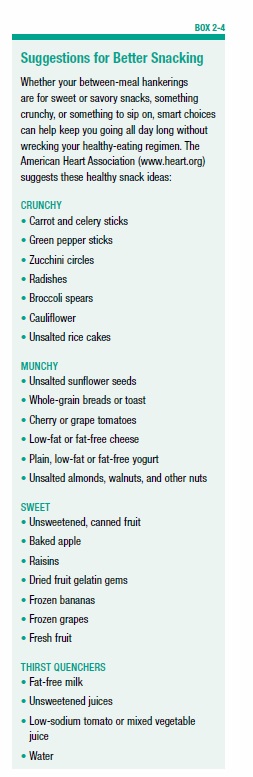
Smart snack choices can help keep up your energy levels all day and help you avoid the lulls your body and brain can experience in between meals. Snacking can also help you get more of the nutrient-dense foods—fruits, vegetables, whole grains, and low-fat dairy—that you may struggle to consume at meals. At the USDA’s Choose My Plate website, www.choosemyplate.gov, for example, all of the sample daily menus include snacks as part of the plan to meet the targets in the federal dietary guidelines. Snack recommendations include two tablespoons of raisins and an ounce of unsalted almonds, one cup of cantaloupe, or a quarter-cup of dried apricots plus one cup of yogurt.
Healthy snack foods should meet the same standards you’d set for mealtime choices: Pick foods that are nutrient-dense—delivering plenty of nutrition per calorie—and select whole, minimally processed snacks over refined products high in added sugars and sodium. Go for whole grains and high-fiber snacks, which will “hold” you longer between meals.
Check the Nutrition Facts panels on your snack foods just as you would mealtime choices. Added sugars, saturated fat, trans fat, and sodium can sneak into your diet via snacks even if you’re careful about what you put on your plate at breakfast, lunch, and dinner.
To help you snack smarter, see Box 2-4, “Suggestions for Better Snacking.”
The post 2. Easy Ways To Get The Nutrition You Need appeared first on University Health News.
Read Original Article: 2. Easy Ways To Get The Nutrition You Need »
Powered by WPeMatico
