
Developments in Breast Cancer Care Continue to Improve Quality of Life
The odds of surviving breast cancer are greater for women in the U.S. than ever before. This increase in survivorship is largely due to advances in early detection and innovative treatment methods, which have significantly improved outcomes. This progress is encouraging, but there is still much work to be done to further reduce breast cancer mortality and improve the lives of those affected by this disease.
Screening Saves Lives
Despite advances in screening and treatment, breast cancer remains the second-leading cause of cancer deaths in women, just behind lung cancer, according to the American Cancer Society. The U.S. Preventive Services Task Force (USPSTF) recommends that women ages 50 and over undergo mammograms every other year for breast cancer screening. The guidelines emphasize the importance of regular screenings to detect breast cancer early when it is most treatable. For women ages 75 and older, the USPSTF notes that there is insufficient evidence to make a definitive recommendation, so the decision should be based on a woman’s health status and personal preferences.
While the USPSTF’s recommendations apply to women who have factors associated with an increased risk of breast cancer, such as having a first-degree relative with the disease, or having dense breasts, they do not apply to women who have a genetic marker or syndrome associated with a high risk of breast cancer, such as the BRCA1 or BRCA2 genetic variation, a history of high-dose radiation therapy to the chest at a young age, previous breast cancer, or a high-risk breast lesion on previous biopsies. “Women should be aware that screening recommendations differ among the various groups such as the USPSTF, the American Cancer Society, the American College of Radiology (ACR) and Society of Breast
Imaging (SBI), among others,” says Dr. Alan Astrow, Chief of Hematology and Medical Oncology in the Department of Medicine at New York-Presbyterian Brooklyn Methodist Hospital, an affiliate of Weill Cornell Medicine. “While the recommendations differ, the most important thing to know is that screening for breast cancer detects cancer at an earlier stage than it would be detected without screening. This leads to the need for less extensive treatment because the cancers are picked up at a less advanced stage and ultimately saves lives,” says Dr. Astrow.
Dense Breast Update
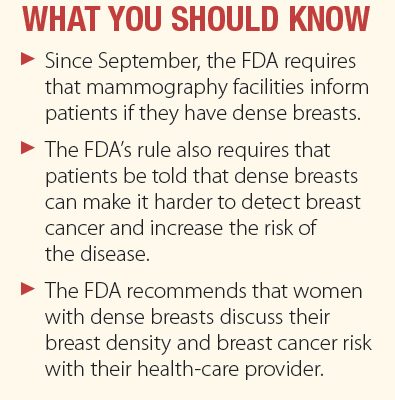
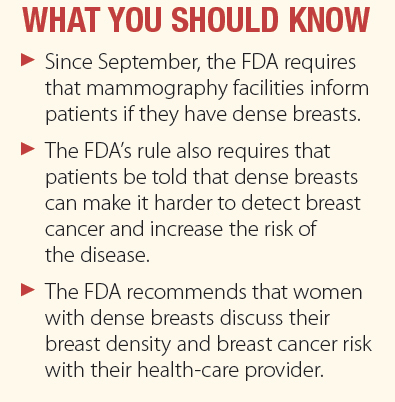
Approximately 50 percent of women have dense breasts, 10 percent have extremely dense breasts, and 40 percent have heterogeneously dense breast tissue. “Both groups are considered to be at slightly increased risk of breast cancer, and both groups are recommended to consider supplemental screening exams,” says Michele Drotman, MD, Chief of Breast Imaging, Weill Cornell Medical Center-New York Presbyterian Hospital. “The choices for supplemental screening are ultrasound, contrast-enhanced mammography (CEM), and MRI. Insurance does not always cover the costs of the additional exams.” Each of the screening options has pros and cons. “Ultrasound is easy to undergo, but has lower sensitivity and a high false positive rate; CEM and MRI have extremely high sensitivity, but require IV contrast administration, and MRI is not well tolerated by people who are claustrophobic,” says Dr. Drotman. Women who have dense breasts should discuss supplemental screening options with their health-care provider.
Important Advancements
New diagnostic tools and personalized treatments are leading to better outcomes. For instance, the HER2DX test is a diagnostic tool used to personalize treatment for HER2-positive breast cancer. It helps determine the best therapeutic approach by analyzing the tumor’s genetic profile, potentially allowing some women to avoid chemotherapy.
Innovative drugs like datopotamab deruxtecan (Dato-DXd) and patritumab deruxtecan (HER3-DXd) target specific proteins in cancer cells, with the aim of providing more effective treatments with fewer side effects. Meanwhile, trilaciclib, a new CDK4/6 inhibitor, is showing promise in treating triple-negative breast cancer, potentially improving responses to immunotherapy and reducing chemotherapy side effects.
Brighter Outlook
Regular breast cancer screenings, cutting-edge treatments, and diagnostic innovations are enhancing both outcomes and quality of life for women today. “Breast cancer is a serious disease, and too many women continue to die of it every year, but we are doing better and aim to continue to do even better as new therapeutic agents and diagnostic modalities are developed,” says Dr. Astrow.
The post Developments in Breast Cancer Care Continue to Improve Quality of Life appeared first on University Health News.
Read Original Article: Developments in Breast Cancer Care Continue to Improve Quality of Life »
