

Minimizing Dementia Caregiver Burnout
In the 1960s, the Peace Corps created a public service campaign with the slogan: “It’s the toughest job you’ll ever love”. The idea of an exotic community service adventure attracted many young people to sign up with the Peace Corps. Doing so changed many people’s lives.
Being a dementia caregiver for a loved one does not have that same appeal. And yet there are similarites in the call to serve. It is with love, determination, courage, and a sense of duty that many people become dementia caregivers. The experience is profoundly life changing.
Dementia, be it Alzheimer’s, Lewy body disease, vascular dementia, or a consequence of Parkinson’s disease, is one of the most feared conditions. Its trajectory is filled with many unknowns, and there’s no escaping the progressive decline. While each person’s journey is unique, there are plenty of similarities and even opportunities to deepen relationships and understandings of what it means to care for a loved one under such extremely difficult conditions. The key is knowing you are not alone. Other people have been there, are there, and are willing to support you and your loved one on this journey.
The UCLA ADC Program
The UCLA Alzheimer’s and Dementia Care (ADC) program is designed to help people with dementia and their families with the complex medical, behavioral, and social needs associated with Alzheimer’s disease and other types of dementia. For example, Paula, a caregiver in the ADC program who took care of her husband Sam, described her caregiver journey this way: “Sometimes we don’t have a choice on whether we want to take on this caregiving role. I would advise you to develop a sense of patience. Looking back, there were times when I could have been more patient because I was looking for the old Sam. Try your best to look for the person you know and remember the person you love. That person is still in there. Slow down and take it easy. Live in the moment. Get help and support. Reach out.”
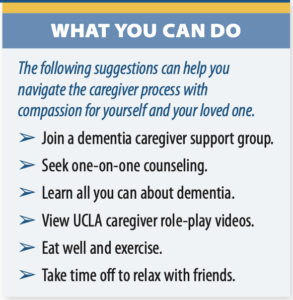
UCLA gerontological nurse practitioner Michelle Panlilio, DNP, GNP-BC, also knows these challenges well. Her interest in dementia care stems from her own experience caregiving for her grandmother. Dr. Panlilio has been an integral part of the UCLA ADC program for over a decade, working with countless patients and caregivers. As the National Lead Dementia Care Specialist, she disseminates the ADC program to health-care systems nationwide. Dr. Panlilio believes that there are three key components that are vital to caregivers: educating yourself about the disease process and prognosis, attending support groups or receiving one-on-counseling, and practicing self-care. “The number one thing I recommend is to reach out for help,” she advises. “Even if you are not in the UCLA program, there are people out there to help you.”
Good Days and Bad Days
Just like the disease trajectory can be a winding road with good days and bad days, so too is the caregiver journey. Feeling overwhelmed is part of the process. So is heartbreak, confusion, and a sense of helplessness. Dr. Panlilio compares dementia caregiving to a marathon. To be there for the long haul, you must pace yourself and know there will be plenty of obstacles on the path, including caregiver guilt, anger, and depression.
“Anyone reading this article may find themselves having to take care of someone with dementia, be it a parent, a spouse, or even a child with early-onset dementia, which is a diagnosis received under the age of 65,” explains Dr. Panlilio. “Families often have a hard time figuring out how to provide the best care for their loved one with dementia. As a result, it is very common for caregivers to experience stress, strain, and depression.”
Recognizing Depression
Depression symptoms in caregivers are both similar and different compared with general depression. Sadness, for example, is common to both, but caregivers have the added responsibility of having to take care of a loved with a progressive disease.
“Family caregivers often tell us they are withdrawing from friends and activities because of the responsibilities involved,” Dr. Panlilio says. “Being a caregiver for someone with dementia can be an isolating experience. Caregivers often report emotional and physical exhaustion, sleeplessness, poor concentration, and difficulty coping.”
UCLA ADC participant Kevin joined the program to provide better care for his mother. He shares this:
“There isn’t an “easy” way to get through this. Seek out all the resources because many of them are free. It’s easy to put our own needs aside when we are busy taking care of our loved one, but you need to take care of yourself to take care of the person with dementia. Attend support groups to learn how to become a caregiver for the long term. Having that information empowered me to make better decisions for myself and my mom.”
How Support Groups Help
Support groups offer a community of encouragement and solace. “Group meetings are an excellent way to learn about the disease and how other people cope as their loved one progresses through the different stages of the disease,” Dr. Panlilio says.
Dementia caregiver support groups can be found through local chapters of the Alzheimer’s Association (alz.org), area medical centers, and senior centers. Attending in person is quite valuable, but there also are virtual online meetings.
However you choose to attend, support groups offer the opportunity to commiserate, vent, share, discover new ways to cope, and even laugh. It’s a place to learn how other caregivers deal with such situations like repetitive questions, reluctance to shower, and why power of attorney and health-care proxy are essential legal documents to secure.
If you’re not ready to participate in a group, seek out one-on-one counseling. Your loved one’s physician may have some recommendations. The Alzheimer’s Association has a 24/7 helpline (800.272.3900) staffed with knowledgeable people that can help you anytime day or night. They can also help you find a support group near you.
Learn All You Can

© Halfpoint Images | Getty Images
Taking time out for fun with friends can help you relax and better care for your loved one.
UCLA recently launched a monthly webinar series called Better Caregiving for All (https://www.adcprogram.org/better-caregiving-for-all). Accessible nationwide via Zoom, it delivers live and recorded content for on-demand viewing. The material covered each month addresses the needs of people who have not been the focus of traditional caregiver education (for example male caregivers, long-distance caregivers, and early- onset dementia caregivers). Each session includes a local content expert and caregivers who share their knowledge and experience.
Learning all you can about the trajectory of the disease can help you prepare in many ways, including emotionally and strategically. For example, no one wants to go to a memory care home, but it’s impossible to promise someone that this won’t happen. How can you know when this is truly necessary? How can you choose the best one? What resources might be available to help you keep your loved one at home for a bit longer? What can you do if your loved one becomes aggressive, sexually inappropriate, or refuses to take medications? The caregiver education page on the UCLA website (https://tinyurl.com/UCLACaregiverEd) has a wealth of resources available to answer those concerns and many more.
The short caregiver videos (located on that same website above) cover subjects in role-play scenarios. They portray real-world experiences and offer strategies for dealing with common behaviors, explaining why they may be happening and what can be done to minimize them. For example, if you are irritable and rush someone, the person with dementia can pick up on your emotional energy and react with agitation or even violence. How you respond to challenging situations influences your loved one. Not that you should expect yourself to be perfect, but these videos provide options that can help guide you.
 The UCLA webinar lecture series presented provides information about disease diagnosis and other subjects like addiction, managing late-stage disease, and in-home and residential placement.
Practicing Self-Care
It can seem like an indulgence to take that yoga class, go for a long walk, or meet friends for a movie, but it’s not an indulgence: It’s a necessity. “Caring for a person with dementia is intense, and caregiver burnout is real,” says Dr. Panlilio. “What many caregivers don’t understand is depth of responsibilities. Caregivers need to be healthy and well so they can take good care of their loved one.”
When you have so many responsibilities, it may seem impossible to eat healthfully, rest adequately, and stay connected to friends. Remember, this is not a sprint, it’s a long-term journey. Be patient with yourself and just make a plan, talk to friend, or go read something at a café. Small actions can help rejuvenate you.
Of course there will be times of extreme stress, grieving, and anger. Think of self-care as a strategy that helps bolster your physical energy and mental clarity to meet the demands of dementia caregiving more effectively. It can help you to provide support over the long haul without overly compromising your own health and well-being.
The post Minimizing Dementia Caregiver Burnout appeared first on University Health News.
Read Original Article: Minimizing Dementia Caregiver Burnout »
