
The Key to Aging Well Lies Within You
When do we feel that we have reached old age? That varies. Many of us are a bit surprised when we look in the mirror or at a photograph of ourselves. …Who is that person staring back at me?
People have lived into old age throughout history, but never before have so many lived so long—and this success has brought new challenges. Half of people born in 1965 will live into their 80s, and many will spend 20 to 30 years in retirement. With these additional years come age- and disease-related changes that can affect what you are able to do. In your 80s, you will not be the same as you were at 20 or even 50. But it’s not all downhill. The truth is that most older adults, even the oldest old (those ages 85 and up) are in good health and able to do much of what they want to do. For example, as many as 80 percent of over-65s and 70 percent of over-85s report that their health is good or excellent. Only 20 percent of people 65 and older, and 40 percent of those over age 85 have significant limitations in vision, hearing, mobility, communication, cognition, or self-care, while only 4 percent of people over age 65 and 13 percent of those over age 85 live in nursing homes.
There are real advantages to living longer. Older people are less insecure than their younger selves. They’re more likely to say exactly what they’re thinking and to do exactly what they want. Societal norms and peer pressure become less compelling, allowing older people to better see the big picture. Yes, death is closer. But coming to terms with this fact and recognizing that your time is limited often results in a greater focus on the present and what is really important, instead of dwelling on the past or the future. Older adults can have intense negative emotions, but studies show that, compared with younger people, these happen less often and are better controlled. Wisdom grows, including having a larger store of coping mechanisms and problem-solving strategies.
A great recipe for aging well is a passage from the familiar Serenity Prayer: “Grant me the serenity to accept the things I cannot change, the courage to change the things I can, and the wisdom to know the difference.” That means accepting the changes and limitations that come with aging and being open to novel ways of adapting and meeting these challenges. Try to think of these extra years as a gift. I know it’s a lot easier to say this than to do it, but try to avoid viewing later life as a glass half-empty because you are not able to do everything you once could. Instead, envision it as a glass half-full of as-yetunknown possibilities.
Resist Ageism
Older adults are commonly portrayed in the media as unattractive, childlike, confused, grumpy, and selfish. Has this been your experience? I find it strange that we disparage and are prejudiced against our future selves, since most of us (the lucky ones!) eventually will be members of this group. Instead, become a role model for aging. You can do this simply by being yourself and telling people your age. You’ll love the look of surprise on their faces. I see it often when medical students meet my patients.
Right-Size Your Expectations
Age doesn’t need to change your passions. You can still be a daily walker or a competitive runner. But if you expect that by working out you will reclaim the speed and strength that you had when you were 40, you’re wrong. Even people in the best shape will walk or run slower as they age. After all, there are Boston Marathon winners of all ages, but the winning time for 20- and 30-year-olds is about two hours, while it’s twice that for 70- to 80-yearolds. Run marathons, walk daily, and work out to slow your age-related loss of speed and strength. Just remember to adjust your goals and expectations.
Be Resilient, Adaptable, and Flexible
With aging, we lose people, roles, and abilities that have been central to our lives. How we react and respond influences our happiness, contentment, and sense of well-being. Being grateful for what you’ve had and what you still have can help your mood and bring your focus more to the present. Compassion, humor, and finding new meaning and purpose can help re-establish a positive outlook. How do you spend your days? Are you doing things that you find meaningful? Getting out daily? Helping other people? Consider volunteering. It is associated with longer life, better moods, and improved health, and is a good way to meet new people and become more engaged in your community. Be proactive and explore what you might do to reinvigorate your life.
Redefine “Independent”
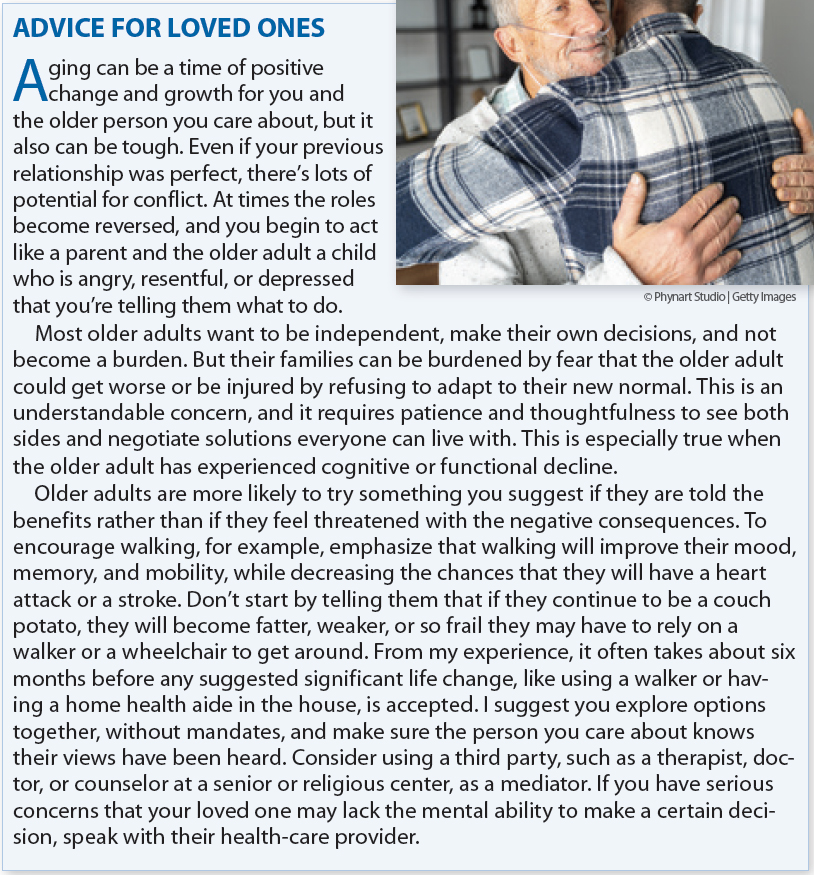
Independence is an important word to teenagers. It means they can do what they want,on their own. As we age, independence continues to mean being able to do what we want—but we may not be able to do it by ourselves, and it can be difficult to accept help. Yet what’s most important to many older adults is to be able to continue meaningful societal and spiritual connections, important activities, and living arrangements. Needing assistance in these areas may feel like a threat to your independence, but accepting help can allow you to do more of the things you want to do. Help can come from a person, a device, by learning new skills, or by adjusting your perspective and doing things differently.
Never Say Never
It’s easy to dig in your heels and proclaim that you will never use hearing aids, move out of your home, have an aide, or take an antidepressant. What you’re really saying is that change is scary and the alternatives have downsides. Which is true… but they also have upsides. Any time you face a new change, make a list of the pros and cons. If possible, do a trial to see what happens. For example, if your mobility isn’t what it was because of strength or balance issues, commit to using a walker for three months. Track your activities, your mood, how often you go outside and socialize, whether you fall. Don’t decide whether you’ll keep using the walker until the end of the trial period. Remember, making a change can be the key to having a more fulfilling and independent life.
Advocate for Yourself, and Allow Others to Advocate for You
Pain, shortness of breath, nausea, insomnia, sadness, and other symptoms affect your daily life. It’s important to identify and treat the underlying cause of these symptoms, but some symptoms may persist. These symptoms are not benign. They can start a spiral in which you become less active, get deconditioned and weaker, more tired, depressed, the list goes on. Don’t accept decline as a part of normal aging. Work with your health-care providers to figure out what is causing your symptoms and what can be done to become as symptomfree as possible. Commit to trying the treatments your providers recommend, including physical and/or occupational therapy, psychotherapy, and medications), and behavioral modifications. Let others help you when you need it.
Select, Optimize, Compensate
I touched on the SOC strategy in a previous article—it’s a useful way to stay focused on what you can do to make your new normal better. Select what really matters to you, optimize by practicing and rehearsing what you are able to do (“use it or lose it” applies here!) and compensate by using alternative mechanisms and equipment. For example, if there is an evening show you really want to attend but you don’t feel you have the energy or stamina, do all you can to get a good night’s sleep the night before. Exercise, eat right, and schedule a nap for that afternoon. Consider using an assistive device—such as a cane, walker, or wheelchair—to conserve your energy on the way to the event. Remember: Never say never. Don’t let vanity and pride get in the way of your having a good time.
Embrace the Change
At some point, aging will be a new stage of life for all of us. Have a sense of what to expect, and maintain an open and flexible attitude, actively embracing change. Work on enhancing your positive perceptions of aging, and don’t let old stereotypes define you. If a symptom or physical condition concerns you or interferes with your daily routine, find out if it’s normal or not, and in either case, be willing to accept and adapt to your new normal. How you react to challenges is a choice. It is not preordained.
The post The Key to Aging Well Lies Within You appeared first on University Health News.
Read Original Article: The Key to Aging Well Lies Within You »
