
Brain Networks May Benefit from Walking
Walking is a favorite exercise here at Focus on Healthy Aging—it’s something you can do at your own pace, it boosts your cardiovascular and bone strength, and it’s free. Moreover, research keeps on coming up with the goods when it comes to providing evidence that regular walking benefits brain power in older age. According to a 2023 study from a team led by University of Maryland researchers, you can even reap substantial rewards if you’ve previously been sedentary and if you already have a degree of cognitive decline.
The small study (Journal of Alzheimer’s Disease Reports, May 12, 2023) included 33 participants, ages 71 to 85, who were sedentary. Sedentary was defined as having engaged in moderateintensity physical activity on fewer than three days per week during the six months preceding the study. Among the participants, 17 had normal brain function and 16 had been diagnosed with mild cognitive impairment (MCI) using National Institute of Aging- Alzheimer’s Association criteria. “MCI is defined as a slight but noticeable decline in mental abilities like memory, reasoning, and judgment, and may be a precursor for Alzheimer’s disease,” says neurologist Sam Gandy, MD, PhD, associate director of the Mount Sinai Alzheimer’s Disease Research Center.
Blood Flow in the Brain
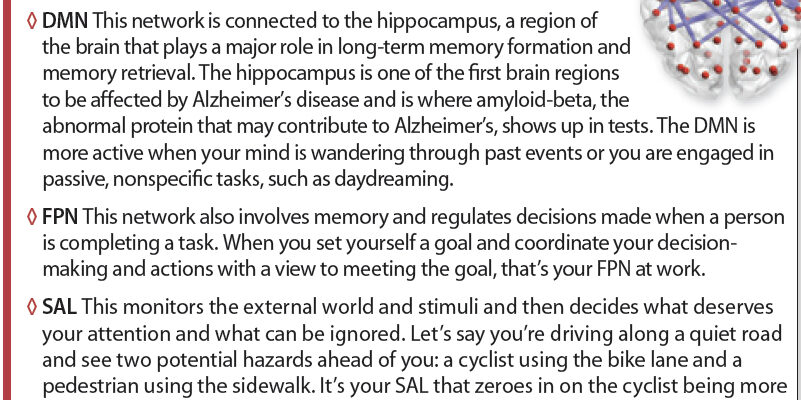
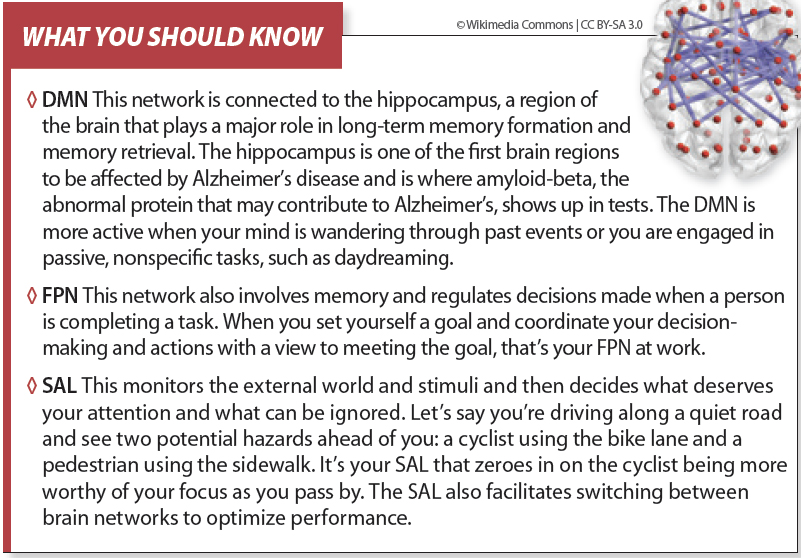
Before the exercise intervention, the participants were asked to read a short story and then repeat it out loud, recalling as many details as possible. They also underwent functional magnetic resonance imaging (fMRI), an imaging technique that tracks changes in blood flow to different regions of the brain. Increases in blood flow indicate which parts of the brain are handling critical functions at any one time. Using fMRI, the researchers measured changes in communication within and between the three brain networks that control cognitive function: the default mode network (DMN), frontoparietal network (FPN), and salience network (SAL)—for more on these, see What You Should Know.
Improvements in Recall Abilities
The 12-week exercise intervention involved supervised treadmill walking for 30 minutes four days a week. At the end of the intervention, the researchers repeated the tests and saw significant improvements in the participants’ story recall abilities. Moreover, fMRI scans revealed stronger activity within the DMN and the SAL, and stronger connections between all three brain networks, suggesting that exercise can improve the brain’s ability to adapt. Dr Gandy says the study data are promising, though he would like to see the results replicated in a larger and more diverse sample size (more than two-thirds of the participants were women, 31 were Caucasian and two were Black).
Dr. Gandy has long-supported physical activity as a method of maintaining brain function in older age. “It’s the one intervention for which we have the strongest evidence of benefit when it comes to delaying and possibly preventing cognitive decline,” he says. “These data suggest that strengthened functional connectivity may serve as one underlying neurophysiological mechanism of exercise-related cognitive improvements.”
The study participants also experienced a 10.5 percent enhancement in their cardiorespiratory fitness. “Previous studies have shown that cardiorespiratory fitness mitigates brain atrophy and the risk of Alzheimer’s disease,” Dr. Gandy notes. “Exercise also helps prevent cardiovascular risk factors associated with cognitive impairment, including high blood pressure, diabetes, obesity, and stroke.”
Think Beyond Exercise
If you aren’t used to exercise, check with your doctor before starting a new exercise regimen. Start low and go slow, with the aim of gradually increasing the speed and duration of your walks. Dr Gandy also encourages all older adults to follow other strategies that may have cognitive benefits, such as consuming a healthy diet, getting as much social interaction as possible, and exploring new skills, like playing a musical instrument or learning a second language.
The post Brain Networks May Benefit from Walking appeared first on University Health News.
Read Original Article: Brain Networks May Benefit from Walking »
