

Dietary Supplements for Sports Performance
Sports supplements come in many shapes and sizes, from tablets and capsules to liquids, powders, and bars. While they promise a lot, the challenging nature of sports supplement research makes it difficult to truly determine the efficacy and safety of these supplements. As an example, let’s take a close look at two popular supplements (for information on another popular supplement, ketone drinks, see page 8):
Branched-Chain Amino Acids (BCAAs).
Of the 20 amino acids the body uses to build proteins, three have a branched chain chemical structure. While it is not the body’s preferred fuel, BCAAs can be used by muscle for energy during physical activity. They also may stimulate pathways involved in muscle protein synthesis in exercised muscle, but this depends on a number of factors and may not necessarily increase muscle mass or strength.
The Promise: BCAA supplements have been marketed to improve performance during endurance-based physical activity, enhance gains in muscle mass and strength, and reduce muscle soreness after physical activity.
What the Research Says: Clinical trials studying BCAA supplements are limited. Of the studies that exist, results demonstrated insignificant improvements in performance and muscle mass. Some studies have shown that BCAA supplements can reduce muscle soreness after resistance-based physical activity, however most of the research is conducted in athletic populations and cannot be generalized to people who do not train regularly. Additionally, BCAA supplementation protocols varied substantially across studies and dietary protein consumption was not considered, which makes interpreting the benefits of BCAA supplements challenging.
Safety: Limited research examining short-term use of BCAAs [20 grams (g) per day for up to six weeks] in healthy adults has not reported adverse effects, but there is not enough data to be sure, especially regarding long-term use and very high doses (exceeding 20 g). You should be able to get all the BCAAs you need from typical intake of dietary protein from legumes, fat-free and non-fat dairy, fish, eggs, poultry and lean meat. This is the safest option.
Creatine.
Creatine is an amino acid found predominantly in animal products such as seafood and red meat. It is also made by our bodies in small amounts. Creatine is part of a compound called phosphocreatine, which is used by muscle for energy at the very start of highintensity activity like jumping, sprinting, or power lifting.
The Promise: Creatine supplements are touted as a way to help fuel muscle performance in short bursts of highintensity activity. More recently, creatine supplementation has also been marketed for reducing muscle damage and enhancing recovery from intense exercise.
What the Research Says: While creatine supplementation has had a positive impact on performance during shortduration, maximum-intensity activities in some studies, the evidence is not unanimous. The impact on performance varies across individuals.
It is important to keep in mind that endurance activities use a different energy system than short, high-intensity activities, so creatine supplementation, even if proven beneficial, would be of little value in these circumstances.
Safety: Typical doses used in research (a “loading phase” of 20 to 25 g/day for five to seven days, followed by a “maintenance period” of about five g/day) has not resulted in adverse effects in healthy adults. Most research uses a form of creatine called creatine monohydrate. Other forms of creatine are not well-studied.
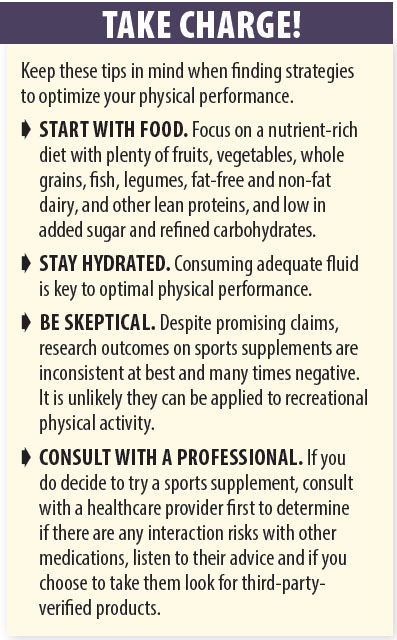
A healthy dietary pattern, regular physical activity and adequate sleep are required for optimal physical performance. Sports (and other) supplements cannot make up for nutrient inadequacy. If you are considering trying any dietary supplements, talk to your healthcare provider before starting. Sports supplements are among the most likely to be tainted with unapproved and potentially unsafe ingredients. Look for labels indicating third-party verification of quality.
The post Dietary Supplements for Sports Performance appeared first on University Health News.
Read Original Article: Dietary Supplements for Sports Performance »
