
DXA Imaging Offers a Look at Bone Health and Fracture Risk
Studies suggest that approximately one in two women ages 50 and older will break a bone due to osteoporosis. Even if you make the right choices in your diet and exercise routine, the fact remains that bone density can change as you age. This is especially true among women who have gone through menopause. “Osteoporosis is a common and debilitating condition for which safe and effective treatments exist, but it is woefully under-recognized and undertreated,” says Alana Serota, MD, an osteoporosis expert at the Weill Cornell-affiliated Hospital for Special Surgery.
Undergoing a dual-energy X-ray absorptiometry—more commonly known as a DXA scan—is the first step to identifying if you are at risk of fracture. “A DXA scan measures bone density of specific areas that are the most common sites of fracture, such as the first four lumbar vertebrae, the femurs (bones that run from your knees to your hips), and the nondominant forearm,” says Dr. Serota.
What Do the Results Mean?
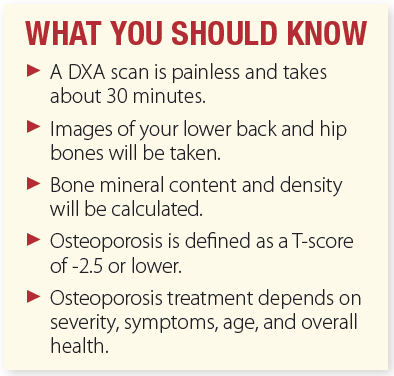
A DXA scan’s result is given as a T-score. “A T-score compares your bone density to a normative database of healthy adult females at peak or ideal bone mass, measured in units of standard deviations,” explains Dr. Serota. A T-score of -1.0 or above is normal bone density. You have low bone density (formerly called osteopenia) if your T-score is between -1.0 and -2.5. Osteoporosis is defined as a T-score of -2.5 or lower. “Severe or established osteoporosis is a T-score of -2.5 or lower accompanied by a history of a low-trauma fracture, which is defined as a fracture caused by a fall from standing height or less,” explains Dr. Serota.
A trabecular bone score (TBS) is a another—newer—parameter that is an indirect indicator of bone microarchitecture. The TBS is generated from a software application that is installed on DXA machines. The program takes the DXA image of the lumbar spine (low back) and creates a grayscale pixel image of the vertebral trabecular bone microstructure. Dr. Serota explains, “Broadly speaking, a TBS is suggestive of bone quality, not simply bone quantity.” TBS is important because about one-half of people who break bones do not have a bone density that is classified as osteoporosis. TBS can help recognize these people and allow for more personalized care to prevent broken bones.
If you think a DXA scan is less important than a mammogram or a colonoscopy, consider this advice from Dr. Serota: “Osteoporosis is a silent thief; it does not cause symptoms or pain until you break a bone. Our skeletal ‘bank account’ is nearly full by age 20, with some consolidation into the early to mid-30s. Everything in life— menopause, illness, lifestyle choices, a nutrient-poor diet—withdraws from this ‘fund.’ The objective is to prevent the first fracture, and a DXA scan helps by showing us how much is in your ‘bank account.’”
Risk Factors
Several underlying medical conditions are associated with low bone density and/or increased fracture risk. Those commonly seen include celiac disease, inflammatory bowel disease, rheumatoid arthritis, anorexia, and hyperparathyroidism.
Lifestyle-related risk factors include smoking and alcohol intake. Dr. Serota notes that drinking cola and caffeinated beverages to excess also may be problematic, as is a diet deficient in protein. Exercise is important, but, Dr. Serota cautions, excessive exercise in the absence of appropriate calories can be harmful to bones.
Who Needs a DXA Scan
A DXA scan is recommended for all women ages 65 and older, but age is not the only factor to consider. “The International Society for Clinical Densitometry also advises DXAs for postmenopausal women younger than age 65 who have risk factors for low bone mass, such as low body weight, prior fracture, high-risk medication use, or a disease or condition associated with bone loss. “If we are expecting a rapid rate of change in bone density, such as in early postmenopause or in the first few years after starting treatment for osteoporosis, we check bone density every year,” says Dr. Serota. Any change in health status, including a new medical condition, weight loss of more than 10 pounds, new medications, and, of course, falls and fractures, may prompt testing at shorter intervals.
The post DXA Imaging Offers a Look at Bone Health and Fracture Risk appeared first on University Health News.
Read Original Article: DXA Imaging Offers a Look at Bone Health and Fracture Risk »
