
Portion Tips and Tricks
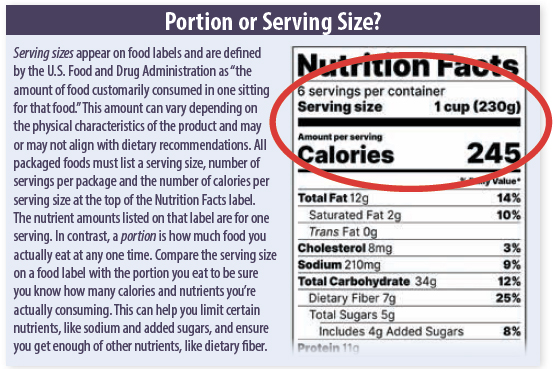
Dietary advice often includes measurements. For example: for someone consuming a 2,000 calorie diet, the Dietary Guidelines for Americans recommend two-and-a-half cup-equivalents of vegetables and two cup-equivalents of fruits a day. But what does that actually look like on your plate? Additionally, Nutrition Facts labels contain a suggested serving size (see “Portion or Serving Size?” box). All of the nutrition data is for this particular serving size. How can you figure out how the portion you’re eating relates to the serving size?
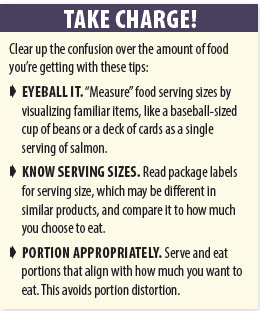
There’s no need to pull out measuring cups or invest in a food scale. Equating these measures with common objects, like a baseball or your thumb tip, can help you get a feel for how much you’re eating. Whether you’re logging food into a food diary or app, trying to meet dietary recommendations, or estimating the size of your serving to see how much sodium, fiber, or other nutrients you’re getting, these visuals can help.
Baseball = 1 cup
Use when looking at whole fruit, like an apple or orange, as well as cut fruits and vegetables, beans, whole grains, pasta, and other solid foods.
Golf Ball = ¼ cup (2 Golf Balls = ½ cup)
Like the baseball, these visuals are good for estimating servings of solid foods, rather than liquids. One golf ball is also equivalent to about 1 ounce of nuts.
Deck of Cards = 3 ounces
Recommendations for animal proteins are typically in ounces, so this works for meat, poultry, and thick cuts of fish, like salmon, tuna, swordfish, and cod.
Dollar Bill = 3 ounces
This is useful for thin cuts of fish, like tilapia, halibut, and flounder.
Ping Pong Ball = 2 tablespoons
This image is good for foods that are typically scooped or spread, but eaten in smaller quantities, like nut butters, smashed avocado, fruit spreads, and seeds
Thumb Tip = 1 teaspoon
This works for solid foods typically used in small amounts, like butter and margarine.
A Quarter = 1 teaspoon
Use this to estimate quantities of liquids, such as olive oil, honey, salad dressings, and cream.
2 Dice = 1 ounce
This works best for blocks of cheese and cheese cubes. (One piece of sliced cheese is also typically about one ounce.)
The post Portion Tips and Tricks appeared first on University Health News.
