
Early Detection of Melanoma Boosts Survival Rates
Skin cancer may seem less threatening than breast or colon cancer, but if you have the most serious form of skin cancer, melanoma, it can be fatal if it’s not diagnosed and treated in the early stages. A dermatologist can perform a thorough screening of your skin, and (obviously) has a much better view of many areas of your body than you do. If you’ve put off scheduling an appointment with your dermatologist, now is the time to make one.
Identifying Skin Spots
If you are age 50 or older, you’re likely to notice new spots developing on your hands, face, and other areas of your skin that have received the most sun exposure. “Solar lentigines” is the medical term for these areas of skin discoloration that are commonly called “age spots” or “liver spots.”
“Lentigines are sharply defined patches that are tan or light brown in color. Benign (non-cancerous) moles are typically brown to darker brown, and they may be flat or raised. Melanomas may be larger and darker than moles,” explains Shari Lipner, MD, a dermatologist at Weill Cornell Medicine.
Lentigines are not cancerous or dangerous, but people who have significant past sun exposure are more likely to have them.

Don’t Skip Screening
See your dermatologist for an evaluation every year; if you’re at increased risk of skin cancer (see What You Should Know) or have previously had skin cancer, you may need to be seen more often. Melanomas may not look threatening, but the longer they go undetected, the more likely the cancer will metastasize (spread to other areas). People with early-stage melanoma have a survival rate of 98 percent, whereas the rate for people whose melanoma has spread to other organs is about 23 percent.
“A board-certified dermatologist is best equipped to diagnose skin cancers. In addition to rigorous training, we also have special lighting and devices called dermatoscopes that help us differentiate between lentigines, moles, and skin cancers,” says Dr. Lipner.
Early-stage melanomas are usually treated with minor surgery that removes the cancerous tissue and a small amount of tissue around the cancer, but later-stage melanomas may require surgery, medication, chemotherapy, and/or radiation.
How to Conduct a Self-Exam
Between visits to your dermatologist, do a monthly self-check of your skin to monitor any moles, freckles, or brown spots you have, and take note of any new spots or growths that appear. Use your smartphone to take photos of any spots you’re concerned about, and check those spots again in future months to see if they’ve changed. If you see changes, see your dermatologist as soon as possible.
Perform your self-exam under a bright light, using a full-length mirror as well as a hand mirror. Keep in mind that melanomas can form in places that don’t get much sun: Check your mouth, ears, scalp, under your breasts, fingernails, and toenails, between your fingers and toes, the soles of your feet, and your genitals.
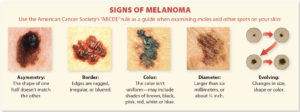
“The ‘ABCDE’ mnemonic can help you remember the warning signs for skin cancer,” says Dr. Lipner. When examining moles and other spots on your skin, look for:
- Asymmetry, in which one half of the mole is shaped differently than the other half.
- Borders that are irregular, ragged, or blurred.
- Color that varies from one area to another, with shades of tan, brown, black, white, pink, red, or blue.
- Diameter larger than 6 millimeters (the size of a pencil eraser).
- Evolving, such as growing larger and/or changing color or shape.
Protect Your Skin
The damage caused by exposure to the sun’s UV rays is cumulative, and the American Academy of Dermatology recommends using sunscreen regardless of your age.
If you spend time outdoors, even in the winter or on cloudy days, use sunscreen on all exposed skin. Choose a product with a sun protection factor (SPF) of 30 or higher that is labeled “broad-spectrum.” Apply sunscreen 15 to 30 minutes prior to sun exposure.
Finally, put sunscreen on your face as part of your daily skin care routine: It will help reduce the signs of aging as well as providing protection.
The post Early Detection of Melanoma Boosts Survival Rates appeared first on University Health News.
Read Original Article: Early Detection of Melanoma Boosts Survival Rates »
