

OTC Pain Relievers May Have Side Effects, Just Like Prescription Drugs
You probably don’t think much about it when you take a couple of Advil or Tylenol to ease a headache, sore muscles, or arthritis pain. But if you take over-the-counter (OTC) pain relievers frequently, you may be increasing your risk of a number of health problems.
OTC pain relievers come with potentially harmful side effects, just like many prescription drugs do.
“People assume OTC products are safe to use as needed since no prescription is required, but there are severe, significant risks, especially with regular, long-term usage and/or high doses,” says Lisa Witkin, MD, a pain management specialist at Weill Cornell Medicine. “If you are using high doses of OTC pain relievers for long periods of time, you need to have a discussion with your doctor to consider other options.”
NSAID Warnings
The U.S. Food and Drug Administration (FDA) has warned that taking the nonsteroidal anti-inflammatory drugs (NSAIDs) ibuprofen (Advil, Motrin) and naproxen (Aleve) is associated with an increased risk of cardiovascular diseases and events, including heart attack, stroke, and heart failure.
The FDA noted that the risks of heart attack and stroke increase even with short-term use, and the risks likely increase further with higher doses of NSAIDs taken for longer periods of time.
“Another risk of NSAIDs is that they can cause bleeding in the gastrointestinal (GI) tract. This risk is higher for people who take blood thinners or who are at increased risk of GI bleeding for other reasons,” says Dr. Witkin.
You’re at higher risk for GI bleeding if you have a peptic ulcer or an H. pylori infection in your stomach. The “blood thinners” mentioned by Dr. Witkin include warfarin (Coumadin), apixaban (Eliquis), clopidogrel (Plavix), dabigatran (Pradaxa), rivaroxaban (Xarelto), and ticagrelor (Brilinta).
Possible consequences of GI bleeding include significant blood loss and a perforated ulcer. Sudden, severe bleeding can cause shock, which may result in unconsciousness. Symptoms of shock include a rapid pulse, minimal or no urination, and dizziness. In extremely severe cases, GI bleeding can cause death.
Aspirin Has Risks, Too
Aspirin is also an NSAID, although it does not carry the same dangers to heart health as ibuprofen and naproxen.
Often, a low-dose (81 milligrams) daily aspirin is recommended for people with cardiovascular disease who have had a heart attack or stroke, cardiac bypass surgery, or who have had stents placed in their coronary arteries.
Previously, a survey revealed that millions of Americans who did not have heart disease were taking lowdose aspirin, but the American College of Cardiology and the American Heart Association advised against this practice after research revealed that the benefit of taking a daily aspirin was offset by the risk of internal bleeding, especially for people ages 70 and older.
“Talk with your doctor to find out if the possible benefit of taking lowdose aspirin outweighs the risks for you,” advises Dr. Witkin.
Acetaminophen
Acetaminophen (Tylenol) relieves pain by a different mechanism than NSAIDS, and it is usually recommended as the first choice for people with cardiovascular disease. However, acetaminophen isn’t risk-free, either.
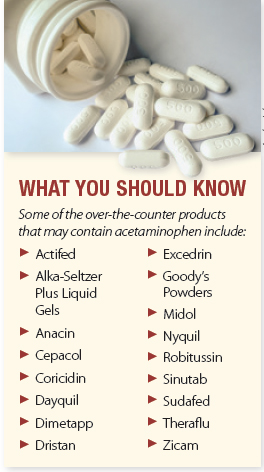
“Your body clears safe doses of acetaminophen, but high doses can cause liver damage,” says Dr. Witkin. “We worry about the cumulative dose patients may be getting without realizing it, since acetaminophen is found in hundreds of OTC and prescription medications. To avoid taking too much acetaminophen, check the labels of all OTC products, especially cold and flu medicines, to see if acetaminophen is an ingredient.” (See What You Should Know for some of the OTC products that contain acetaminophen.)
And a study published in February 2022 in the journal Circulation found that people with high blood pressure who took 4,000 milligrams (mg) of acetaminophen daily for two weeks had an average increase in systolic blood pressure of 4.7 mmHg.
Experts now advise limiting acetaminophen to 3,000 mg a day.
The take-home message: Choose your OTC pain reliever carefully, and always use the smallest amount for the shortest period of time possible.
The post OTC Pain Relievers May Have Side Effects, Just Like Prescription Drugs appeared first on University Health News.
Read Original Article: OTC Pain Relievers May Have Side Effects, Just Like Prescription Drugs »
