

Strong Core Muscles Contribute to Better Balance and Stability
Even though you can’t see them, your core muscles can have a major effect on your health. Weak core muscles may have a detrimental effect on your posture and your back, and they also can raise your risk of falls and fractures due to poor balance and lack of stability.
“If your waistline is expanding, you’re either gaining weight or not using your abdominal muscles, or both,” says Robert Turner, PT, OCS, a board-certified orthopedic clinical specialist and Clinical Supervisor in the Spine Therapy Center at the Weill Cornellaffiliated Hospital for Special Surgery.
“You need to strengthen your abdominals and your core or that drooping waistline will put stress on your lower back. That, in turn, will lead to overall postural decline and fatigue,” he warns. “Think of it this way: Strengthening your core means strengthening your antigravity muscles.”
What Is Your “Core”?
Think of your core as a 3-D cylinder that wraps around the body from the back to the front, from the pelvis up to the rib cage. Your core includes your abdominal and pelvic muscles, as well as the lower back muscles. “All of those muscles have to be engaged to keep your spine in a neutral and stable position, which is critical when you’re doing core strengthening,” says Turner.
Skip the Crunches
Often, people think that all they have to do to strengthen their core is sit-ups or “crunches,” but these exercises target only your abdominal muscles, which are a small portion of your core.
“If you focus only on your abdominal muscles, you’re going to develop imbalances,” Turner emphasizes. For one thing, many people do crunches and situps incorrectly and end up overusing the hip flexors, which makes those muscles tight and pulls your spine forward. Also, if crunches are done incorrectly, you may be using muscles in your lower back. This puts your spine in a position that sets the stage for hip pain, back pain, and poor posture.
Exercises for Your Core
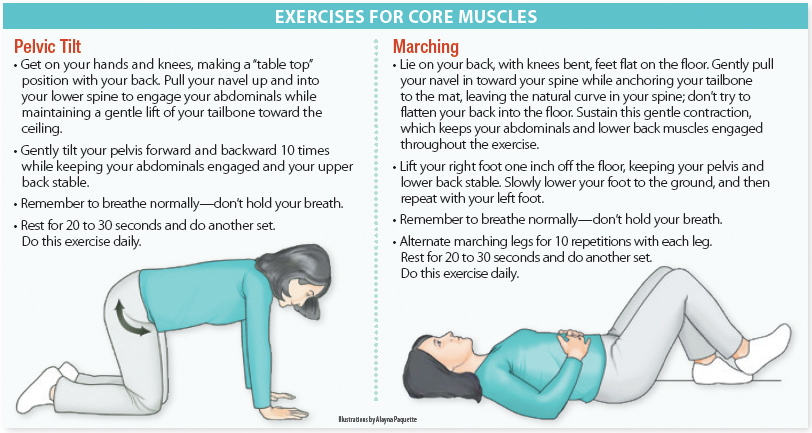
Instead of crunches or sit-ups, do exercises such as the two shown below that engage the entire core—front, sides, and back. You also can strengthen your core with simple balance exercises, such as standing on one leg; hold onto a wall or tabletop at first to avoid falling, and make sure all your core muscles stay engaged. You will see little or no external movement when doing many core exercises, since the targeted muscles require only small movements—but you will definitely feel them if you’re doing the exercises correctly.
“No matter what exercises you do for your core, remember to keep breathing normally,” Turner stresses. “Holding your breath generates internal pressure that can lead to injury. You want to move freely while keeping your whole core engaged—and that means you have to breathe.”
The post Strong Core Muscles Contribute to Better Balance and Stability appeared first on University Health News.
Read Original Article: Strong Core Muscles Contribute to Better Balance and Stability »
