
Curbing Emotional Eating and Overindulging
With the pandemic on the wane and many people having received the COVID-19 vaccine, larger gatherings with family and friends are going to be an option this holiday season. Celebratory features in many home will include an abundance of delicious and rich holiday goodies. While there is seldom the need to avoid all festive food and drink, it is helpful to be aware that emotions can hijack your best intentions to not overindulge.
“The holidays are a highly anticipated time of year when emotions run high because we have expectations of what we want to see, do, and who we want to celebrate with,” explains Dana Hunnes, RD, MPH, PhD, Assistant Professor UCLA Fielding School of Public Health. “If things don’t live up to expectations, it can be emotional and may increase the likelihood of emotional eating.”
Stress, anticipation, sadness and even being happy all can lead to increased intake.
Bing Eating: Beyond Occasional
In medical terms, emotional eating equates to binge eating, which is not the same as occasional overconsuming. Binge eating disorder (BED) consists of consuming a larger amount of food than other people would be able to consume in similar circumstances and similar period (usually within a two-hour period), and lack of control of eating and feeling guilty after eating. Frequency is also considered. To be diagnosed as BED, episodes of overeating need to occur every week (at least once a week) for three months.
Risk factors for BED include childhood obesity, distorted body image perception, family weight concerns and eating problems, family conflicts, perfectionism, mental-health impairments, and intestinal microbiota alteration. BED is more commonly diagnosed in young adult years, though older adults can be afflicted as well.
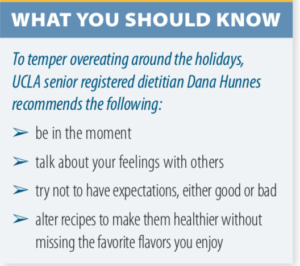
Even if you don’t have BED, insights from treating the disorder can be helpful in curbing over indulging, which can lead to digestive discomfort, guilt, and weight gain. The key is to take stock of your emotions when you find yourself consuming more than you want or feel you need, according to Hunnes. She recommends trying to catch yourself in the moment and ask such questions as: Are you sad? Are you angry? Are you happy? Are you moody? Are you anxious?
Avoid Dieting and Deprivation
Dieting before the holidays or severe food restrictions before the holidays or a party can backfire. Experts say that dietary restriction (not eating enough calories) and deprivation (avoiding certain foods) can not only lead to overeating, it can lead to craving high-carbohydrate foods, which play starring roles at parties. If you haven’t eaten much all day, you’ll have less impulse control when you see bowls of salty cashews, chocolate covered almonds, and platters of pita and hummus. It’s best, therefore, to eat sensibly throughout the day.
Furthermore, not eating enough gives rise to negative emotions and the term “hangry” (anger due to hunger). This can lead to anxiety and lashing out at others. When we get hangry, blood sugar drops. Low blood sugar can cause dizziness, sweating, fast heartbeat, irritability, and the inability to concentrate. When you can’t think straight, it’s easy to eat fistfuls of nuts, be rude to people, and blame feelings on something or someone, rather than on the fact that we are just hungry. But being emotionally aware can help.
Emotional Rescue
Before you give in to the impulse to have another drink or second helping, assess the situation with the acronym HALT. Ask yourself if you are hungry, angry, lonely, or tired? Feeling insatiable is a sign that you need to attend to your emotions. Instead of mindless munching to stuff difficult feelings, take a few deep breaths and allow yourself to relax. Physical movement, be it formal exercise or a simple walk, can shift your attitude. Likewise, talking with a friend or a mental-health professional can provide support and a different perspective.
Finally, it’s not just negative emotions that can lead to overconsumption, as Hunnes points out. “Sometimes when we are happy or with others who are eating a lot, we tend to eat a lot as well,” she says. “Libations can further remove inhibitions.”
The post Curbing Emotional Eating and Overindulging appeared first on University Health News.
Read Original Article: Curbing Emotional Eating and Overindulging »
