
Focal Therapy for Prostate Cancer
Not that long ago, the go-to treatment for breast cancer was mastectomy, meaning total removal of the breast. Today, “lumpectomy,” which spares much of the breast, is a standard offering to women. A similar option for prostate cancer, known as focal therapy, is now being offered to men.
While the surgical removal of the entire gland (radical prostatectomy) is a common method of treatment, focal therapy aims to eliminate only the cancerous tissue in the gland. Identifying the precise location of diseased tissue is crucial to the treatment.
“Focal therapy offers the opportunity for cancer cure without the side effects of surgery or radiation,” says urologist Leonard Marks, MD, Professor of Urology and member of the UCLA Jonsson Comprehensive Cancer Center. “We offer it to men with intermediate-risk prostate cancers. Such lesions now account for more than 40% of all new cases found. The MRI-guided biopsy, which was pioneered at UCLA, is enormously helpful in determining intermediate risk.”
Determining Risk with Fusion Biopsy: MRI + Ultrasound
Each year, about 1 million men in the U.S. undergo biopsies to determine whether they have prostate cancer. The biopsy procedure traditionally has been guided by ultrasound imaging, but this method cannot clearly display the location of tumors in the prostate gland. A multidisciplinary team of UCLA physicians has found that a biopsy method that combines magnetic resonance imaging (MRI) with the traditional ultrasound method is better at detecting prostate cancer.
This conclusion was drawn from a three-year study, supported by the National Cancer Institute and conducted at UCLA, then published in JAMA Surgery in 2019. The study objective was clearly defined: In men undergoing a first prostate biopsy to rule out clinically significant cancer, should samples be taken exclusively from lesions visible on MRI, or should systematic sampling also be obtained? Systematic sampling refers to taking multiple samples from different regions of the prostate gland. This procedure is guided by an ultrasound device.
In the 300-person study, 248 men had a prostate lesion visible on MRI. By using all available biopsy information and methods together, the researchers detected cancer in 70% of those men. Noteworthy was the finding that an additional 52 men in the trial had no lesion visible on MRI, yet 15% of those men were found to have cancer via the traditional ultrasound method.
“When there’s a lesion on MRI, physicians should take systematic and targeted biopsies together for the best chance at finding cancer,” says Dr. Marks. “Even if the MRI is negative, men at risk—including those with elevated levels of prostate-specific antigen, a prostate nodule, or family history—should still receive a systematic biopsy,”
Treating Prostate Cancer
Treating prostate cancer has typically involved radical prostatectomy or administration of radiation therapy to the whole prostate. Possible side effects of these procedures include erectile dysfunction and/or urinary incontinence. Because focal therapy aims to treat only the cancerous tissue, it may minimize or prevent the urinary and sexual side effects that can accompany whole-gland treatments.
Focal therapy is a general term that describes minimally invasive techniques such as high-intensity focused ultrasound (HIFU) and cryotherapy. Candidates for these techniques are men with cancer that has not spread outside of the prostate, including men for whom radiation therapy has failed.
“The outcomes for HIFU and cryotherapy are very similar, showing that about 75% of men in each group appear cancer-free at six-month follow-up biopsy,” explains Dr. Marks. “We use cryotherapy for larger prostates and anterior lesions; we use HIFU for smaller prostates with posterior lesions.”
Destroying Tissue with Fire and Ice
For both focal therapies, physicians are guided by MRI and ultrasound imaging to target the location of the tumor. The way HIFU works is akin to what happens when you capture the sun’s rays in a magnifying glass and focus it on a piece of paper—it burns a tiny hole in it. With HIFU, the ultrasound beam does similarly with sound waves—it delivers bursts of intense heat, about 200 degrees Fahrenheit for a few seconds at a time, on a very specific area. Each blast ablates tissue about the size of a grain of rice, getting rid of the cancer speck by speck.
Cryotherapy likewise destroys prostate cancer tissue. It is a centuries-old technique that uses extremely cold temperatures to freeze and kill cancer cells. Like HIFU, cancers treated with cryotherapy are considered to be of intermediate risk, meaning the tumor might be observed for a while but could progress if not treated.
Patients who select focal therapy are watched and checked for recurrence of cancer. Compared to traditional surgery, cryotherapy and HIFU offer a shorter recovery period, no hospital stays, less blood loss, and less pain. Because the patient must be motionless for these procedures, general anesthesia is required.
New Study on Cryotherapy
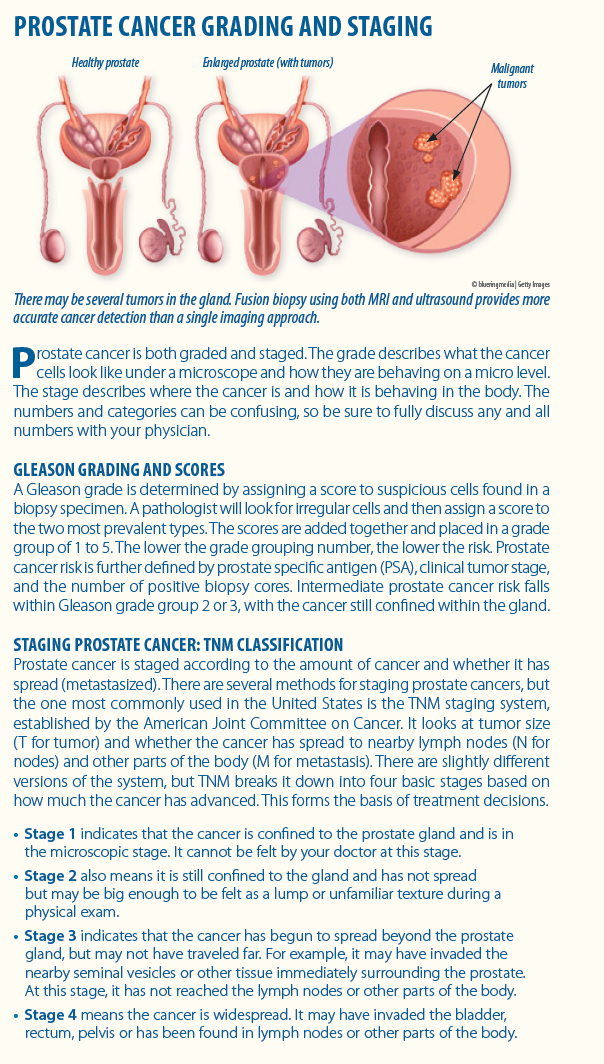
In a study published in the Journal of Urology in 2020, UCLA researchers reported that removing half the prostate gland (hemi-gland) using cryotherapy is an effective, primary treatment for men with intermediate-risk prostate cancer (see box for grading classifications). In a group of 61 patients with intermediate-risk prostate cancer, researchers found that 80% of patients had no signs of cancer at six months and 18 months after cryotherapy treatment. In 10% of cases, there was minor residual cancer and a 10% failure rate among those who didn’t respond to treatment. While these results are very encouraging, physician-scientists note that research on the use of cryotherapy treatment for prostate cancer is still very preliminary when considering the long history of prostate cancer. More research is needed.
“For most men in their 60s and 70s, the time when prostate cancer is often discovered, preserving quality of life is just as important as extending length of life,” says Dr. Marks. “Therefore, focal therapy is a compromise between aggressive treatment and observation alone, offering the potential for cure and maintenance of life quality in properly selected patients. We emphasize that a follow-up plan is part of the focal-therapy decision; it’s not a one‑and-done procedure.”
The post Focal Therapy for Prostate Cancer appeared first on University Health News.
