

Older Women Especially Vulnerable to Alzheimer’s
More than 5 million Americans are living with Alzheimer’s disease (AD), and research suggests that about two-thirds of them are women. The risk of AD increases with age—while about 10 percent of people age 65 and older develop it, about 50 percent of those age 85 and older have it. Since women live longer than men, the general mindset has been that longevity drives AD prevalence in women—however, other factors contribute, too. Even so, Mount Sinai geriatrician Patricia Bloom, MD, emphasizes that having these risk factors doesn’t mean that AD is inevitable. “There’s still a lot you can do toward maintaining good cognition as you get older,” she says.
Women and AD-Linked Comorbidities Numerous studies point to an association between depression and AD, and women are twice as likely as men to develop depression. “Depression also may have more impact on women’s brains,” Dr. Bloom notes. “Imaging studies have suggested that the hippocampus—a region of the brain that is important for memory and learning—shrinks faster in women with depression than it does in men with depression.” Women also are more likely to suffer from other comorbidities that have been linked to the risk of AD, including stroke, migraines with aura (a temporary visual disturbance that may manifest as flashing lights, zigzag lines across your field of vision, and even loss of vision), and thyroid disease.
Lack of Physical Activity A sedentary lifestyle boosts AD risk, and there is evidence that women exercise less than men. “Exercise is the lifestyle choice for which there is the strongest evidence of a protective effect against AD,” Dr. Bloom says. “In one study of women age up to 60, those who were very fit were 88 percent less likely than their less-fit peers to develop AD over a 44-year follow-up.”
The Caregiver Connection Women make up about two-thirds of family caregivers for people with AD, and there is evidence that people who are caring for a loved one with AD may be more likely to develop the condition. “Caregiving is associated with high levels of stress, depression, and poor sleep, all of which are associated with AD and worse cardiovascular health,” Dr. Bloom explains. “Poor cardiovascular health is in itself an AD risk factor because it may reduce blood flow to the brain.”
AD Genes and Women You may have heard of the apolipoprotein E4 gene (ApoE4), which is associated with AD. Women with the gene are more likely to develop mild cognitive impairment (MCI), which can be a precursor for AD. Older women with ApoE4 also have higher levels of amyloid-beta (A-beta) and tau, abnormal proteins that are considered hallmarks of AD. “A-beta forms clumps between brain cells, disrupting their communication with each other, while tau forms tangles within brain cells,” Dr. Bloom explains. MCI doesn’t always progress to AD, but research suggests that progression is more likely in women with MCI who also have the ApoeE4 gene.
Menopause and Hormones Menopause frequently is accompanied by poor sleep (see Newsbriefs, page 2) and depression, both risk factors for AD. During menopause, estrogen levels plummet. “Estrogen influences the function of vital brain chemicals and regulates glucose uptake by the brain,” Dr. Bloom says. The brain relies on glucose to generate adenosine triphosphate (ATP), a compound that provides energy for cells. “About three-quarters of the ATP generated in the brain is used to fuel communication between brain cells,” Dr. Bloom adds. “Lower levels of estrogen have been linked to lower glucose metabolism by the brain—this may reduce ATP and, therefore, the brain’s energy levels.” However, high-quality studies have not shown that estrogen therapy decreases the risk of dementia.
Research also has linked lower glucose metabolism and less brain volume to greater A-beta deposition in the brains of older women than in older men. However, Dr. Bloom notes that while A-beta and reduced brain volume are associated with a greater risk of AD, neither are a guarantee that a person will develop AD.
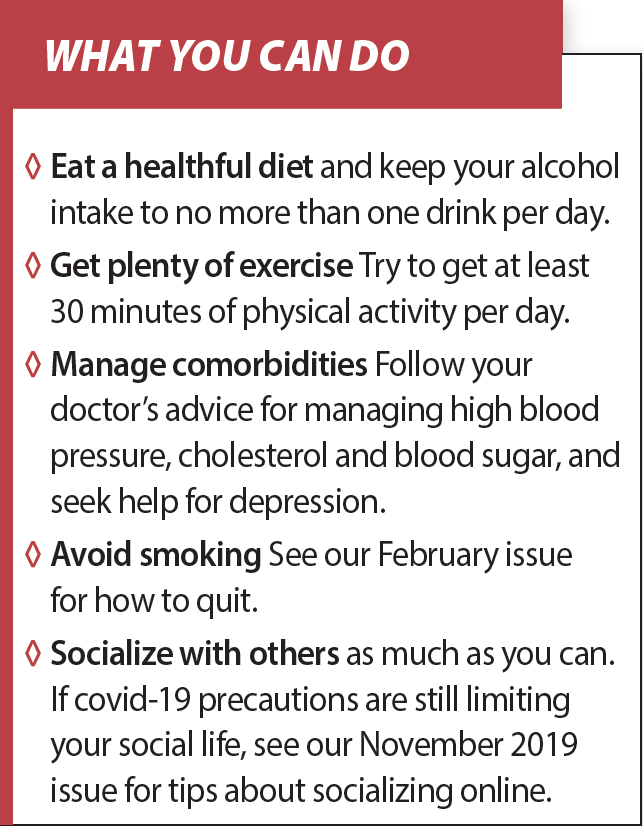
You Can Protect Yourself Dr. Bloom emphasizes that being post-menopausal and having comorbidities that have been linked to a greater risk of AD doesn’t mean that you are destined to develop the disease. Instead, she recommends older women see these risk factors as an incentive to do all they can to protect their cognitive health. “While there isn’t a prescription that guarantees good cognition, studies have linked several behavioral and lifestyle choices with better memory and thinking skills in older adults,” she concludes. See What You Can Do for helpful strategies.
The post Older Women Especially Vulnerable to Alzheimer’s appeared first on University Health News.
Read Original Article: Older Women Especially Vulnerable to Alzheimer’s »
