
There’s an App for That
Nutritionally, America is still falling short. A 2020 report published in the American Journal of Clinical Nutrition said that 46 percent of US adults and 56 percent of children have an overall poor quality diet, which burdens the US economy via massive health care costs. It’s dire statistics like this which leave many people searching for ways to eat better to improve health and shed pounds.
Enter the burgeoning field of web based tools and smartphone apps geared towards helping people track what they eat and make the necessary tweaks to improve the nutritional quality of their diets. The ubiquitousness of smartphones has led to the rapid development and proliferation of weight loss applications (apps). “Tracking your food intake with an app can help keep you accountable and open your eyes to where nutrition gaps are occurring and to where improvements can be made,” says Eliza Savage, RD, a registered dietitian at Middleburg Nutrition in New York City. “For this purpose, apps are convenient, affordable, and easy-to-use, and now there is a variety available depending on your nutritional needs.” So, a 24/7 nutrition-oriented program on a smartphone may address certain limitations of traditional nutrition counseling such as cost and the need to schedule face-to-face time, while also reducing burden on certain health care providers. Many apps also provide additional services like dietitian-led coaching and recipe suggestions that can aid in improving eating habits.
There is mounting research demonstrating that digital nutrition and lifestyle-oriented programs can effectively aid in improving eating habits and contribute to weight loss success. For instance, a meta-analysis of the available science published in the journal Obesity Reviews found that app-based mobile interventions can improve various nutrition behaviors and, in turn, nutrition-related health outcomes including positive effects on obesity. In analyzing data from fourteen studies involving 2,129 people, researchers reported in the journal Obesity that individuals using mobile apps, including those which require food intake monitoring, lost an additional 1.85 pounds in body weight and 1.35 centimeters in waist circumference compared to those not using the apps. Research also demonstrates the efficacy of mobile apps that allow for food tracking and expert feedback to increase daily vegetable consumption. This underscores the potential of app-based food tracking programs to operate at a large scale to improve collective eating habits and lend a hand in battling the obesity epidemic in a broad spectrum of the population.
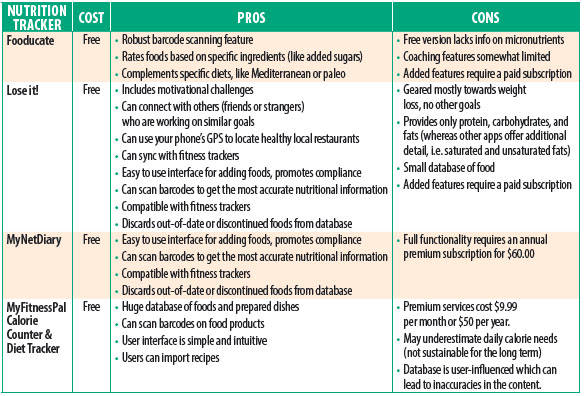
But food tracking in the digital world is not a perfect science. “The variance of nutrient and calorie intake can be quite big,” warns Savage. “And I find that people either over or underestimate their actual intake, so the numbers you get from a food app need to be taken with a grain of salt.” A Journal of Nutrition Education and Behavior study discovered that among adults taking part in a dietary self-monitoring program using a smartphone app, there can be a weekend effect such that participants reported significantly fewer foods consumed between Thursday and Sunday relative to Monday. This can lead to significant inaccuracies that may impact the usefulness of the app to reach desired goals. So, using programs that provide real-time prompts like encouraging text messages on weekends may improve adherence and overall success. Apps may also be another thing steering us towards an increased reliance on digital devices at a time when most health experts are telling us that we should be reducing screen time.
While tracking apps can be helpful motivators for many, they are not right for everyone. Savage cautions taking a numbers focused approach to health—say defining it in terms of calories— can lead to unhealthy eating behaviors. There is evidence, for example, that using a tracking device can exacerbate symptoms of eating disorders in susceptible people who get too fixated. “In this case, I would advise a person to take a break from the app and instead try speaking with a registered dietitian to improve nutrition choices,” notes Savage.
The post There’s an App for That appeared first on University Health News.
