
3. Symptoms of Alzheimer’s Disease
A person with Alzheimer’s disease will have increasing difficulty not only with memory but also language, time perception, visual-spatial orientation, and problem-solving ability. Mood and behavior changes will also occur. But these don’t come on suddenly. A person with Alzheimer’s disease won’t be entirely normal one day and completely incapacitated the next. The effects of the disease come on gradually.
At first, symptoms will be mild and may be noticeable only to the person with dementia and possibly family members and close friends. Day-to-day activities may be only minimally affected. As brain cells continue to die and connections between nerve cells are lost, the symptoms increase and worsen. Because the disease affects people differently, not everyone will lose function in the exact same way.
Early Signs of Alzheimer’s Disease
Many people fear that everyday acts of forgetfulness, such as not remembering where you put your car keys, are early signs of Alzheimer’s disease. Although forgetfulness can be an early warning sign, the memory loss of Alzheimer’s disease is more serious than normal age-related memory difficulties. Misplacing your keys only to find them later is not uncommon. Placing the keys in an odd or inappropriate location, such as inside the sugar bowl, and completely forgetting about it indicates a more serious problem.
With Alzheimer’s disease, forgetfulness is a consistent problem, and the information generally is not recalled later, as it often is with normal aging. Also, Alzheimer’s disease affects more than just memory. Language, behavior, and the ability to handle day-to-day tasks also become compromised.
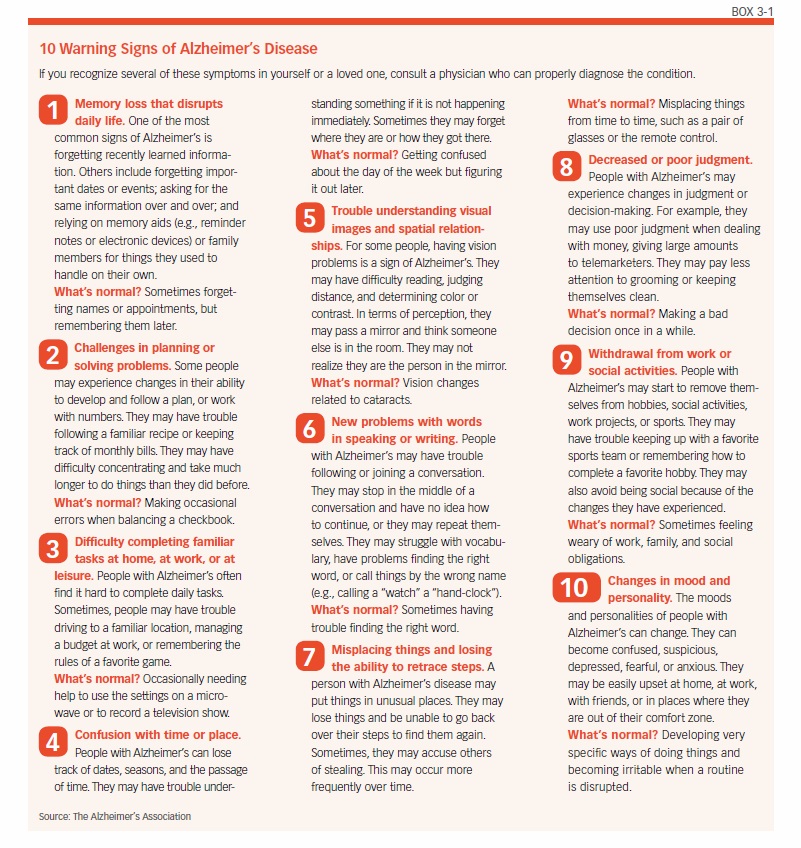
To help recognize the warning signs of Alzheimer’s disease, and to distinguish them from normal memory lapses, the Alzheimer’s Association has developed a checklist of common symptoms. These are listed in Box 3-1, “10 Warning Signs of Alzheimer’s Disease,” on page 17.
Memory Loss
For most people, memory loss is the first noticeable sign of Alzheimer’s disease. Early in the course of the illness, a person with Alzheimer’s disease will tend to forget recent events and new information, while retaining memories of past events. Forgetting recent events may cause the person to ask the same questions repeatedly. This memory loss also causes the person to have difficulty learning new information. Eventually, the person may not remember the names or identities of family members or close friends, and long-term memory will be lost as well.
Memory is not one simple function, but a collection of several memory systems. For example, remembering how to drive a car involves a different memory system from that used to remember your wedding day, or from the one that allows you to do mental calculations.
With Alzheimer’s disease, recollection of facts and events (called “declarative” memory) tends to become impaired first, particularly with recently acquired memories. With this disruption, it’s easy to forget appointments and the content of conversations. A person with Alzheimer’s disease may ask a question, get an answer, and then ask the same question five minutes later. Often, people in the mild stage of Alzheimer’s disease will be confused about recent experiences, although they have excellent recall of events that occurred 20 years ago. It may be easier to define vocabulary words than to supply recent autobiographical details (such as what the person did yesterday).
Memories of previously acquired skills and procedures, such as playing golf or mowing the lawn (called “procedural” memory), remain intact longer. These well-learned routines hold up for a while, and it may be possible to learn new routines that make use of the procedural memory system.
Alzheimer’s disease damages another system called “working memory.” Working memory allows you to mentally hold onto information while processing it. For example, arithmetic is performed in working memory. A person with Alzheimer’s disease may be able to remember a string of numbers for a short time, but be unable to add or subtract them. Working memory also helps us divide our attention. A person with normal memory can participate in a conversation while remembering that he has to turn off the oven in five minutes. A person with Alzheimer’s disease has increasing difficulty dividing his attention, so the oven stays on.
Language Difficulties
Language ability is divided into expression and comprehension. With Alzheimer’s disease, the ability to intelligibly express oneself with language tends to deteriorate faster than the ability to comprehend words and sentences. Most people with Alzheimer’s have trouble finding the right words to express what they want to say. For example, a person might want to refer to his watch but can’t remember the word “watch,” so he says “the thing you tell time with.” A person with Alzheimer’s may also become confused and refer to her husband as her son or brother, mistaking one word for the other.
Perception of Time and Orientation
Impaired orientation means that the person with Alzheimer’s becomes increasingly confused about time (date, day of the week, month, year, season) and place (residence, neighborhood).
Early on, people may become confused about the date or day of the week. Time relationships may be slightly impaired. For example, people may get ready for an appointment hours ahead of time. Also, while it may be easy enough to navigate familiar places, such as their own neighborhood, unfamiliar locations begin to present a problem.
In the moderate stage, time orientation worsens. A person in this stage may believe that he or she is living in another period of life, and may think that deceased relatives are still alive. Orientation to place also declines. People in this stage will increasingly have trouble finding their way around, even in familiar places. They may not recall where to put items, such as the dishes or towels, and will store them in inappropriate locations. It’s particularly important at this stage for people with Alzheimer’s to be supervised and to have identification in case they become lost. (The Alzheimer’s Association provides the “Safe Return” program, discussed in Chapter 8.)
Visual-Spatial Changes
Many people with Alzheimer’s disease have problems with visual identification of objects and spatial orientation. A test often used to determine the extent of these problems is called the clock-drawing test. The person is asked to draw a clock with the hands set at a particular time. This task requires several cognitive abilities, including visual perception, spatial organizational ability, and planning. Some people with Alzheimer’s disease are able to perform this task correctly, but many cannot.
Visual-spatial impairments also make it difficult to recognize faces and to identify and name objects. For example, a person with Alzheimer’s disease may be unable to recall how common objects, such as a comb, toothbrush, or hammer, are used. The meaning of the object, not the skills involved in its use, are lost.
Visual-spatial changes also may account for some of the difficulties in driving—for example, not being able to accurately judge the size and shape of the car when parking, having small accidents that cause nicks and dents, and so forth.
The extent of disability with regard to visual-spatial ability depends on how much damage has been done to the area of the brain that controls this function.
Problem Solving and Judgment
One area that often becomes noticeably impaired is the ability to solve problems in day-to-day life. Impairments occur in the ability to do calculations or manage complex tasks. A person with Alzheimer’s disease may have trouble balancing her checkbook or handling a household emergency. She will also slowly lose the ability to grasp abstract concepts.
Even though the ability to deal with more than one task at a time becomes increasingly impossible, people in the mild stage can often continue to handle some household tasks, with the exception of financial transactions. The ability to handle finances, including checkbook management, bill payment, and understanding a bank statement, is already impaired in the mild stage of Alzheimer’s disease. This capacity declines rapidly.
People with Alzheimer’s disease may also have poor judgment, which can lead to being vulnerable to financial scams.
Mood and Behavior Changes
In addition to having impaired mental function, people with Alzheimer’s disease may exhibit changes in mood and behavior. These can occur at any stage of the illness and tend to come and go. Mood and behavior changes vary widely from person to person.
People with Alzheimer’s disease may become depressed. Generally, major depression is defined as a feeling of sadness and decreased interest in most things, most of the day, nearly every day, for at least two consecutive weeks. Other symptoms of major depression include:
- Decreased energy
- Change in appetite, often with weight loss
- Sleep disturbance
- Low self-esteem or guilt
- Decreased concentration
- Thoughts of suicide or the feeling that life is not worth living
Many people with Alzheimer’s disease who are depressed do not experience all of the classic symptoms that occur in major depression. It may be difficult for a doctor to diagnose depression in people with Alzheimer’s disease because some of the symptoms overlap. Nonetheless, depression should be treated, often with antidepressant medication. Involvement in a support group may help people in the early stage counteract the symptoms of depression and social withdrawal.
Later Symptoms of Alzheimer’s Disease
As Alzheimer’s disease progresses, the above symptoms will worsen and additional ones tend to arise.
Agitation and Aggression
Some behavioral changes are common. For example, a person with Alzheimer’s disease may become more irritable than usual, getting angry without provocation. Agitation and aggression can develop, even in people who were easygoing prior to the illness, and people who were gregarious and outgoing may become subdued.
The behavioral changes, particularly agitation, can get more burdensome as the disease worsens. As language ability deteriorates, people with Alzheimer’s may express agitation through behaviors such as screaming, pacing, and an inability to sit calmly. People in the moderate and later stages of Alzheimer’s disease are likely to wander aimlessly from room to room.
Verbal or physical aggression may occur when a caregiver is helping with tasks such as bathing, grooming, or meal preparation. This may represent frustration over not being able to do these things independently or not comprehending the purpose of the tasks.
Sundowning
Sundowning—agitation that increases in the evening and nighttime—is relatively common among people with Alzheimer’s. It’s not known why this happens, but people with this disturbance experience increased confusion, anxiety, agitation, and disorientation beginning at dusk and continuing throughout the night. Sundowning may be complicated by sleep disturbances. The person may sleep during the day and stay up all night.
This disruption in the normal cycle of sleeping at night and being awake in the daytime can be caused by an upset in the body’s circadian rhythm (internal biological clock). It might also be due to other factors. Dim lights, increased shadows, and the lack of sensory cues from the immediate environment can cause confusion. Or, the person may be hungry, uncomfortable, or in pain and unable to appropriately express those needs.
Some strategies for dealing with sleep disturbances in people with Alzheimer’s disease are described in Chapter 8, “Caring for a Person with Alzheimer’s Disease.”
Delusions and Hallucinations
Some people with Alzheimer’s disease experience delusions or hallucinations. A delusion is a false belief that is not consistent with reality. A hallucination is seeing, hearing, smelling, or feeling something that doesn’t exist. Hallucinations are less common than delusions.
Some people with Alzheimer’s disease who continually misplace objects—such as money, jewelry, keys, or even non-valuable items like papers, clothing, or cans of food—develop a paranoid delusion that someone has stolen them. They may become quite agitated about this concern. Sometimes people with Alzheimer’s think that a deceased family member still lives in the house, or that strangers have moved in. Calm reassurance by a caregiver about the reality of the situation may alleviate these problems, at least temporarily.
Stages of Alzheimer’s Disease
Because Alzheimer’s disease continues to get worse over time, it’s often thought of as unfolding in stages. This can be helpful, but it’s important to understand that the symptoms and rate of progression can vary from person to person.
There are different systems for staging Alzheimer’s disease. Many experts categorize it as mild (early-stage), moderate (middle-stage), and severe (late-stage). These stages refer to the period of time beginning when symptoms become apparent. For many years this was considered to be the start of the disease.
It is now known that the disease process actually begins before the diagnosis can be made. To reflect the deeper understanding of Alzheimer’s disease and to prepare for future advancements in diagnosis and treatment, the National Institute on Aging and the Alzheimer’s Association describe three distinct stages of Alzheimer’s disease. These are:
- Preclinical: In this stage, brain changes have begun but symptoms are not evident. People in this stage have biomarkers (see “New Methods of Diagnosis,” page 44) of Alzheimer’s disease, such as buildup of beta-amyloid in the brain, which can be detected with new, experimental tests. Currently, this stage is used only in the context of a research study, and the diagnostic parameters are still being evaluated. It is not yet clear what proportion of people who exhibit the biomarkers end up with clinical symptoms of the disease, over what period of time.
- MCI due to Alzheimer’s: The MCI stage is marked by symptoms of memory problems, enough to be noticed and measured, but not compromising a person’s independence. People with MCI may or may not develop Alzheimer’s dementia. For now, the identification of people as having MCI due to Alzheimer’s is also largely for research purposes.
- Alzheimer’s Dementia: This refers to the stage of the disease when symptoms are evident and causing problems. It is the Alzheimer’s dementia stage that is divided into mild, moderate, and severe, as described below.
Mild (Early-Stage)
In general, people in the early stage of Alzheimer’s have memory problems that make it more difficult to absorb new information. They may lose or misplace objects. Planning and organizing become difficult. It becomes increasingly more difficult to perform daily activities, such as shopping, cooking, or keeping appointments.
People in the mild stage of Alzheimer’s are still able to have coherent conversations, but they may have trouble finding the right words or remembering names.
Moderate (Middle-Stage)
In the moderate stage of the disease, the memory loss worsens, and it is more obvious to others. But highly learned information (such as the person’s birthday) and procedural memory (how to brush the teeth) are usually retained. In this stage, the names and identities of family members or close friends may become confused.
In the moderate stage, the person with Alzheimer’s is not able to manage money at all. Before this happens, it is important that arrangements be made regarding the handling of finances (see Chapter 10, “Practical Advice: Legal, Financial, Healthcare”). This is especially important because cognitively impaired older adults can become victims of financial fraud schemes. Problem solving and judgment are generally impaired to the point where the person may not be able to handle a household emergency or make a decision about a stranger at the door.
Also in this stage, judgment about how to respond socially declines. It’s not uncommon for people to act inappropriately in social situations, using coarse language or telling crude jokes. The enjoyment of social events and outings does not necessarily diminish. However, people with Alzheimer’s may avoid social situations because of embarrassment about their condition and their inability to process new and complex information.
In the moderate stage, the person continues to be able to read and understand what they are reading, and comprehend what people say to them. But the ability to formulate coherent sentences and to name objects deteriorates. As it becomes more difficult to retrieve desired words, speech may become vague and imprecise. And as the ability to produce spontaneous sentences diminishes, the person may resort to repeating commonly used phrases over and over in a conversation.
Severe (Late-Stage)
In the severe stage of Alzheimer’s, long-term memories will gradually fade, along with highly learned information and activities. The person may still recognize people who are always around, or with whom they’ve had a longstanding relationship, but will not be able to verbalize the people’s names or any other information about them.
In the severe stage, when many aspects of memory function are impaired and the person needs help with most activities of daily living, language comprehension and expression are both severely diminished. However, a person in the severe stage may still be able to recognize his or her name and respond when addressed directly. The ability to produce coherent sentences will vary from person to person—at this stage, some people with Alzheimer’s do not speak at all.
In the severe stage, problem solving and judgment are significantly impaired, and even simple decisions—such as what to eat and wear—must be supervised.
Effect of Alzheimer’s on Day-to-Day Functioning
Household Tasks
In the mild stage, people with Alzheimer’s can generally continue to carry out day-to-day tasks like going shopping, preparing meals, and doing household chores. Some supervision may be needed, and memory aids—such as lists, schedules, calendars, and alarms—may help to compensate for memory lapses. As memory problems worsen, more help will be needed. Simple tasks can continue to be performed, but anything requiring coordination of sequences of activities, such as home repair or car maintenance, will be problematic.
People in the moderate stage will require much more supervision. However, they can still do simple chores, such as washing dishes, setting the table, or making the bed. These involve the overly learned procedural memory system, which holds up the longest. Caregivers need to assess which tasks people are able to continue doing and which they need help with, and then allow them to continue to function at the highest possible level. The longer people can tend to household functions, the better it will be for their self-esteem and the longer they will be able to maintain some basic skills.
In the severe stage, the person with Alzheimer’s will be unable to perform any household tasks, and will require complete assistance.
Involvement in the Community
At first, Alzheimer’s will not dramatically affect the person’s ability to be involved in the community. He or she can still participate in senior groups and volunteer organizations, as well as usual recreational activities, such as playing cards or exercising.
In the moderate stage, it will become increasingly difficult to function independently. Participation in activities where appropriate direction is not available will become problematic. However, the person can still perform certain types of hobbies and recreational activities, and these should be encouraged. There are an increasing number of adult daycare centers, including evening care programs and other supportive environments, where people with Alzheimer’s can engage in meaningful activities under the necessary supervision. The social aspect of these programs is an important benefit.
In the severe stage, reliance on caregivers increases. However, many people with Alzheimer’s continue to enjoy socializing in a supervised setting.
Personal Care and Grooming
In the beginning, people with Alzheimer’s will be able to handle their own personal care (dressing, bathing, brushing teeth, shaving, eating). Although these activities involve judgment, planning, and visual-spatial skills, because they are highly practiced tasks, the memory of how to perform them remains intact for a while. However, difficulties with spatial relationships may make it necessary to have help tying shoelaces or buckling a belt.
In the moderate stage, there is wide variability in which functions remain and which require assistance. Some people continue to dress themselves, but it’s likely that they will need help choosing what clothes to wear. Prompting may be necessary to ensure that clothes are put on in the correct order.
At this stage, help is often needed to bathe or take a shower. Shaving with an electric razor is usually preferable to using traditional razor blades. Brushing teeth and combing hair may or may not require assistance.
In the severe stages of Alzheimer’s, help is needed with all personal care and grooming activities. Incontinence can occur, necessitating adult diapers and regular trips to the toilet. Some patients may require help cutting food, or need to be fed.
Driving
At some point, probably early on, it’s best for a person with Alzheimer’s disease to relinquish the car keys and stop driving. In the very early stage, some people will be able to continue driving without problems. However, the deficits that occur in Alzheimer’s disease can impair critical functions and make driving dangerous. For example, a person with Alzheimer’s may become disoriented (forgetting how to navigate to familiar places) or may react incorrectly in dangerous situations. Also, visual-spatial impairments and difficulty with problem solving and judgment may make the task of driving too challenging.
Giving up driving may be difficult to accept because it means losing a large degree of independence, particularly in suburban and rural areas that don’t have public transportation systems. If you’re unsure whether it’s the right time for a person with Alzheimer’s to stop driving, there are resources available to help with the decision.
The New York State Office for the Aging has published a handbook for families, friends, and caregivers who are worried about the safety of an aging driver (visit http://bit.ly/1uKbC8e). The handbook offers advice on how to assess an older driver’s ability, and it is not specific to New York State. People living elsewhere can contact their state’s office on aging to inquire about an older driver assessment program. You can also contact your physician or Department of Motor Vehicles to make arrangements for a road test.
Expected Timeline of Alzheimer’s
The duration of Alzheimer’s from the mild stage to death varies widely from person to person, ranging from four to 20 years. Women with the disease tend to live somewhat longer than men. Compared to the overall U.S. population, people with Alzheimer’s disease tend to have shorter life expectancies.
The progression of the disease is also highly individual. Caregivers need to pay close attention to activities and functions that the person with Alzheimer’s is still capable of, and to encourage him or her to continue taking as active a role as possible in the day-to-day activities of living. Several Alzheimer’s organizations and charities offer caregiver training programs that provide instruction on how to help a loved one maintain personal skills (see Appendix II: Resources).
The post 3. Symptoms of Alzheimer’s Disease appeared first on University Health News.
Read Original Article: 3. Symptoms of Alzheimer’s Disease »
Powered by WPeMatico
