
How Long Does Gout Last? These 3 Factors Determine the Answer
Gout attacks quickly, usually at night and most often on your big toe. The pain heightens about eight to 12 hours after onset. It can be extremely painful, and the first 24 hours are usually the worst. A gout attack typically lasts three to 10 days. However, the answer to the question “How long does gout last?” is more complicated.
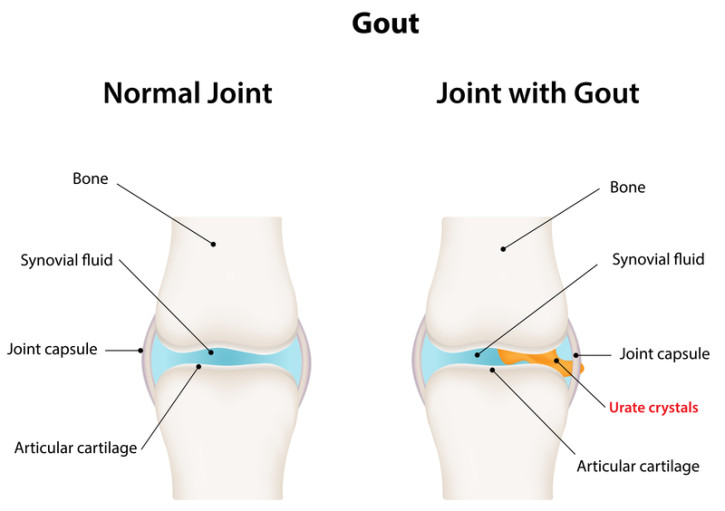
Remember that your gout problem has actually been brewing for quite some time, possibly years. Gout is caused by uric acid buildup in the blood. Uric acid is a waste product normally eliminated from your body by your kidneys. When your kidneys aren’t fully functioning and/or your body is producing too much uric acid for the kidneys to keep up, excess uric acid in the blood can become hard crystals that attach to joints and tendons, setting the stage for inflammation and painful gout. Answering the question “How long does gout last?” depends on three main factors.

Eat Right, Starting Now!
Download this expert FREE guide, Complete Nutrition: Low-carb diet, high-protein foods, healthy meal plans, how to use a calorie counter, and more.
Create healthy meal plans and discover the Superfoods that can transform your plate into a passport to better health.
1. Your Gout Symptoms
First, you need to know how to define gout, which means you need to see a doctor, at least for the first attack. Gout symptoms—swelling of the joint, inflammation, redness, and sore skin—can be associated with other diseases, too.
If gout sounds a lot like arthritis, you’re right. Gout is a form of arthritis in that it’s an inflammation of the joints. And like arthritis, the real answer to “How long does gout last?” is, unfortunately, a lifetime. The good news is that medicine and diet can make a difference in gout’s severity and frequency.
With treatment, individual episodes of a gout attack will be fewer and the length and severity lessened. Some gout sufferers never have a second episode. But untreated, gout will likely return.
2. Your At-Home Gout Treatment
Second, you can usually alleviate gout symptoms at home. The medicines your doctor prescribes are important in controlling gout over the long run, but once gout appears, your goal will be to ride it through via treatment and diet. It also helps to rest the joint as much as possible, applying cold packs as needed. Sometimes even a sock is painful to wear, so some gout sufferers cut the big toe out of their socks.
You should also drink plenty of fluids, and consider using an NSAID (non-steroidal anti-inflammatory drug), like ibuprofen, for the pain.
3. Know Which Foods Cause Gout Attacks3>
Third, with or without medicine, you have to change your diet in order to lessen the number and severity of attacks. Learn which items in your diet cause flare-ups, and avoid foods that cause gout. Most gout patients might agree that avoiding foods that cause gout is far easier than enduring another flare up.
Among the foods known to cause gout are sugary soft drinks, beer, alcohol, tomatoes, beef, pork, lamb, liver, herring, mackerel, mussels, sardines, tuna, and smelt. We’d also be careful about our intake of bacon, turkey, salmon, trout, and haddock. (See “Foods to Avoid with Gout.”) That might make you wonder what you can eat.
The list probably won’t surprise you: vegetables, low-fat dairy, cherries, and high-fiber carbohydrates are among the items that can help you avoid gout pain. Our posts “Gout Foods: Keep These 6 Foods in Your Diet” and “Add the DASH Diet to the List of Gout Remedies” discuss foods that work as part of a “gout diet.”
For more information on gout in general, see these University Health News posts:
The post How Long Does Gout Last? These 3 Factors Determine the Answer appeared first on University Health News.
Read Original Article: How Long Does Gout Last? These 3 Factors Determine the Answer »
Powered by WPeMatico
