
9. Hydration and Healthy Beverages
Meeting Your Water Needs
You’ve no doubt heard that everyone should drink eight glasses of water a day, but that’s mostly a myth. What is true is that there’s far more to hydration than counting glasses of water: In addition to water, other beverages, and even foods, can help you meet your water needs. And, one size doesn’t fit all: Various factors, including age, gender, and activity level, have an effect on your fluid needs. For most people, according to the Institute of Medicine, “fluid intake, driven by … thirst … allows maintenance of hydration status and total body water at normal levels.”
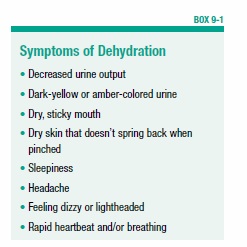
As you age, however, you may need to pay extra attention to your body’s hydration needs. Older people often have a reduced sensation of thirst, so it’s easier to miss the warning signs that you’re dehydrating (see Box 9-1, “Symptoms of Dehydration”). Older individuals also tend to have lower reserves of fluid in their bodies, and sometimes, they drink insufficient water following fluid deprivation to replenish their bodies’ water deficits. Because of this, older people may need to learn to drink fluids regularly even when they’re not thirsty.
According to the Institute of Medicine, the Adequate Intake for water for men over age 50 is 3.7 liters (almost 4 quarts) a day, which includes about 13 cups from beverages including water; the rest is typically obtained from food. For women over age 50, the AI is 2.7 liters (a little over 2.8 quarts) a day, with about 9 cups coming from water and other beverages. So, you actually do need more than eight glasses’ worth of fluids every day—but it doesn’t all have to be water.
Water Sources
As for what “counts” toward fluid intake, a study found no significant differences in hydration whether the beverages people consumed were carbonated, diet, or contained caffeine. Researchers saw no evidence that the diuretic effects of caffeinated beverages at levels typically consumed cancel out their hydration benefits, concluding: “Advising people to disregard caffeinated beverages as part of the daily fluid intake is not substantiated by the results of this study.”
An Institute of Medicine expert panel echoed that conclusion. Most Americans, the experts found, get plenty of water not only from plain water but also from food, milk, juice, and even coffee, tea, and alcoholic beverages. The share of that fluid intake coming from caloric beverages has sharply increased in recent years, however, contributing to the obesity epidemic. Total daily fluid intake by US adults increased from 79 fluid ounces in 1989 to 100 ounces in 2002—with the increase coming entirely from caloric beverages.
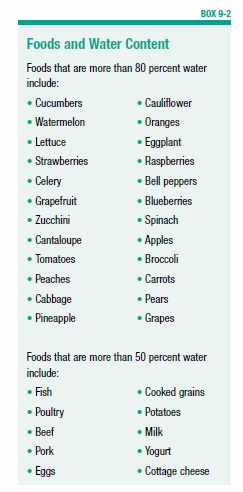
You may not think of food as a primary source of water, but foods may provide up to about 22 percent of the average American’s water intake; see Box 9-2, “Foods and Water Content,” for foods that provide plenty of fluids.
Hydration and Health
The most obvious way in which hydration affects health is in the function of the kidneys, which play a key role in regulating your body’s fluid balance. Your kidneys work more efficiently when your body has plenty of water. If your kidneys don’t receive adequate fluids, they must work harder and are more stressed.
Hydration is also important to regulating your body’s temperature through sweating. Another reason older people need to be more aware of their fluid needs is that their bodies are less able to compensate for the increased blood thickness that results from the loss of water through sweating.
Dehydration can also affect your brain, at least in the short term, though research findings on these effects are inconsistent. Mood and alertness seem to suffer the most when you don’t get enough fluids.
The Arthritis Foundation recommends drinking plenty of water and other liquids to combat the inflammation associated with arthritis. “Prehydrating”—drinking water before you exercise, not just after you’ve worked up a sweat—can help people with arthritis engage in physical activity with less discomfort. Increasing fluid intake may also help reduce the recurrence of gout.
Not surprisingly, strong evidence links good hydration with a reduced risk of kidney stones and other stones in the urinary system.
For combating constipation, getting enough dietary fiber is more important than drinking plenty of water, although increasing your fiber intake means you also need more water to help the fiber bulk up and do its job.
Tea Time
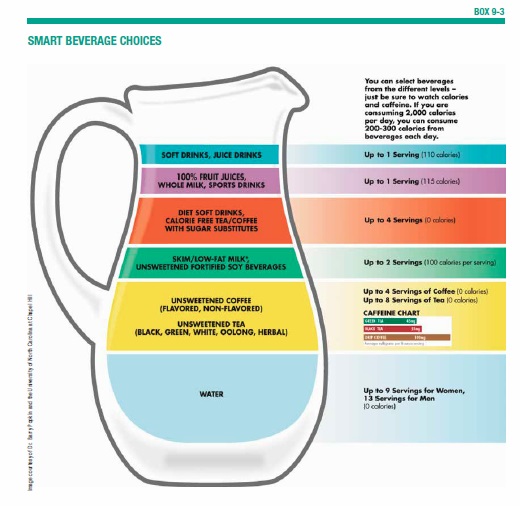
Besides water, you can also boost your odds of healthy aging with the beverages you drink (see Box 9-3, “Smart Beverage Choices,” on page 87). Certain beverages have been linked to improved health and reduced risk of chronic diseases. The most convincing evidence is for health benefits of tea and coffee. You can think of these beverages as a form of “liquid plants,” since they are derived from plants and retain many of their sources’ healthy nutrients.
The US lags far behind Britain, China, and Japan in per capita tea consumption—Americans drink less than one-fifth as much tea as the British, for example. But Americans may need to start steeping and sipping more if we want to be healthier.
“If there’s anything that can confidently be communicated to the public, it’s the strong association of tea drinking with a lower risk of common chronic diseases, particularly heart disease, and the demonstration of that benefit through clinical trials,” says Jeffrey B. Blumberg, PhD, director of Tufts’ HNRCA Antioxidants Research Laboratory and chair of the Fifth International Scientific Symposium on Tea and Human Health.
“About one-third of the weight of a tea leaf is flavonoids, which is high, especially when you consider that they are accompanied by virtually no calories,” Dr. Blumberg explains. “There are a lot of related flavonoids in fruit and vegetables, but many people aren’t consuming the amount of flavonoids in their diets as are being found necessary to promote health. Another way to get them is tea. A cup of tea is like adding a serving of fruit or vegetables to your diet.”
Hibiscus vs. Hypertension
Even if you prefer herbal teas, you might be enjoying a health boost from hibiscus. Hibiscus is one of the most common ingredients in herbal teas; it gives the beverages a fruity, tart taste and red color. This fruit of a flowering plant is rich in antioxidants including anthocyanins, flavones, flavonols, and phenolic acids. Research led by Diane L. McKay, PhD, scientific adviser for this Special Health Report, has shown that a few cups a day of herbal tea containing hibiscus can help to lower high blood pressure in pre-hypertensive and mildly hypertensive adults as effectively as some medications do.
In one study, Dr. McKay and colleagues recruited 65 pre- or mildly hypertensive volunteers, ages 30 to 70. About half of the participants drank three cups of hibiscus tea per day for six weeks, while a control group received a placebo beverage containing artificial hibiscus flavoring and color. Those who drank the hibiscus tea saw a 7.2-point drop in their systolic blood pressure, significantly more than the placebo group. Those results are comparable to that delivered by standard blood-pressure medications. Participants with the highest blood pressure at the study’s start showed the most significant reductions.
Other studies have linked non-herbal tea to blood pressure benefits. In one, men with high blood pressure who drank just one cup of black tea daily saw lower blood pressure levels—even when they ate a meal of fatty, sugary food, which tends to constrict blood vessels and boost blood pressure.
A meta-analysis (a review of numerous studies) concluded that drinking three cups of tea daily was associated with an 11 percent drop in the risk of heart attacks, and other studies have suggested that green tea might help improve cholesterol and triglyceride levels.
Brew for Your Brain
Tea seems to help protect the aging brain in a variety of ways. Animal tests have shown that tea extracts reduce damage to the brain from strokes. Other animal experiments suggest that compounds in tea can help counter the loss of neuronal plasticity—the brain’s ability to adapt to new inputs—and repair injuries to the brain’s neurons associated with aging.
Green tea may specifically benefit the hippocampus, a part of the brain that’s important to memory. In a study in humans with mild memory impairment, daily supplements of green tea extract plus L-theanine (an amino acid unique to tea) for four months resulted in improved memory and mental alertness compared to a placebo. Another study using functional MRI scans found that green tea extract affects activity in an area of the brain key to memory processing.
Tea may even help protect against or slow the progression of Alzheimer’s disease: Researchers have shown that tea compounds bind to the beta-amyloid proteins in the brain associated with Alzheimer’s.
It’s possible to get too much of a good thing, especially if you’re sensitive to caffeine. But tea contains about half the caffeine of coffee, and most of tea’s benefits can be derived from decaffeinated teas (though some of the flavonoids are lost in the decaffeination process).
Additional Benefits
Other research suggests that drinking tea might also be good for your bones. In one study, 171 postmenopausal women with low bone mass were given 500 milligrams daily of green tea polyphenol capsules—the equivalent of about four to six cups of tea. After six months, the women showed indications of improved bone formation and muscle strength that could lower the risk of falls and fractures, as well as a reduction in cell damage from oxidative stress.
Tea drinking could likewise improve your overall ability to live independently, which can be affected not only by osteoporosis but also by factors such as stroke and cognitive impairment. A study on “functional disability”—a limited ability to perform activities such as walking, dressing, and bathing—followed 14,000 older adults for three years. Those who reported consuming five or more cups of green tea daily were about 50 percent less likely to develop functional disability than those drinking less than a cup daily.
Coffee Break
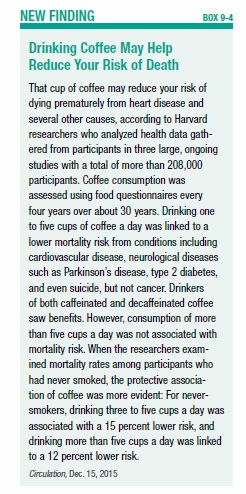
Drinking coffee has also been associated with a wide range of health benefits—so much so that the latest 2015-2020 Dietary Guidelines for Americans mention coffee specifically. The guidelines followed evidence that drinking three to five eight-ounce cups a day (up to about 400 milligrams of caffeine) was associated with minimal health risks and possible benefits. The ink was barely dry on that advice when another study reported that people who drink up to five cups a day have a lower mortality risk (see Box 9-4, “Drinking Coffee May Help Reduce Your Risk of Death”).
What about concerns that the stimulant effect of caffeine might lead to atrial fibrillation? (Atrial fibrillation, or AFib, is the most common type of arrhythmia—a problem with the rate or rhythm of the heartbeat. Even when AFib produces no symptoms, it can increase the risk of stroke.) A 2014 meta-analysis concluded that it’s unlikely habitual caffeine intake from coffee and other dietary sources increases risk; in fact, the analysis found that AFib risk fell with increasing
caffeine intake.
Coffee vs. Diabetes
Another study suggests that increasing your coffee consumption might lower your risk of developing diabetes. Scientists analyzed data on more than 120,000 adults in three large, long-running studies and documented 7,269 cases in which participants developed type 2 diabetes. People who increased their coffee intake by more than one eight-ounce cup per day over a four-year period were 11 percent less likely to be diagnosed with diabetes during the subsequent four years—but participants who decreased their coffee consumption by more than a cup per day were at 17 percent greater risk of type 2 diabetes.
Shilpa N. Bhupathiraju, a research fellow at Harvard University who earned her PhD from Tufts’ Friedman School, and colleagues also looked at changes in tea consumption and found no similar association with type 2 diabetes risk; other research, however, suggests a benefit of overall tea consumption against type 2 diabetes.
“It’s not the caffeine in the coffee,” Dr. Bhupathiraju commented, noting that effects on glucose metabolism have previously been found in studies of decaffeinated coffee. “We know that. But coffee has a lot of antioxidants and other bioactive compounds.”
She added that drinking more coffee is not a substitute for an overall healthy lifestyle in preventing diabetes. “If you’re going to eat a doughnut and smoke while having coffee, the coffee won’t help.”
Dosing your latté with loads of caloric sweeteners, full-fat dairy, or additions like caramel would cancel out any health benefits, as well.
Advice on Alcohol
Alcoholic beverages come with far more cautions due to the many harmful effects that may result from alcohol abuse and dependence. However. moderate alcohol consumption has been linked to a reduced risk of cardiovascular disease, and the resveratrol compounds in red wine are being studied for a wide range of health effects. Moderate drinking may also reduce osteoporosis risk in postmenopausal women by slowing the rate of bone “remodeling”—the body’s ongoing replacement of old bone with new.
The latest Dietary Guidelines for Americans advises women who choose to drink alcoholic beverages to limit intake to one glass a day and men to stop at two drinks (see Box 9-5, “Standard Drink Sizes”). Overdoing it has health consequences including liver damage and increased cancer risk, as well as social, psychological, and legal risks.
Older adults need to be especially cautious with their alcohol use: According to AARP, one in 10 older adults who drink alcohol are “at risk” of excessive or potentially harmful alcohol use.
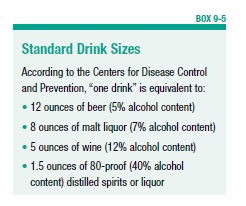
Even if you could “hold your liquor” when you were younger, your body’s ability to metabolize alcohol declines with age; this is especially true with women. The National Institute on Alcohol Abuse and Alcoholism suggests that people over age 65 limit themselves to no more than one alcoholic drink a day, and not more than two on any occasion. High levels of alcohol in the body can mask or worsen symptoms of stroke, diabetes, memory loss, heart disease, or mood disorders. In older adults, alcohol is also more likely to reduce or heighten the effect of medicines you may be taking.
Avoid Sugary Beverages
You also need to be wary of beverages sweetened with sugar, high-fructose corn syrup, and other types of sugar, such as sodas, sports drinks, “gourmet” tea and coffee drinks, and juice drinks that are not 100% fruit juice. Such beverages are major contributors to the obesity epidemic, accounting for almost half the added sugar in the American diet.
For the first time, the Dietary Guidelines for Americans call for limiting added sugars to less than 10 percent of calories per day. In a 2,000-calorie daily diet, that means no more than 200 calories from added sugars, or roughly 12 teaspoons—about the amount in one regular 16-ounce soft drink. Naturally occurring sugars such as those in milk or fruits don’t count toward this limit, because they are accompanied by valuable nutrients, such as calcium, protein, fiber, and vitamins. However, sugary drinks contribute only calories.
Not so Sweet for Your Heart
Sugar-sweetened beverages might be bad for your heart even beyond their effects on weight gain, hypertension, and type 2 diabetes. A 2014 analysis of dietary data found an association between consumption of added sugar and a higher risk of death from cardiovascular disease.
Non-diet soft drinks stood out in the analysis as contributors to cardiovascular disease leading to death. Participants who averaged seven soda servings per week—just one a day—were 29 percent more likely to die from cardiovascular causes than those consuming less.
The study was based on data on nearly 43,000 participants in the National Health and Nutrition Examination Survey, who were followed for up to 22 years. Those who reported consuming 25 percent or more of their calories from added sugars—one in 10 participants—were at nearly double (175 percent) the risk of dying from cardiovascular disease. Even those getting 10 to 24.9 percent of calories from added sugars were 30 percent more likely to die of cardiovascular causes than those consuming less than 10 percent.
How much sugar does it take to total 10 percent of calories? In a 2,000-calorie daily diet, one-and-a-half 12-ounce cans of regular soda—containing about 35 grams of sugar per can—will take you over the 10-percent mark.
Links to Liver Risk
Recent Tufts research also founds that sugary drinks may increase your odds of developing non-alcoholic fatty liver disease (NAFLD). NAFLD, which is characterized by a buildup of fat in the liver unrelated to alcohol consumption, frequently goes undetected because it often produces no symptoms; as many as 25 percent of US adults may have the disease. NAFLD may cause the liver to swell and become inflamed, which may lead to scarring (cirrhosis) and, eventually, to liver failure.
Researchers analyzed 2,634 dietary questionnaires from participants in the Framingham Heart Study. The sugar-sweetened beverages on the questionnaires included caffeinated- and caffeine-free colas, other carbonated beverages with sugar, fruit punches, lemonade, or other non-carbonated fruit drinks. (A serving size was considered a glass, bottle, or can of these beverages.) Participants underwent a CT scan to measure the amount of fat in their livers. The study found a higher prevalence of NAFLD among people who reported drinking more than one sugar-sweetened beverage per day compared to people who said they drank none. This association persisted after adjusting for age, sex, body mass index, and dietary and lifestyle factors such as calorie intake, alcohol, and smoking.
Sugar-sweetened beverages are a major dietary source of fructose, the sugar that is suspected of increasing the risk of NAFLD because it is metabolized by the liver, where it may be converted into fats called triglycerides.
Are Diet Sodas Safe?
You may be reluctant to switch from sugar-sweetened soft drinks to diet sodas because of safety concerns. Most of these worries are urban legends and unsubstantiated Internet rumors. According to the FDA, “Food safety experts generally agree there is no convincing evidence of a cause-and-effect relationship between these sweeteners and negative health effects in humans. The FDA has monitored consumer complaints of possible adverse reactions for more than 15 years.”
Questions have also been raised about whether non-caloric sweeteners might somehow nonetheless contribute to weight gain. While it’s best not to overdo diet drinks, Tufts experts say artificial sweeteners remain an acceptable option for people who are working to control their weight—but that water should be your first choice.
Sodas and Your Bones
Another Tufts study suggests that consuming lots of cola drinks—even diet colas—might be bad for your bones. In the study, women who drank three or more cola drinks daily had lower bone mineral density (BMD) in areas at the top of their femurs (the bone that runs from the hip to the knee), which is a common site for fractures. However, in men, there was no link between cola consumption and lower BMDs, and consumers of non-cola soft drinks did not have lower BMDs.
The culprit might be phosphoric acid, an ingredient found in cola drinks but not other flavors of sodas. Caffeine, also found in colas but not most other soft drinks, can interfere with calcium absorption, and the study found greater risk from caffeinated sodas.
It’s also true that people who drink lots of soft drinks of any type tend to drink less milk, which reduces their intake of calcium necessary to build healthy bones. If you’re an all-day soda drinker, check out the previous chapter on the health benefits of reduced-fat dairy—and consider substituting good old water for some of those sodas. You’ll save money as well as your health.
Summary
Whether you are making choices about what to put on your plate or what to pour in your glass, cup, or mug, it’s clear that what you put into your body affects how your body ages. Following a scientifically proven nutrition plan such as that shown in Tufts MyPlate for Older Adults can help you minimize your risks of illness and disease and live healthier longer.
The post 9. Hydration and Healthy Beverages appeared first on University Health News.
Read Original Article: 9. Hydration and Healthy Beverages »
Powered by WPeMatico
