
8. Understanding Fats
Complex Chemistry
Making smart choices about fats and oils is not as simple as proponents of this product or that fad diet would have you believe. Common vegetable oils, as well as animal fats, such as butter, lard, and the fats in meat and dairy, contain a mix of different types of fatty acids. Olive oil is mostly oleic acid, for example, while safflower oil is rich in linoleic acid. Coconut oil, which some are now claiming has a wide range of health benefits, is high in lauric acid.
Based on their fundamental chemistry, these fats are grouped into saturated, monounsaturated, and polyunsaturated fats. Even oils that are considered “heart-healthy,” such as soybean and canola oils, contain both kinds of unsaturated fat, omega-3 and omega-6 fatty acids, and a small amount of saturated fat. (The type of omega-3 fatty acid they contain, however, are different from the type of omega-3 fatty acid found in fish and fish oil.)
When evaluating health claims and warnings for fats and oils, keep this complexity in mind. Besides being high in calories—which are the same in all types of fats—the most important property of different fats is their effect on LDL (“bad”) cholesterol. Saturated fatty acids composed of chains of 12 to 16 carbon atoms—including lauric acid, myristic acid, and palmitic acid—have the greatest effect on increasing LDL cholesterol levels. Not surprisingly, these are the fatty acids most prominent in animal products and tropical oils (palm, palm kernel, and coconut).
In addition to raising LDL cholesterol, saturated fatty acids also raise levels of the good HDL (“good”) cholesterol, but not enough to offset the harmful effects of the higher LDL cholesterol. Sometimes, healthcare professionals speak of this in terms of the LDL/HDL cholesterol ratio: The lower the ratio—the more HDL cholesterol compared to LDL—the better.
Is Butter Really Back?
You may have seen headlines that announced, “Butter is back.” In 2014, a review published in Annals of Internal Medicine, for which researchers analyzed more than 70 studies that had a total of more than 600,000 participants, produced surprising results. The researchers concluded that “current evidence does not clearly support cardiovascular guidelines that encourage high consumption of polyunsaturated fatty acids and low consumption of total saturated fats.”
Not so fast, says Alice H. Lichtenstein, DSc, director of Tufts’ HNRCA Cardiovascular Nutrition Laboratory. “The conclusions of an extensive review—conducted by a group of researchers with an extensive range of backgrounds in the area of nutrition and cardiovascular disease risk, released by the American College of Cardiology and the American Heart Association—found strong evidence for a link between saturated fat (butter, cheese, fatty meat) and heart disease,” she points out. “Particularly in an era when dietary restraint is not our strong suit, returning to butter and fatty cuts of meat may likewise return us to the high rates of heart disease we had decades ago—not a place that any of us wants to see again.”
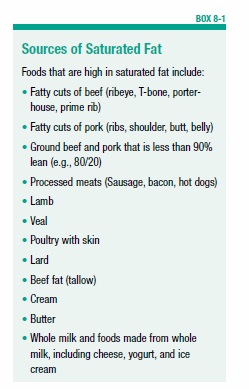
To trim foods from your diet that are high in saturated fat, see Box 8-1, “Sources of Saturated Fat.” Which foods provide the most saturated fat in the American diet? According to research conducted by the National Cancer Institute, these 10 foods contribute more than 50 percent of the saturated fat consumed in the US:
- Regular cheese
- Pizza
- Grain-based desserts (pies, cakes)
- Dairy desserts (ice cream, cheesecake)
- Chicken and chicken mixed dishes
- Sausage, franks, bacon, and ribs
- Burgers
- Mexican mixed dishes
- Beef and beef mixed dishes
- Reduced-fat milk.
Dr. Lichtenstein references another study that further illustrates the link between saturated fats and negative health consequences, which found “strong evidence to support that plasma saturated fats and trans fats can predict all-cause death and cardiovascular disease more effectively than other fatty acid markers.”
Rethinking Risks
What’s a confused consumer to make of these studies? “When considering different components of the diet, it is rarely an either/or situation,” Dr. Lichtenstein notes. “When one component of the diet increases, another decreases. Choosing to focus on one, and not the other, can result in questionable conclusions.”
Some experts caution that focusing on individual nutrients may never solve heart disease. The results from various studies on saturated fat, for example, may be at odds because it’s only one contributor to heart disease. Many health experts now emphasize that your overall dietary pattern is more important than concerning yourself with single nutrients or foods.
A Heart-Healthy Choice
It’s also worth mentioning the findings from a subsequent study that didn’t garner as many headlines—perhaps because its findings weren’t so encouraging to butter lovers. That research found that people who swap five percent of the calories they consume from saturated fat sources such as red meat and butter with foods containing linoleic acid—the main polyunsaturated fat found in vegetable oils, nuts, and seeds—saw a nine percent lower risk of coronary heart disease events and a 13 percent lower mortality risk from coronary heart disease.
Results also showed that the more linoleic acid consumed, the lower the risk of heart disease. Compared to those with the lowest intake, those who consumed the most dietary linoleic acid had a 15 percent lower risk of heart-disease events and a 21 percent lower risk of coronary deaths. The results were independent of common risk factors such as smoking and other dietary factors.
The researchers also found another benefit associated with linoleic acid: Substituting: five percent of calories from carbohydrates with an equivalent number of calories from linoleic acid was associated with similar reductions in the risk of heart disease.
“This is a very important study,” says Dr. Lichtenstein. “Prior work has not consistently taken the replacement dietary component—fat or carbohydrate—into consideration when drawing conclusions about the effects of saturated fat in the diet and heart-disease outcomes. This study has accomplished this, focusing on the effect of swapping out saturated fat and replacing it with polyunsaturated fat. The results are clear and consistent with current dietary guidance—there is a benefit.”
Smart Fat Switches
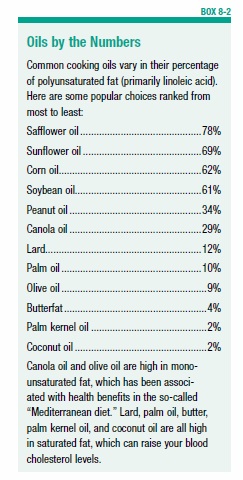
Linoleic acid is the primary omega-6 polyunsaturated fatty acid in the Western diet, found in liquid vegetable oils such as soybean, sunflower, safflower, and corn oils (see Box 8-2, “Oil by the Numbers”), as well as nuts and seeds. A tablespoon of soybean or corn oil contains about 7 to 8 grams of linoleic acid, and seven shelled walnuts provide about 11 grams. Consuming about two to three tablespoons of vegetable oil daily will provide you with enough linoleic acid to meet the Institute of Medicine’s Adequate Intake recommendations of 14 grams per day for men over age 50 and 11 grams per day for women over age 50.
Says Dr. Lichtenstein, “The emphasis should be on replacing animal fat with these sources of linoleic acid, not on adding sources of linoleic-acid-rich foods or oils to the diet.”
A review of the evidence in 11 different studies similarly concluded: “To prevent coronary heart disease, saturated fatty acids should be reduced and replaced with polyunsaturated fatty acids among all middle-aged and older women and men.” In the pooled data, switching from saturated fat to polyunsaturated fat for five percent of calories reduced the risk of coronary events by 13 percent and the risk of coronary deaths by 26 percent—even after adjusting for other lifestyle factors.
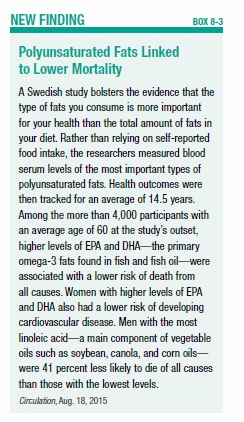
According to the World Health Organization, “The most effective replacement for saturated fatty acids in terms of coronary heart disease outcome are polyunsaturated fatty acids, especially linoleic acid. This finding is supported by the results of several large randomized clinical trials, in which replacement of saturated and trans fatty acids by polyunsaturated vegetable oils lowered coronary heart disease risk” (see Box 8-3, “Polyunsaturated Fats Linked to Lower Mortality”).
Stop Worrying about Total Fat
While you should still be cautious about saturated fat, you can put aside concerns about total fat consumption, except as it contributes to your total calorie intake. The 2015 report of the Dietary Guidelines Advisory Committee (DGAC) notably omitted any upper limit on total fat consumption, as did the 2015-2020 Dietary Guidelines for Americans. The DGAC noted that reducing total fat intake by substituting carbohydrates does not reduce cardiovascular risk, concluding, “Dietary advice should put the emphasis on optimizing types of dietary fat and not reducing total fat.”
This position change on total fat runs counter to 35 years of nutrition policy. In 1980, the federal Dietary Guidelines first recommended limiting dietary fat to less than 30 percent of calories. Since one gram of fat—regardless of the type of fat—contains about 9 calories, in a 2,000-calorie daily diet, that advice translated to a maximum of 65 grams of fat per day. Twenty-five years later, the 2005 Dietary Guidelines recommended aiming for a range of 20 to 35 percent of calories from total fat. However, the percentages used in the Nutrition Facts panel continue to be based on the 1980 recommendation of 30 percent, or 65 grams per day.
Fat is a concentrated source of calories—that 9 calories per gram of fat compares to 4 per gram of protein or carbohydrate—so limiting fat intake seemed like a sound strategy for preventing obesity. But, the overemphasis on reducing total fat intake led many people to substitute high-carbohydrate, processed foods—many of which contained refined, white flour and high amounts of sodium and/or added sugar—for fats. Replacing fats with processed carbohydrates backfired as an anti-obesity strategy: Between 1980 and 2000, obesity rates among US adults doubled.
The realization that all fats are not equal and not all should be avoided has been slow to penetrate official standards as well as the popular mindset, however. It’s not just the Nutrition Facts panel that’s behind the times: The FDA’s definition of “healthy” as a claim allowed on packaging still includes a requirement that a product be low not just in saturated fat but also in total fat.
Consumers haven’t gotten the message about total fat, either. A recent Gallup poll found that a majority of Americans are still trying to cut down on their intake of all fats.
Trans Fat: A Special Case
Trans fat—once hailed as a healthy alternative to butter and shortening—is considered to be the worst of all fats when it comes to heart health. Trans fat increases LDL (“bad”) cholesterol and, unlike saturated fat, does not increase HDL (“good”) cholesterol.
Experts advise avoiding manmade trans fat altogether—which will soon be much easier to do. Trans fat in the form of partially hydrogenated oils will all but disappear from the US food supply by June 2018. The US Food and Drug Administration announced in 2015 that trans fat will no longer be considered “generally recognized as safe,” effectively placing a ban on it. The agency gave the food industry three years to reformulate products without trans fat or to petition for specific, limited uses, such as in “sprinkles” atop ice cream.
Use of trans fat has dropped by about 80 percent since 2003, when the FDA announced it would begin requiring levels to be disclosed on Nutrition Facts panels by 2006. The latest FDA move follows a long accumulation of scientific evidence that trans fat contributes to heart disease.
Trans fats have an unusual chemical structure that is commercially created by adding hydrogen to liquid vegetable oils. The process of “partially hydrogenating” these otherwise healthy polyunsaturated fats makes them solid at room temperature and increases their shelf life. (“Fully” or “completely” hydrogenated oils do not contain trans fats.)
Although food manufacturers began shifting away from partially hydrogenated oils after the FDA required labeling, these oils continue to be used in some cake frostings, baking mixes, microwave popcorn, frozen pizzas and other frozen foods, baked goods, fried foods, coffee creamers, and even chewing gum. Some restaurants still use trans fat for frying and baking, although some city and state ordinances prohibit their use.
Until the ban takes effect in 2018, how can you be sure foods you buy are free of trans fat? First, be aware that the Nutrition Facts label can be misleading: Seeing “0% trans fat” on the label is not a guarantee that the food is actually free of trans fat, because the FDA allows foods with less than 0.5 grams of trans fat to be labeled as zero. Though this is a small amount, it can add up quickly, especially if you are eating several foods each day that contain trans fat. A foolproof way to find out if a food contains trans fat is to check the ingredients list; if you see the term “partially hydrogenated” (for example, “partially hydrogenated soybean oil” or “partially hydrogenated palm oil”), the product does contain trans fat.
If you’re not a numbers checker or a label reader, follow this rule of thumb to avoid trans fat: Eat whole and minimally processed foods as often as possible, and skip highly processed food products, fast foods, and fried foods.
Fat Fads vs. Facts
You will also read a lot of misinformation and half-truths about fats on websites (“7 Reasons Why Butter is Good For You”), product promotions (“50 Ways to Use Coconut Oil to Better Your Life”), and even in newspaper articles and popular magazines. If science is still debating how and how much saturated fat affects heart disease risk—the subject of countless large-scale studies—it’s unlikely that these far-less-tested assertions are worthy of dietary changes. Here’s a look at some popular notions as yet unproven by the evidence:
- Claim: Saturated fat changes LDL cholesterol from small, dense, and very harmful molecules to large LDL molecules, which are benign.
Says Tufts’ Dr. Lichtenstein, “The data on this are interesting but limited, and it is unclear how generalizable the available data are. There have been no intervention studies that show changing LDL particle size decreases heart disease risk—but there have been intervention studies that show substituting saturated fats with polyunsaturated fats decreases rates of cardiovascular disease.”
- Claim: Monounsaturated fat is healthier than polyunsaturated because it doesn’t oxidize.
“There is little evidence to support this claim,” says Dr. Lichtenstein. “Most of the data suggest a stronger inverse association between polyunsaturated fatty acids and risk of cardiovascular disease than monounsaturated fatty acids.”
- Claim: Short- and medium-chain fats are metabolized differently and lead to improved satiety and increased fat burning.
“It is an interesting hypothesis; however, I have not seen adequate data to support the claim,” says Dr. Lichtenstein. This claim is often made for the lauric acid in coconut oil. (Short-chain fatty acids contain fewer than six carbons in length, while medium-chain fatty acids contain six to 12 carbons, and long-chain fatty acids have 14 to 24 carbons.) It’s true that some small studies using pure, medium-chain fatty acids have shown a modest reduction in body weight, but studies actually using coconut oil (which is 44 percent lauric acid) have not achieved similar results.
- Claim: Coconut oil boosts brain health and prevents dementia.
One recent study found that coconut oil helped protect mouse cortical cells in the lab. But it’s much too soon to jump from this to the conclusion that coconut oil is similarly good for human brains. The 2015-2020 Dietary Guidelines specifically mention coconut oil as a source of saturated fat to be avoided, suggesting scientific skepticism about the faddish health claims made for coconut-oil products.
You may also read about various fats having antioxidant or anti-inflammatory properties. One study found, for example, that palmitic acid has antioxidant effects. But whatever (as yet unproven) benefits these antioxidants might have in fighting “free radicals” can’t outweigh this saturated fat’s effects on increasing LDL cholesterol.
Healthy fats should have an important place in your diet, but don’t lose sight of the big picture: You should give at least as much attention to reducing refined carbohydrates and sugars as to cutting back on saturated fat and avoiding trans fat. As we’ve seen throughout this book, a diet rich in vegetables, fruits, whole grains, vegetable oils, nuts and seeds, legumes, fish, and low-fat dairy products is the basis for a dietary pattern that supports healthy aging.
The post 8. Understanding Fats appeared first on University Health News.
Read Original Article: 8. Understanding Fats »
Powered by WPeMatico
