
5. Make Half Your Grains Whole
Fiber for Your Heart
You can obtain much of the dietary fiber you need by eating grains. Tufts’ MyPlate for Older Adults provides examples of choices that are high in fiber, such as whole and fortified grains and 100% whole-wheat bread. Fiber from grains is known as “cereal fiber,” a term that applies to the fiber in foods such as brown rice, millet, barley, and bulgur wheat, not just to your morning breakfast cereal.
Higher cereal fiber intake is associated with a lower risk of cardiovascular disease, and a recent study found cereal fiber is also associated with a decreased risk of dying after surviving a first heart attack. Researchers analyzed pre- and post-heart attack data on more than 4,000 people for a period of nine years. The patients who increased their cereal fiber intake after a first heart attack were 35 percent less likely to die of cardiovascular causes than patients whose cereal fiber intake didn’t increase.
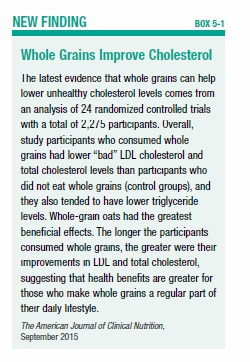
Why does dietary fiber help protect your heart? Greater intake of dietary fiber improves glycemic response and insulin sensitivity and aids in regulation of blood sugar levels, which in turn contribute to better heart health and a reduced risk of diabetes (diabetes is a risk factor for heart disease). Research has also shown that consuming soluble fiber (the type that absorbs water) modestly reduces levels of LDL (“bad”) cholesterol in your blood. The beneficial effects of fiber go beyond what can be achieved just by reducing saturated and trans fats and dietary cholesterol (see Box 5-1, “Whole Grains Improve Cholesterol”). In addition, consuming fiber can make you feel full more quickly and help the feeling of fullness last longer, so you may eat fewer total calories, which reduces your risk of obesity and heart disease.
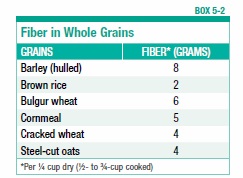
Fewer than five percent of all Americans eat the recommended amount of fiber, which is 25 grams per day for women ages 18 to 50 and 38 grams for men ages 18 to 50. Calorie needs decrease as you get older, and so does the recommendation for fiber; for women and men over age 50, it drops to 21 grams per day and 30 grams per day, respectively. The % Daily Value (% DV) for fiber shown on Nutrition Facts labels is based on a daily recommendation of 25 grams. But you may not be reaching any of these targets: The average American eats only 10 to 15 grams of fiber per day. Eating more whole grains and fewer refined grains, such as breads and other products made with white flour, will get you closer to your daily fiber goal; see Box 5-2, “Fiber in Whole Grains,” for the amount of fiber in some whole grains.
Healthy Whole Grains
When choosing cereal and other grains, you’ll get the most nutrients by following the Dietary Guidelines for Americans’ advice to “make [at least] half your grains whole.” For everyone age nine and older, for whom the recommendation is a total of six or more grain servings per day, that’s three servings (three ounces by weight) or more of whole grains per day—and most Americans average only about one-third that amount.
For example, you can meet your minimum whole-grain needs for one day by eating one cup of 100% whole-grain ready-to-eat breakfast cereal, one slice of 100% whole-grain bread, and a half-cup of cooked brown rice or whole-grain pasta.
A recent study that combined data from two large, ongoing research projects totaling more than 117,000 participants underscores the health benefits associated with diets rich in whole grains. Each additional one-ounce serving of whole grains daily was associated with a five percent lower overall mortality risk and a nine percent reduction in death from cardiovascular causes. The participants who consumed the most whole grains saw a nine percent total risk reduction and a 15 percent lower cardiovascular mortality risk compared to the group with the lowest intake of whole grains.
The findings also showed the importance of substituting whole grains for less-healthy choices, not simply adding them to your diet (which would also add calories). Substituting one serving of whole grains daily for the same amount of refined grains was associated with an eight percent lower mortality risk, mostly from cardiovascular causes. For example, that could mean switching your breakfast cereal to one that is 100% whole grain, or replacing a half-cup of cooked white rice with brown rice. Eating one daily serving of whole grains instead of one serving of red meat was linked to a 20 percent drop in cardiovascular mortality.
Higher whole-grain consumption was not associated with a lower overall risk of cancer mortality. In men, however, eating more whole grains was linked to a lower risk of mortality due to colorectal cancer.
Improving Cholesterol Numbers
If you’re over age 40, the odds are nearly one in four that you’re taking a statin medication to improve your cholesterol levels. Recent Tufts research suggests that patients taking statins should also consider consuming more whole grains. This research showed that statin users who also consumed more than 16 grams a day of whole grains had healthier cholesterol levels than statin patients who ate fewer whole grains.
The Tufts cholesterol study was based on data from 4,284 adults age 45 and older who participated in a national nutrition and health survey. All participants had total cholesterol and non-HDL-cholesterol levels measured; 25 percent of the participants reported they were taking a statin medication. After adjustment for demographic and lifestyle factors, the non-HDL-cholesterol levels (calculated from total cholesterol, HDL, and triglycerides) were significantly lower in statin users than in nonusers, as would be expected. (Non-HDL-cholesterol, like LDL-cholesterol, is used as a predictor of risk for cardiovascular events, such as heart attack and stroke; the higher the non-HDL level, the higher the risk.)
However, people who combined statins plus whole grains had even better cholesterol numbers: Statin patients who consumed more than 16 grams of whole grains each day had non-HDL-cholesterol levels that were 11 milligrams per deciliter lower than those who took statins but ate a smaller amount of whole grains. Significant interactions were also observed between statin use and whole-grain intake in relation to total cholesterol/HDL-cholesterol ratios and elevated total cholesterol concentrations.
How much is 16 grams of whole grains? According to the Whole Grains Council, you can obtain about 16 grams of whole grains from foods such as:
- 4 Triscuit crackers
- 2⁄3 cup of Cheerios
- 1⁄3 cup of Wheat Chex
- 2⁄5 cup of cooked oatmeal
- One slice of whole-grain bread
- ½ whole-grain English muffin
- 1⁄3 cup of cooked whole-wheat pasta
- 1⁄3 cup of cooked brown rice, bulgur, barley, or other cooked grain.
Even if you’re not taking statins, upping your whole-grain intake is a good idea if you’re concerned about cholesterol. One study reported that healthy middle-age adults lowered total cholesterol by 4.3 percent and LDL (“bad”) cholesterol by 4.9 percent by eating whole grains instead of refined grains. Other studies have linked consumption of specific whole grains, including oats, barley, sorghum, and amaranth, to healthier cholesterol levels.
Identifying Whole Grains
Whole grains and foods made from them contain the entire grain seed—all of the parts in their original proportions, including the naturally occurring nutrients. According to the Dietary Guidelines, if the grain has been cracked, crushed, or flaked, a food must retain the same relative proportions as they exist in the intact grain to be called a “whole grain.” This means that 100 percent of the original grain—all of the bran, germ, and endosperm—must be present to qualify as a whole grain. Refined grains retain only the inner (endosperm) portion of the original seed, sacrificing a lot of healthy nutrients, including up to two-thirds of the fiber.
If a food package does not contain the Whole Grain Stamp from the Whole Grains Council (see Box 2-2 on page 23), look at the ingredients list for such phrases as “100% whole [name of grain].” All of these ingredients indicate that a product contains whole grains:
- Whole grain [name of grain]
- Whole wheat
- Whole [name of grain]
- Stoneground whole [grain]
- Brown rice
- Oats, oatmeal (including old-fashioned and instant oatmeal)
Other ingredients, according to the Whole Grains Council, indicate only a “maybe”; these include wheat, wheat flour, semolina, durum wheat, organic flour, stoneground (without “whole”), and multigrain. Words that never describe whole grains include enriched flour and degerminated corn meal. Terms like wheat germ and oat bran indicate that supplemental fiber was added to the product.
Build a Better Breakfast
Your first opportunity to enjoy more whole grains comes at breakfast. If you’re already starting your day with a bowl of hot oatmeal, you’re doing it right—but there are other whole-grain options for hot cereals you can consider for variety.
You might assume that all hot cereals—like good old oatmeal—are whole-grain choices. But Cynthia Harriman, director of food and nutrition strategies at the Whole Grains Council, cautions, “While oatmeal (all versions, from instant to steel-cut) is always whole grain, and most other multigrain choices are whole grain, some popular longtime cereals, such as the original Cream of Wheat (farina), are not whole grain—although now, there’s a special whole-wheat version of Cream of Wheat. The original Cream of Rice is also not a whole-grain cereal.”
Even when you’re buying a whole grain like oatmeal, the way it’s processed can make a difference. “Avoid instant when possible,” says Harriman. “Although instant oatmeal is a whole grain, with the same nutrition as rolled oats or steel-cut oats, it has a higher glycemic index than regular oats because it breaks down more quickly. Steel-cut oats are the best choice for supplying the slow, steady stream of blood sugar that supports good health.”
If you don’t want to cook up a big batch in advance, you aren’t losing much time buying “quick” rather than “instant” varieties—most “quick” hot cereals cook up in five minutes or less.
Watch out for added sugar, too. Buy plain cereals instead, and add your own finishing touches: dried fruit, nuts, or fresh or canned fruit. Even if you add a touch of sugar, honey, or maple syrup, you’ll doubtless end up with a lot less sugar than in the packaged, sweetened varieties that contain as much as 12 grams, or three teaspoons, of sugar in one serving. Spices like cinnamon and nutmeg can also help you add flavor and the perception of sweetness.
Whole Wheat for Smarter Sandwiches
At lunchtime, it’s easy to substitute whole grains for refined grains by building your sandwiches with whole-wheat bread. If you’re concerned about calories, you can find ultra-slim options with as little as 45 calories per slice, or sandwich “thins” that provide 100 calories total.
A recent diet fad has given rise to concerns about eating any product containing wheat, however. Popular books have warned that wheat consumption is a key contributor to abdominal fat (a condition termed “wheat belly”), as well as triggering diseases ranging from diabetes to rheumatoid arthritis, and that eating wheat is linked to Alzheimer’s disease and depression.
“It is true that Americans over-consume refined wheat products—energy-dense, nutrient-poor foods that are high in sugar and fat—so wheat is often a ‘co-passenger,’” says Nicola McKeown, PhD, an assistant professor at Tufts’ Friedman School of Nutrition Science and Policy and a scientific advisor to the Whole Grains Council. “Yes, cutting out these refined foods will lead to weight loss. However, the trouble lies in the message that wheat is the culprit. There is a lack of scientific evidence to support the claims that eating wheat is an independent risk factor for greater abdominal adiposity or weight gain. From my perspective, education on how to identify healthier whole-grain options to replace refined grains, and how to incorporate ancient grains/seeds into our diets, is what is important.”
Research by Dr. McKeown and colleagues has shown that substituting whole grains for refined grains is associated with less belly fat. Cutting back on wheat-containing pastries, snacks, and other processed foods that are also sources of sugar and saturated fat is a good idea. But replacing those unhealthy foods with whole grains, including whole wheat, will help you control your weight—not pack on a mythical “wheat belly.”
The charges about wheat’s mental effects don’t stand up to scientific scrutiny any better, according to Cynthia Harriman of the Whole Grains Council. Both the DASH dietary plan, designed to combat hypertension, and the Mediterranean diet include grains, she points out, and research has linked both regimens to a lower risk of dementia.
Whole Grains for Dinner and Snacks
All that being said, cereal and sandwiches shouldn’t be your only sources of whole grains. Tufts’ Dr. McKeown advises choosing a variety of whole grains, including brown rice, quinoa, barley, farro, popcorn, and wheatberries. These can find their way into your diet as side dishes, snacks, and even salad ingredients.
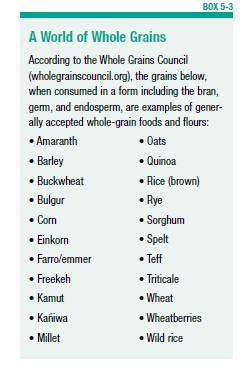
Some whole grains may be quite familiar, like good old popcorn, but others have only recently become widely available in typical supermarkets. Here we spotlight a sampling of whole grains (see Box 5-3, “A World of Whole Grains”), including some you might not have tried.
Spotlight: Quinoa—Mother of Grains
When it comes to whole grains, we’re only about 5,000 years behind the Incas. Those ancient people of the Andes were the first to cultivate quinoa (KEEN-wah), which they called chisaya mama, the mother of all grains. Today, quinoa has been designated a “super crop” by the United Nations for its potential to feed the world’s hungry, and studied by NASA as an ideal food for long-duration space flights. In a recent “What’s Hot” survey of American chefs, the National Restaurant Association named quinoa as the hottest trend in side dishes. Quinoa can be found in a variety of colors (white, red, black) and forms (grains, flakes, cereals, pasta) in most large supermarkets.
For all the excitement over this so-called “super grain,” quinoa isn’t technically a grain at all. It’s the seed of a large plant, Chenopodium quinoa or “goosefoot,” that is distantly related to spinach, beets, and chard. These seeds are protected from pests and the elements by a bitter, soapy coating called saponin. By the time it reaches grocery stores, most quinoa has had the saponin removed—but it’s still a good idea to give the grains a quick rinse and rub them together with your hands to remove any lingering traces.
What makes quinoa such a standout among “grains”? It’s one of only a handful of plant foods that supplies all the amino acids (notably lysine) necessary for a “complete” protein. Quinoa has an unusually high ratio of protein to carbohydrates, since its protein-rich germ makes up about 60 percent of the grain. A half-cup of cooked quinoa packs more than 4 grams of protein. It’s also gluten-free, making quinoa a nutritious option for people with celiac disease.
Quinoa ranks highest among all grains in potassium (159 milligrams in a half-cup), a mineral associated with reducing high blood pressure. It’s high in iron and most B vitamins and is a good source of zinc, copper, magnesium, and manganese.
Quinoa has few downsides, and is not a commonly allergenic food. People advised to reduce oxalate consumption, such as those at risk of kidney stones, should note that quinoa does contain oxalate.
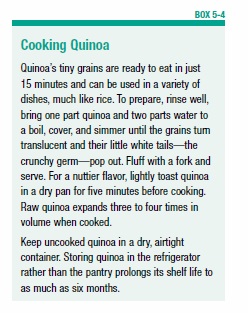
For tips on preparing quinoa, see Box 5-4, “Cooking Quinoa.”
Spotlight: Corn and Popcorn—Veggies and Grains
Corn occupies a unique position in the American diet. It’s a grain, a vegetable, a snack and cereal ingredient, an ethnic-food mainstay, a source of cooking oil, a cherished treat of summer and early fall, and even a sweetener (not to mention a fuel source). Nutritionally, corn and corn products are all over the board. On one hand, you should avoid empty-calorie sweeteners made from corn, including corn syrup and high-fructose corn syrup. On the other hand, corn can be a healthy, high-fiber whole grain.
“With respect to meal planning, sweet corn falls under the vegetable category,” says Dr. McKeown. “The dried, ground corn we eat in foods such as corn bread, grits, and polenta falls under the grain category. Make sure cornmeal, corn flour, grits, corn tortillas, and polenta packages have ‘whole corn’ or ‘whole grain corn’ listed as an ingredient; degerminated corn is not a whole grain.”
It may surprise you that popcorn is not only a popular snack but also a healthy one.
“Air-popped popcorn is an excellent whole-grain snack that provides dietary fiber—about three grams per three cups,” Dr. McKeown notes. “And, if you serve the popcorn as-is, with no added butter or salt, it is low in calories and fat and free of sugar and sodium. Popcorn falls under the ‘grain category’ for meal planning.”
Cooked corn is a good source of fiber, potassium, and niacin. Corn is relatively low in calories at 125 per cup—at long as you don’t slather it with butter. One cup of corn contains almost 5 grams of protein—more than a comparable serving of broccoli, for example.
When it is dried and considered as a grain, on a gram-for-gram basis, milled whole-grain corn is higher in vitamin A and carotenoids and slightly lower in dietary fiber than other whole grains, such as whole wheat or whole rye.
Yellow corn contains lutein and zeaxanthin, two carotenoid antioxidants that are important to eye health. The antioxidant phytonutrients in corn vary by color, with blue corn containing anthocyanins (similar to blueberries) and purple corn high in protocatechuic acid (related to compounds in green tea). White corn, which lacks these pigment compounds, is lower in antioxidants.
Although corn is a “starchy” vegetable that is high in carbohydrates and natural sugars (9 grams per cup), it releases sugar into the bloodstream steadily rather than causing a spike in blood sugar. In moderate amounts, corn has been associated with improved blood sugar control, and the American Diabetes Association includes it as a “best choice” among starchy vegetables as well as whole grains.
For tips on choosing and cooking fresh corn, see Box 5-5, “Selecting the Best Ears.”

Spotlight: Farro—“Ancient Grain”
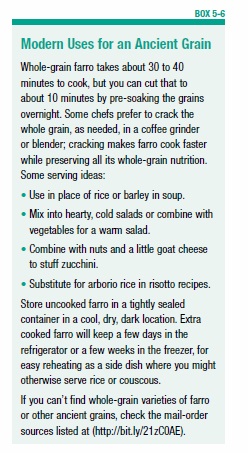
The ancient Roman legions knew something that modern chefs are now rediscovering: Farro, a form of wheat that originated in the Middle East’s Fertile Crescent thousands of years ago, offers nutrition enough to march on, along with a nutty taste and pleasantly chewy texture. Over the centuries, farro, initially called “emmer wheat” and sometimes referred to as “the pharaoh’s wheat,” was largely abandoned in favor of durum wheat, which is easier to hull and has a higher yield per acre. But farro is making a culinary comeback, as chic restaurants around the country are demonstrating: Farro is versatile enough to substitute for rice and other, more familiar grains in dishes ranging from risottos and salads to soups and breakfast bowls.
You’ll get the most nutrition by buying whole-grain farro. To make sure you’re getting whole farro, avoid labels that say “pearled,” which indicates that the outer bran has been removed. If you can’t find whole-grain farro, choose “semi-pearled” (semiperlato in Italian), which contains some of the fiber- and nutrient-rich bran.
As you might expect, farro is rich in fiber. Just a half-cup of cooked farro has 5 to 7 grams of fiber—about four times as much as a comparable amount of brown rice. (Semi-pearled farro has about 3 grams of fiber.) The complex carbohydrates in farro break down slowly, which helps regulate your blood sugar. These carbs also contain cyanogenic glucosides that have been found to stimulate the immune system and improve cholesterol levels.
Farro is also a good source of plant protein–about 7 grams in a half-cup of cooked farro. It also provides niacin (vitamin B3), which helps the body metabolize protein, carbohydrates, and fats, as well as magnesium, iron, and zinc.
Farro is an example of an “ancient grain,” a popular culinary trend in its own right—ancient grains and farro both made the National Restaurant Association’s list of 100 foods that are “hot” in 2015. Other ancient grains include several heirloom varieties of wheat, such as spelt, einkorn, and kamut. Gluten-free ancient grains include quinoa, amaranth, teff, and millet. All of these grains provide your body with beneficial fiber, protein, vitamins, and minerals.
For tips on choosing and serving farro, see Box 5-6, “Modern Uses for an Ancient Grain.”
What About Gluten?
You’ve no doubt seen “gluten free” labels on products in every supermarket aisle. Gluten, a protein found in wheat, rye, and barley, has been blamed for everything from intestinal distress to weight gain to mood swings. For people with celiac disease, a condition in which eating gluten triggers an immune reaction that damages the small intestine and decreases nutrient absorption, it’s a medical necessity—not a fad—to completely abstain from gluten.
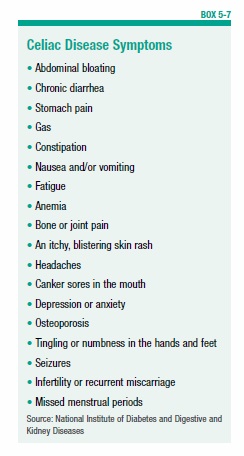
It is believed that one in 133 Americans, or less than one percent of the population, has celiac disease. However, it’s estimated that as many as 90 to 95 percent of people who have celiac disease are undiagnosed (diagnosis requires a blood test and a follow-up biopsy to confirm inflammation in the small intestine). Robert M. Russell, MD, emeritus professor at Tufts’ Friedman School, advises, “If you are having a problem with intermittent abdominal bloating and pain, unintentional weight loss, or chronic diarrhea, you should consult your doctor. A gluten-free diet will result in a prompt lessening of symptoms in those who have been diagnosed with celiac disease. It is not prudent, however to attempt to diagnose yourself by cutting out gluten-containing foods to see if you feel better. This can actually make celiac disease more difficult to clinically diagnose.”
What about “gluten intolerance” or “gluten allergies”—conditions less serious than celiac disease that can be improved by avoiding the culprit protein? A review of the evidence on non-celiac gluten sensitivity noted, “The symptoms overlap considerably with those of irritable bowel syndrome, and the number of individuals embracing a gluten-free diet is rapidly growing. No discriminative markers to support a diagnosis of gluten sensitivity have been identified; the perceived response to a gluten-free diet after exclusion of celiac disease is currently the best diagnostic and therapeutic marker.”
Many people following a gluten-free diet don’t have celiac disease, although they believe avoiding gluten will help them feel healthier or lose weight. Pamela Cureton, RD, LDN, a research dietitian at the Center for Celiac Research, says, “There is no evidence that gluten is harmful in healthy people without a gluten-related disease.”
As for weight loss, Karen Ansel, RD, a spokesperson for the American Dietetic Association, agrees: “There’s nothing in gluten that makes you gain weight.” Most people who go gluten-free lose weight simply because they eat less—for a while; cutting out a whole swath of food products likely also means cutting down on total calories.
And, gluten-free diets can come up short on nutrients. A report from the American Dietetic Association cautioned that gluten-free products averaged lower amounts of B vitamins, calcium, iron, zinc, magnesium, and dietary fiber. In addition, just because a food is gluten-free doesn’t mean it is healthy; there are plenty of gluten-free junk foods, including chips, snack foods, and sweets, that are high in calories, fat, sugar, and/or sodium but provide few, if any, valuable nutrients.
If you suspect you have celiac disease (see Box 5-7, “Celiac Disease Symptoms”), see your doctor and get tested. If you do have the disease, you will need to learn to live without gluten. Otherwise, there’s no scientifically valid reason to deprive yourself of the nutrition you’ll get from consuming moderate amounts of wheat, barley, and rye, especially in their whole-grain forms.
The post 5. Make Half Your Grains Whole appeared first on University Health News.
Read Original Article: 5. Make Half Your Grains Whole »
Powered by WPeMatico
