
9. Exercise Resources
Your Exercise Toolbox
With a little searching, you probably can find many physical activity experts and community resources to help you on your fitness journey. Whether it’s an exercise class to inspire you or a personal trainer to give you one-on-one instruction, there are a lot of options. Community fitness programs, health clubs, and retirement villages provide many opportunities for physical activity. The bigger the city, the more resources you likely have at your disposal. If you live in a small town, you may have to search a little harder, but start asking around, and you might be surprised what you find. You may discover that others are looking for the same resources you are, perhaps leading you to form your own group. You also can purchase your own exercise equipment and use fitness trackers to help maintain your motivation.
Community Programs
You can look for community fitness programs, physical activity opportunities, and related resources at many different places, including:
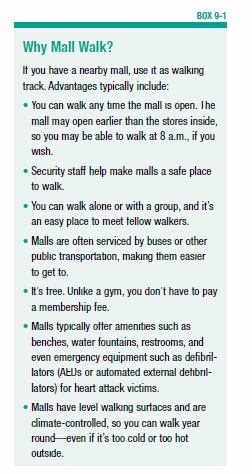
➧ Shopping malls are a great place to walk. See Box 9-1, “Why Mall Walk?” for a list of advantages of mall walking. If your local mall doesn’t have a formal mall walking program but you’re interested in helping start one, read Mall Walking: A Program Resource Guide, which is available at: cdc.gov/physicalactivity/downloads/mallwalking-guide.pdf.
➧ Large community spaces, such as zoos and museums, provide space for walking.
➧ Faith-based organizations and churches sometimes offer exercise programs, and organizations such as wholyfit.com help provide exercise leader training and support.
➧ Hospital-sponsored wellness and rehabilitation centers employ physical therapists and other experts to assist with recovery from injury and illness.
➧ Your local Area Agency on Aging may be able to assist you in finding physical activity programs for older adults, such as tai chi classes for better balance, as well as transportation assistance. Visit n4a.org to help locate the office for your state or city.
➧ Parks and recreation departments in your city can provide information about indoor and outdoor activities, bike/walking trails, public swimming pool information, and more.
➧ Senior centers for community gatherings often offer exercise programs for a small fee, such as classes on tai chi, yoga, and tap dancing.
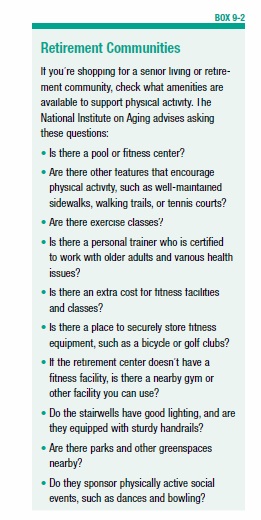
➧ Senior living (retirement) communities may offer physical activity opportunities for residents (see Box 9-2, “Retirement Communities”).
➧ The StrongWomen Initiative was founded by Miriam Nelson, PhD, at Tufts University and is targeted to midlife and older women. StrongWomen programs include strength training and heart disease prevention (aerobic activity) programs and are currently offered in at least 29 states. Visit www.strongwomen.com to find locations and learn more.
➧ Active.com, an event registration website, helps you find physical activity events in your area, such as 5K races (walk or run), bicycling group events, and marathons. A related site, activeendurance.com, provides resources for helping organize a fun run and other race events.
Health Clubs
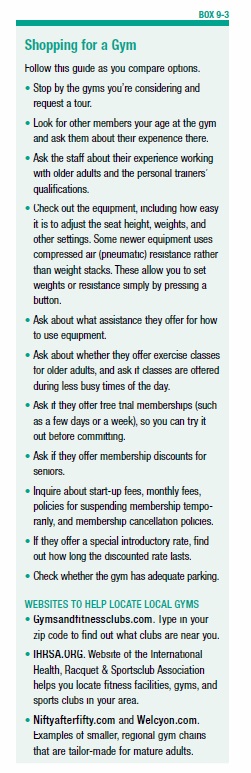
Fitness centers aren’t just for 20-somethings. In fact, a growing number of gyms are catering to those over age 50. Think of a gym as a great indoor playground. Gyms, health clubs, and fitness centers not only house a lot of fitness equipment and exercise classes under one roof, but they also provide an opportunity to socialize with others interested in physical activity. Before you join a gym, research it thoroughly (see Box 9-3, “Shopping for a Gym,” on page 85).
Insurance Plans May Help
Some insurance plans may qualify you for a discount at certain clubs. For example, the SilverSneakers program offers gym discounts to those with Medicare Advantage or Medicare Supplement Health plans. Visit the website silversneakers.com or call 1-866-584-7389 to find out if you qualify. Before you choose a health insurance plan based on gym membership discounts, check which gyms in your area are included in the discount offer, and visit them to make sure they’re a facility you’d want to join.
Monitoring Gadgets
Numerous step counters, activity trackers, fitness wristbands, and other gadgets are available to help monitor you during exercise, track physical activity, and help keep you motivated to move your body. Sophisticated devices such as heart rate monitors are available, too. If you have a smartphone, you can tap into countless free or low-cost activity tracking applications or apps (software programs), which you can locate by checking the health and fitness category on the iTunes App Store or Google Play. In general, the best choice is whatever accurately gives you the information you need, is easy to use, and is affordable.
Pedometers
If you walk, run, or jog, a pedometer can help you track your distance in terms of steps. About 2,000 steps equal one mile. Pedometers are small devices that can be strapped to your waistband or fit in your pocket and generally range in price from $20 to $50. Some popular brands include Omron (omron-healthcare.com) and Yamax (yamax-digiwalker.com). For more information on using a pedometer, see the section on “Counting Steps” on page 20 in Chapter 2.
In general, to test the accuracy of a pedometer, attach it to your belt or waistband on either side of the front of your body so that it’s in line with the center of your kneecap and walk 50 steps at your typical walking pace. If it reads between 47 and 53 steps, it’s likely reasonably accurate and your placement is good. If the reading varies more than three steps above or below 50, reposition it on your waistband and repeat the test (try the opposite side of your waist, if necessary, too). If your waistband is loose, that can lead to undercounting steps. If no position is very accurate, the device itself may not be very good and you may need to return it for a refund. Also keep in mind that most pedometers are fairly accurate at speeds of 2.5 mph and above. However, even some of the most accurate pedometers miscount steps at slower speeds, according to the American College of Sports Medicine.
Fitness Bands
An alternative to a simple pedometer is a fitness wristband with a pedometer feature, such as from Fitbit (fitbit.com), Garmin
(garmin.com/en-US), or Jawbone (jawbone.com). However, these generally have added features, such as more extensive activity tracking, heart rate monitors, food tracking, and/or sleep tracking,
so they are more expensive than a simple pedometer. Prices may range from $50 to well over $200. Such fitness bands typically have memory and download options so you can store your physical activity data over time, as well as share it on social networking sites online, such as Facebook, if you desire.
Smartphone Apps
If you carry your smartphone with you wherever you go, including during exercise, you can download (often free) a pedometer app or other physical activity trackers for your phone, such as Pacer
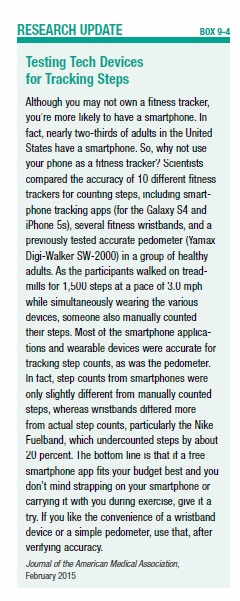
(www.pacer.cc), Moves (moves-app.com), or Accupedo (accupedo.com). A recent study compared the accuracy of dedicated fitness trackers versus smartphone fitness apps for counting steps (see Box 9-4, “Testing Tech Devices for Tracking Steps”) and suggests smartphone apps can be a good choice. Because technology changes quickly, check for the latest reviews on whatever device or smartphone app you’re considering. Many reviews are available online, and computer magazines sometimes have reviews, as do magazines such as Consumer Reports and Time, which often are available at libraries.
Heart Rate Monitors
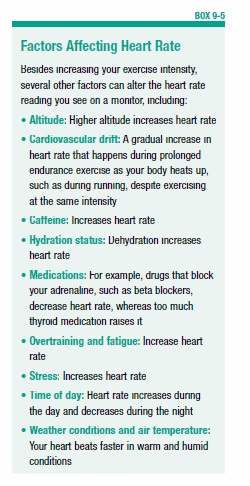
A heart rate monitor helps you keep tabs on your exercise intensity without the need to stop and take your pulse, as (discussed in Chapter 2, page 18). The most accurate heart rate monitors have a chest strap that detects your pulse and sends data to a wrist-watch style receiver, so you can keep an eye on your heart rate during exercise. Strapless heart rate monitors simply use a sensor built into a wristband that tracks your pulse, which can be more comfortable but isn’t as accurate. You can wear a heart rate monitor during most physical activities such has walking, biking, and yardwork. Some models can be worn during swimming. Many monitors have extra features, such as a watch, stopwatch, memory, and a backlight, which can increase price. If you’re considering purchasing a heart rate monitor, it’s important to realize that many factors can affect heart rate and the reading you’ll see, as discussed in Box 9-5, “Factors Affecting Heart Rate.”
Exercise Equipment
For some people, buying fitness equipment for home use may be a good alternative to joining a gym, especially if it makes it more likely you’ll exercise. You can purchase lower cost tools such as stability balls, free weights (dumbbells), and resistance bands, as well as pricier equipment such as home weight machines and cardiovascular workout equipment such as treadmills and exercise bikes. If you already have an outdoor bicycle, consider buying a bike trainer that allows you to ride your regular bike in place indoors when the weather is bad. You’ll pay a fraction of the cost for a bicycle trainer (many are less than $100) compared to a dedicated exercise bike.
Especially for larger purchases, be sure to try exercise equipment before you buy it. If you’ve never used an elliptical machine, for example, don’t buy one simply because your friend raves about hers. Stores typically have floor models you can try. To save money, check stores that sell second-hand exercise equipment. If you’re tired of the equipment you have and want something different, some exercise equipment stores pay cash for used equipment, although you may be able to make more money selling it on your own.
Renting Equipment
Some businesses rent exercise equipment, such as treadmills, rowers, elliptical machines, and weight equipment. A couple of examples are gymsource.com and pushpedalpull.com. Renting gives you a chance to try out machines and determine how much you’d really use them. It also may be handy for temporary locations, such as a winter home. Joining a gym, however, would most likely be a lot more budget friendly.
If you’re considering renting, do some research to compare what it would cost to rent versus buy the equipment. Rental fees can vary depending on your location and the specific model of equipment, and you may have to rent for a minimum time period, such as three months. For example, on the east coast, renting cardio equipment, such as a treadmill, may cost $495 per month while it may cost about half that in the Midwest. For a fee, such as $65 to $150 each way, stores typically deliver and pick up equipment. Free maintenance service generally is included in the rental cost, but be sure to ask. Renting may be a better option for activities you only do occasionally, such as outdoor winter sports. Some parks and outdoor sports stores rent equipment such as showshoes, ice skates, and skis.
Activity and Nutrition Specialists
Trained experts in nutrition and physical activity can help you on the path to reaching your health and fitness goals. Some of the experts you are more likely to encounter are described here.
Exercise Physiologists
Exercise physiologists help people increase health, fitness, and quality of life. Traditionally they have worked with athletes, but now they also can be found in medical and workplace settings. For example, an exercise physiologist may work as a cardiopulmonary rehabilitation specialist helping people after a heart attack, heart surgery, or with emphysema. A minimum of a 4-year college degree is required.
Group Exercise Instructors
Group exercise instructors may teach classes on aerobic exercise, cycling, core training, or other forms of physical activity. Minimum requirements can vary but may require a college degree and should include some type of recognized certification in group fitness instruction, such as from the American College of Sports Medicine (ACSM) or the National Strength and Conditioning Association (NSCA).
Occupational Therapists
Occupational therapists (OT) can help older adults safely do the things they want to do, including performing activities of daily living and helping them with fine motor skills and dexterity. For example, OT assistance may be needed after a stroke or hip replacement surgery to help teach you ways to move safely during recovery to perform daily activities such as bathing, cooking, and dressing. OTs must have a master’s degree and pass an initial certification exam, and state laws typically require OTs to be licensed or certified to practice.
Personal Trainers
Personal trainers can help you to safely start and maintain an effective exercise program and are typically paid by the hour. Currently there is no national standard or minimum requirement for personal trainers. Look for a personal trainer who is certified by a nationally recognized organization that is reputable, such as the ACSM or NSCA, and who has a four-year degree in exercise science, kinesiology, physical education, or a related health-and-fitness field.
Physical Therapists
Physical therapists (PT) are highly educated (with either a master’s degree or a clinical doctorate from an accredited physical therapist program), licensed healthcare professionals who help people improve or restore mobility and reduce pain. They examine, evaluate, and treat people whose conditions limit their ability to move and function in daily life. In most states you can make an appointment with a PT without a doctor’s referral. Most insurance plans, including Medicare, provide coverage for physical therapy services that are medically necessary. You can locate a PT at moveforwardpt.com. Some PTs have specialty certifications, such as in geriatrics or sports physical therapy.
Registered Dietitian Nutritionists
Registered dietitian nutritionists (RDNs), also called registered dietitians (RDs), are food and nutrition experts who help individuals improve their dietary patterns to help maximize performance and to help prevent disease and improve health. Dietitians must have a minimum of a four-year college degree with specific coursework in dietetics, complete 1,200 hours of supervised practice through an accredited dietetic internship, pass a national examination, and maintain continuing education hours. Some also are Board Certified Specialists in Sports Nutrition, which is noted by the credentials CSSD.
Anti-Aging is at Your Fingertips
With so many resources and experts to assist you, the time is now to get started on the path of exercising and eating well for a healthier, younger-feeling you. Start with whatever sounds most doable to you and slowly build from there. Small successes with simple changes can help boost your confidence for further change. Additionally, as you become more fit inside and out by eating well and moving your body more, you’ll be able to set bigger goals. Enjoy the journey!
The post 9. Exercise Resources appeared first on University Health News.
Read Original Article: 9. Exercise Resources »
Powered by WPeMatico
