
7. Getting Active
Taking the First Steps
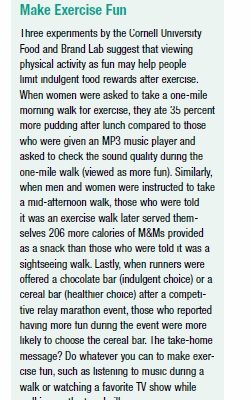
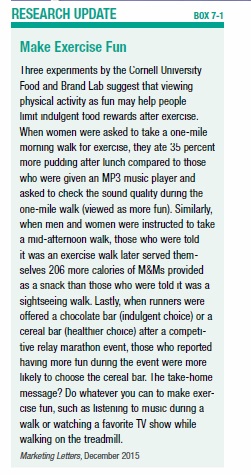
If you’re ready to get more active, start by thinking about what sounds like fun. Remember when you were a kid and it was fun to play hopscotch, jump rope, or ride your bicycle with your neighborhood friends? Most likely you didn’t think about the fact that it was exercise since you were just having fun. Similarly, as an adult, you’ll be a lot more likely to stick with an activity if it’s something you enjoy; a new study suggests you may be less likely to reward yourself with indulgent food after physical activity if you view it as fun (see Box 7-1, “Make Exercise Fun”).
To figure out what activities sound like fun, it may be helpful to tap into activities you used to do in the past and enjoyed. For example, if you used to like to ride your bike, consider picking it up again. If you used to enjoy participating in team sports, join an exercise class. If you prefer two-person activities rather than large groups, consider activities you could do with a partner, such as dancing, pickleball (similar to badminton), cross-country skiing, or aqua-jogging. If you love animals, consider volunteering to walk your neighbor’s dog, or adopt your own dog from an animal shelter.
If you can’t think of any type of exercise you particularly enjoy, think about places you like to spend time, such as visiting nature centers, people-watching at the mall, or hanging out at the lake. Those places support activities such as hiking, mall walking, and kayaking. Maybe it’s time to check out an activity you’ve always been curious about but never tried, such as tai chi or water aerobics. Talk to your friends and ask what they enjoy doing to stay active. Or, if you’re curious about an activity you see someone else doing—perhaps Nordic walking with poles or yoga in the park—ask them about it. You may meet a new exercise buddy in the process.
When to See Your Doctor Before Activity
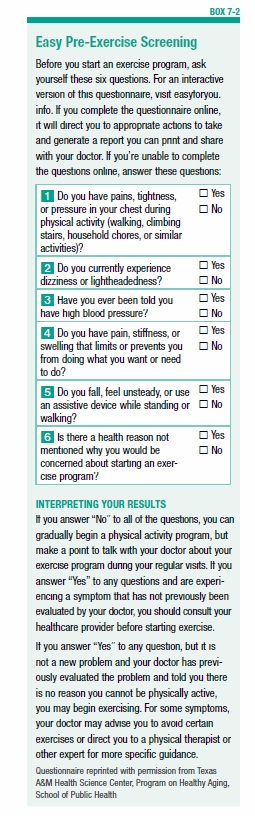
Can you just jump into an exercise program or do you need to see your doctor first? You may be accustomed to seeing the legal disclaimer, “Always consult your physician before beginning any exercise program.” Unfortunately, this disclaimer tends to discourage exercise rather than encourage it, so experts developed an EASY tool to help you know when to see a healthcare provider before exercise (see Box 7-2, “EASY Pre-Exercise Screening”).
Sample Exercise Routines
As discussed in detail in Chapter 2, the Physical Activity Guidelines for Americans advise including both aerobic and strength training (resistance) exercise in your fitness regimen. Regular aerobic exercise helps make your lungs, heart, and cardiovascular system stronger and healthier, so you may have more stamina and reduced risk factors for chronic disease, such as elevated blood pressure, cholesterol, and triglycerides. Resistance training is especially important for inhibiting the loss of muscle mass and strength that occurs with age and keeping bones strong. There are countless aerobic and strength training programs you might choose on the path to fitness. Here we provide sample exercise routines for an aerobic workout (walking) and for core strength training, as well as general guidelines for warming up before exercise and cooling down after exercise.
Warming Up, Cooling Down
You should warm up before resistance exercise, including core training, as well as aerobic exercise. Warming up before exercise helps provide a safe transition to more vigorous exercise, and cooling down at the end of a session supports your body’s recovery after exercise. Warming up helps gradually increase your heart rate and breathing, improving delivery of oxygen and fuel to working muscles. It also helps warm up your muscles so they’re ready to work, which helps reduce risk of injury and muscle soreness after exercise. Cooling down at the end of your exercise session helps you gradually decrease your body temperature, heart rate, and breathing, as well as reduce the risk of dizziness associated with abruptly stopping exercise. Keeping your arm and leg muscles moving during the cool down helps prevent blood from pooling in your hands and feet and can help reduce muscle stiffness after your session, too.
Warm Up
Regardless of what kind of exercise you’re going to do, take about five to 10 minutes at the beginning of your workout to warm up. If you’re frail or it’s been a long time since you exercised, a longer warmup period is generally better. Avoid static stretches (stretching to a challenging but comfortable position and holding it for several seconds) during the warmup—save these for the cool down when muscles are warm. A few ideas of how to warm up include:
- Walk around or march in place while swinging your arms, along with some knee lifts and small kicks.
- Walk up and down some stairs a few times.
- Dance around your living room to a couple of songs.Mimic some of the same movements you’ll be doing during exercise, but at a slower pace and lower intensity, for example:
- Warm up for a walk by walking slowly at first, then gradually increase your pace.
- If you’re going to play tennis, hit some easy groundstrokes from the middle of the court. Or, if you are going to play a round of golf, warm up by taking some easy swings on the driving range.
- If you are going to do wall push-ups, go through the wall push-up motion but stand closer to the wall, move slower, and do fewer repetitions than you’ll do during the exercise session.
Cool Down
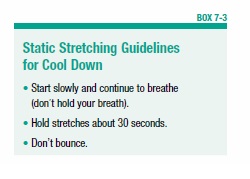
Take about five to 10 minutes at the end of your workout to cool down. It’s a bit like the warmup but in reverse, and can include some flexibility stretches and relaxation breathing. Stretching at the end of your cool down may help increase your range of motion in future exercise. Stretch the same muscles you worked during your exercise session (see Box 7-3, “Static Stretching Guidelines for Cool Down”).
Fitness Walking Routine
Walking is something people typically do every day as part of regular activities. Although walking is something you’ve likely been doing since you were a toddler, it’s a good idea to brush up on proper walking techniques for fitness walking, see Box 7-4, “Proper Walking Techniques.”
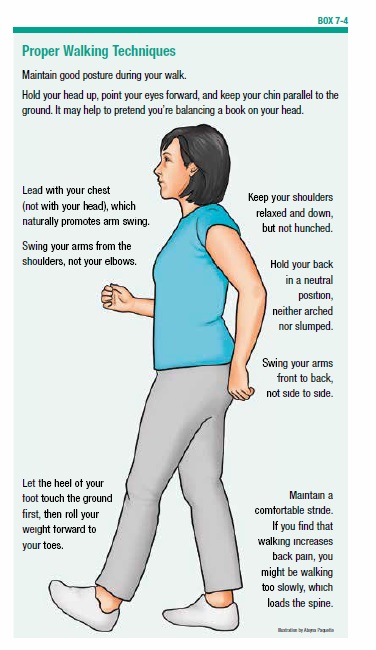
Turning walking into aerobic exercise just requires increasing the intensity and pace for a finite period of time, such as 30 minutes, and repeating the session on a frequent basis, such as once a day. Walking is inexpensive, simple, and carries a low risk of injury, yet it can be very effective for improving cardiovascular fitness if done regularly and at a high enough intensity. If you haven’t walked for more than five minutes at a time in quite a while, it will take some time to build up to 30 minutes or longer of walking. See Box 7-5, “Sample Walking Program,” for a timetable for how you might gradually increase walking.
The general structure of a walk is as follows:
- Warm up by walking slowly.
- Increase your speed to a brisk walk, which means a pace that raises your heart rate but still allows you to speak and breathe easily.
- Cool down by walking at a slower pace.
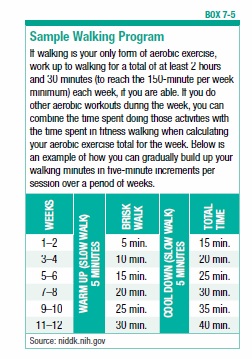
Maybe all you can start with is a walk around the block. As that becomes easier over time, you can gradually increase the distance and your pace.
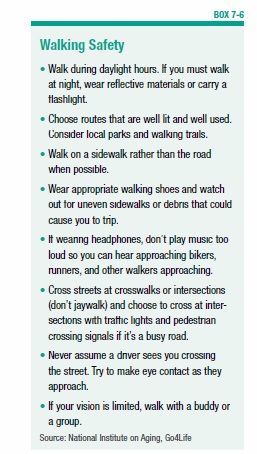
If you already are quite fit and want to get in even better shape by walking, you will have to increase your intensity, for example, by adding in hill walking, wearing a weighted vest, and/or by increasing your speed. For tips on walking safely in your community, see Box 7-6, “Walking Safety.”
Core Fitness Routine
Core strengthening is one form of resistance exercise. As introduced in Chapter 2, your core includes the muscles of the abdomen, lower back, and hips.
Building a strong core provides a good foundation for all physical activity. Core muscles are essential to movement and provide strength, flexibility, and balance—impacting your ability
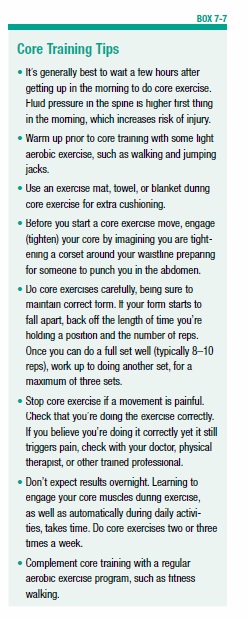
to do all kinds of daily activities, such as bathing, getting dressed, or lifting a grandchild. A strong core also helps prevent falls and injuries during everyday activities. See “Appendix III: Core Exercises,” on pages 92-93, for some core training exercises. For tips on making your core exercise session more effective see Box 7-7, “Core Training Tips,” on page 69.
Overcoming Barriers to Activity
Life can get in the way of your best intentions to exercise. Sometimes your calendar gets overloaded, rain may ruin your plans for an outdoor walk, or money to support exercise may be limited. With a little planning and creativity, however, you can overcome these barriers and keep exercise on track.
Finding Time
If you have a busy schedule, it can be more challenging to fit in exercise. Some people find that exercising in the morning works best, before their schedule gets too busy. Others prefer to exercise in the late-afternoon, as a way to unwind and destress. If you don’t have a 30-minute or longer time block to exercise, schedule exercise in 10-minute sessions during the day, such as morning, lunchtime, and as an afternoon break. Once you’re comfortable with core exercises or weight lifting, you may be able to multi-task and exercise while you watch TV.
Regardless of when you plan to exercise, schedule exercise on a calendar, daily planner, smartphone, or wherever you keep your appointments. Treat exercise like an appointment you shouldn’t break. If you have to take a break from exercise because you’re sick or injured, as soon as you’re able, pick up exercise again. Start at a lower level than where you left off, and gradually work back up to the level of activity you were previously doing.
When you’re outside your normal routine, such as when you’re traveling or during holidays, it can be more challenging to exercise. It helps to set up your environment to support activity. For example, pack your exercise clothes or swimming suit. Choose a hotel with a swimming pool or a fitness room. Alternately, take along an exercise DVD, which you may be able to play on your computer laptop or inquire if the hotel room has a DVD player. Or, use an online exercise video on your computer or smartphone. Lay out your exercise clothes before you go to bed at night. Set your sneakers by the door as a reminder to exercise. During the holidays, set a new tradition of going for a walk after a holiday meal. Plan an active get-together, such as a holiday bowling event rather than a dinner party.
Staying Active in Bad Weather
Whether it’s too hot, too cold, too icy, or too wet outside, the weather sometimes can put a real damper on your exercise plans. That’s when you need to have a Plan B for getting exercise. Indoor exercise provides a great alternative for staying active year-round. Options you could consider include:
- Join a bowling league.
- Use an exercise video in your home.
- Clean your house on a bad-weather day, including more vigorous activities such as mopping the floor and vacuuming.
- Buy your own exercise equipment for home use.
- Walk at a local mall or other large facility.
- Take a dance class, such as ballroom dance, square dance, or tap.
- Join a gym or health club. You’ll be able to use fitness equipment such as treadmills and elliptical machines, swim laps in the pool, take exercise classes, and more.
When Funds Are Tight
Some people have more discretionary income to spend on exercise than others. Fortunately, many exercise options are free. Treat the great outdoors as your free gym. Take advantage of parks, bike trails, and nature centers. Some other options you can explore for budget-friendly exercise include:
- Check local senior centers, community centers, and places of worship for low cost or free exercise classes.
- Find free exercise videos online, such as at youtube.com. Choose videos by trained exercise professionals.
- Walk at the mall or large supercenter stores.
- Check second-hand sports equipment stores for treadmills, weights, exercise bands, and more.
- Shop for used exercise equipment at garage sales or on websites with classified advertisements, such as Craigslist.com.
- Look for membership discounts at gyms during certain times of the year such as around the New Year and summertime.
- Check with your city’s parks and recreation department for free or low-cost exercise resources.
Sticking with It
To gain the most benefits from exercise, you should stick with it for the long-haul. Getting into the habit of exercise doesn’t happen overnight. Studies suggest it may take about 10 weeks of consistently repeating a desired behavior, such as fitness walking, to form a new habit. The more consistently you exercise, the easier it will probably get and the more likely it will become second nature, so that if you skip doing it, it will feel strange. Missing a single day of exercise won’t necessarily derail your exercise habit, but missing a whole week could. So, aim to be as consistent in your routine as you can. Several factors can help increase the likelihood you’ll keep up the exercise habit, such as anchoring exercise to an existing habit, tracking your progress, and peer support, as explained in the following paragraphs.
Anchoring Exercise
You are more likely to exercise if you make it a regular part of your day and anchor it to an existing habit, just as you might do for brushing your teeth before you go to bed or flossing your teeth after you brush them. This concept of anchoring has been popularized by a Stanford University researcher, BJ Fogg, PhD. To anchor exercise to an existing habit, think about what time of day you’d like to exercise, and then think about something you already do daily near that time. For example, if you’d like to go for a walk in the evening after dinner, you might anchor your habit like this: After I do the dishes, I will go for a walk. You can create your own anchoring statements by filling in these blanks, being as specific as you can, so it’s unmistakable when you’ll exercise:
Track Your efforts
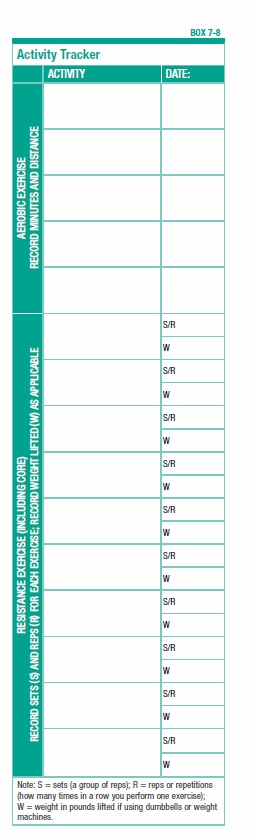
By logging your activity every time you work out, you can see your progress over time. Plus, if you are unable to exercise for a few days, you’ll easily be able to look back and see where you left off. You can track your activity in whatever way you prefer, such as in a notebook, on a computer spreadsheet, with an app on your smartphone, or on a social networking site online.
Self-Tracking
See Box 7-8, “Activity Tracker” for a sample form you can use to record your exercise sessions. Leave this form blank so you can make copies of it. Keep a binder of your completed forms so you can see your progress over time.
Technology for Tracking
Countless Internet sites and smartphone apps are available to make tracking physical activity easy and fun. Here is a small sampling of what’s available.
➧ SuperTracker: A free online tracking tool from the USDA that includes a goal-setting tool and tracking tools for what you eat and your physical activity. You also can form an online group and print reports of the group’s physical activity progress. Details are available at supertracker.usda.gov.
➧ SparkPeople: A free online health and fitness community that offers countless resources, including fitness tracking that allows you to log and print out reports of the exercise you’ve done. Integrates with SparkPeople Mobile, so you can track on your smartphone, too. Details at sparkpeople.com.
➧ MapMyWalk: A free smartphone fitness app that uses the built-in GPS of your smartphone to track your walk, including duration, distance, pace, speed, elevation, calories burned, and route traveled on an interactive map. Also allows you to share the details of your fitness activities with others via email, Facebook, and Twitter. Offers similar apps for running, bicycling, hiking, and dog walking. Details at mapmywalk.org.
➧ Charity Miles: A free smartphone app that enables you to choose a charity and earn money (up to 10–25 cents) for every mile covered when you walk, run, or bike (and similar activities). The app uses your smartphone’s GPS and accelerometer to measure your distance. Details at charitymiles.org.
Exercise Buddies and Groups
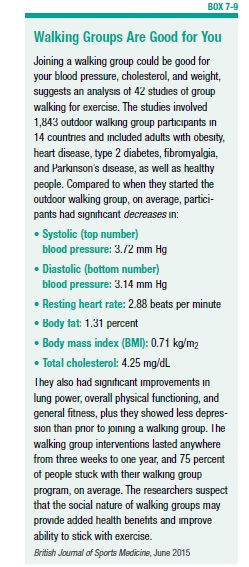
Many people find it motivating (and more fun!) if they exercise with someone else. Research shows that the social support of walking groups can help older adults increase physical activity, as well as improve health (see Box 7-9, “Walking Groups Are Good for You”). Consider asking a friend, family member, coworker, or neighbor if they’d like to join you for a walk, hike, or a trip to the gym. You also can get peer support from virtual exercise communities using smartphone apps and websites, and many organizations can help you find a buddy or group to exercise with in person. Here is a sampling:
➧ American Volkssport Association: A personal fitness and sports recreation program that brings people together for noncompetitive group walks, hikes, bike rides, swims, and in some parts of the country, cross-country skiing. They may charge a small fee. Find a local club (or find out how to start your own club) at ava.org or call 210-659-2112.
➧ Racewalk.com: Locate a racewalking club in your area and learn more about racewalking at this website. Racewalking is a more intense, faster form of walking that utilizes more of your muscles and gives you a more complete workout.
➧ Fitlink.com: For a $5 lifetime membership fee, you can join virtual exercise and fitness groups and participate in online fitness forums, as well as locate workout partners and personal trainers in your area for specific types of exercise.
➧ Exercisefriends.com: Helps you meet others with the same exercise goals, interests, and skill level, so you can team up for exercise. (Note: When meeting anyone online, use appropriate discretion for your safety.)
What You Should Wear
Special clothing is not needed for most exercise, but it should be comfortable and allow you to move around easily. If you plan to exercise outside, dress in layers so you can shed a layer as you warm up during exercise. If you plan to exercise outdoors in the early morning or evening when lighting is dim, wear bright or reflective clothing.
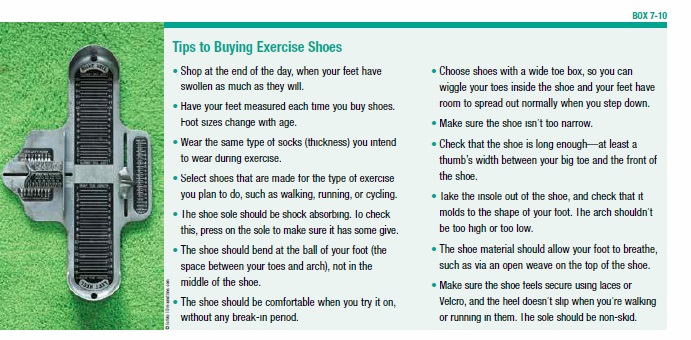
Probably the most important thing for most exercise is to have shoes that fit well and are comfortable, providing cushioning to help protect against muscle and joint injuries. As a general guideline, replace athletic shoes after three to six months of regular use or when you’ve put approximately 350–500 miles of walking or running on them. If you’re not sure how long you’ve had your shoes or how many miles are on them, replace shoes when the tread is worn out or your feet feel tired after exercising. For more information on buying exercise shoes, see Box 7-10, “Tips To Buying Exercise Shoes.”
The post 7. Getting Active appeared first on University Health News.
Read Original Article: 7. Getting Active »
Powered by WPeMatico
