
2. Essential Exercise
What’s Your Exercise Story?
Individuals come to exercise programs with different histories of physical activity. Maybe you played a team sport in high school and intramural athletics in college, but gradually became less active with the demands of work and family. Perhaps you’ve always preferred solitary activities, such as hiking on nature trails or one-on-one workouts with an exercise video in your living room. Maybe you don’t view yourself as athletic and have never stepped foot inside a gym, but you like to dance. Your physical activity background, health status, and current fitness level play bigger roles than your age in determining what you can do now and where you should start with an exercise program.
Your reasons for exercising today likely differ from when you were younger. So, it’s important to take stock of your goals. Even if you’re not all that interested in being able to walk three miles just for the exercise, the level of fitness that comes from being able to do that carries over into your ability to perform activities of daily life such as caring for yourself and for your home, as well as spending time with your family in more active pursuits, such as traveling and taking grandchildren to the park. Similarly, you may be interested in improving your muscle strength so you can more easily climb stairs, or maybe you’d like to improve your endurance to make shoveling snow or mowing the lawn easier.
If you currently have a low fitness level, it may take several months to reach your activity and performance goals. That’s OK. The important thing is that you’re working toward your goals. Over time, you can gradually increase the amount of time you exercise and the difficulty level. On the other hand, if you already are quite active, are in good health, and are interested in doing more, go for it. The benefits tend to be even greater with more activity.
Physical Activity Recommendations
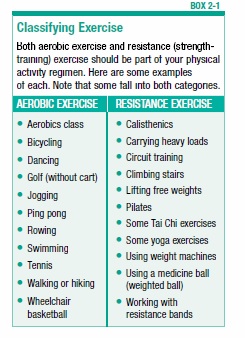
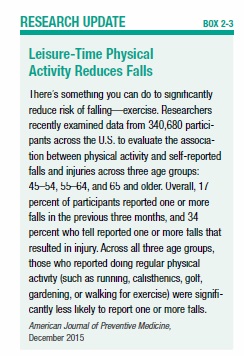
As introduced in Chapter 1, the government’s Physical Activity Guidelines for Americans recommend aerobic and muscle-strengthening (resistance) exercise for all adults, in addition to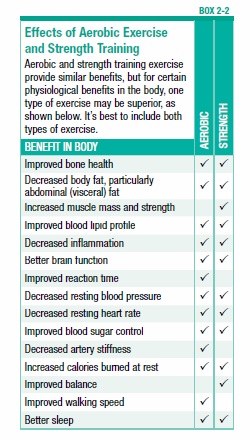 balance training for older adults at risk for falls. For examples of aerobic versus resistance exercise, see Box 2-1, “Classifying Exercise.” Both aerobic and resistance exercise provide several important benefits, many of which overlap, but in certain cases the different forms of exercise have unique benefits (see Box 2-2, “Effects of Aerobic Exercise and Strength Training”). Although balance is not a focus of this report per se, it’s worth noting that balance can be impacted by your muscular strength and aerobic endurance, in addition to specific exercises to improve balance. Importantly, regular physical activity can help reduce risk of falls (see Box 2-3, “Leisure-Time Physical Activity Reduces Falls”).
As stressed by the Physical Activity Guidelines for Americans, all adults, including older adults, should avoid inactivity. If you’re not able to do a lot right now, do whatever amount of activity you can—even if that’s just 5 or 10 minutes a day. There can be significant benefits in progressing from no physical activity to a little activity. When you’re able, slowly increase the amount of time you exercise, then try to gradually increase the intensity. To get the most health benefits, if you’re able, try to work up to the following goals:
Aerobic Exercise
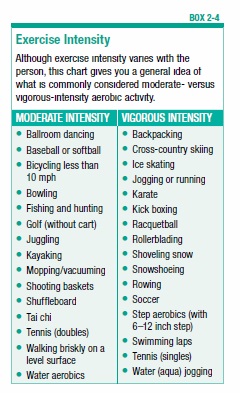
Do at least 150 minutes (2 hours and 30 minutes) a week of moderate-intensity, or at least 75 minutes (1 hour and 15 minutes) a week of vigorous-intensity, aerobic activity. (For examples of aerobic exercise that are generally moderate or vigorous in intensity, see Box 2-4, “Exercise Intensity,” on page 17.)
- For moderate aerobic activities, you can break the sessions into 10 minutes each, to total 30 minutes a day, and work toward a goal of at least five days a week.
- For vigorous activity, you can break aerobic exercise sessions into 20 minutes a day.
- You can opt to do a combination of moderate- and vigorous-intensity exercise, if you wish. In general, 2 minutes of moderate-intensity activity counts the same as 1 minute of vigorous-intensity activity. For example, 15 minutes of vigorous walking (such as walking up hills) counts as 30 minutes of moderate-intensity walking. With vigorous exercise, you get similar health benefits in half the time it takes you with moderate exercise.
- If you’re already active, you can gain even more health benefits by moving beyond the 150 minutes and aim for 300 or more minutes a week of relatively moderate-intensity aerobic activity.
Resistance Exercise
Do muscle-strengthening exercise that works each major muscle group (arms, shoulders, chest, abdomen, back, hips, and legs) at least two times a week. Avoid exercising the same muscle groups on two consecutive days, as time is needed for muscle recovery.
- There is no set time for exercise sessions, but the goal is to do eight to 12 repetitions of each exercise, and if you’re able you can do two or three sets (of eight to 12 repetitions) of each exercise. (For further explanation of repetitions and sets, see page 21.)
- Core training exercise, which targets the muscles attached to your trunk and spine, should be done in addition to traditional resistance training exercise. Core muscles are involved just about every time you move your body and thus support other physical activity. (Core training is highlighted in Chapter 7.)
- As you become more advanced, you may prefer to split up your muscle-training routine, which means you might exercise specific muscle groups one or two days a week and the remaining muscle groups on a separate one or two days. This is fine, as long you allow at least 48 hours of recovery time for each muscle group.
- After doing resistance exercise, your body starts to repair and replace damaged muscle fibers, forming new strands of muscle protein that result in stronger muscle tissue, and in some cases (particularly younger individuals and men), bigger muscle tissues. This process of muscle rebuilding takes time.
Types of Activity
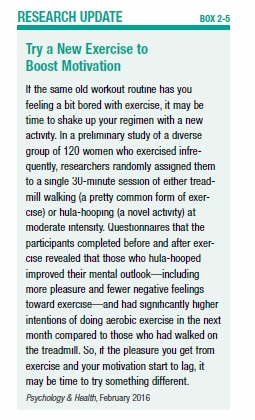
The best type of exercise varies from person to person, based on your individual goals and abilities, but your exercise regimen should include both aerobic exercise and resistance training. It’s also important to select activities you enjoy. Walking is one of the simplest forms of aerobic exercise that most people can do, and it has a low risk of injury. Tai chi, water aerobics, and dancing are a few more examples of good activities for beginners. It’s not so important what you do, but that you do something active. Consider doing different activities on different days so you don’t lose interest in exercise. Don’t be afraid to try something completely different—it just might make exercise more fun (see Box 2-5, “Try a New Exercise to Boost Motivation”).
Aerobic Exercise
Aerobic activity, sometimes called endurance exercise, involves moving large muscle groups in a rhythmic manner for an extended time period, such as 10 minutes or more. Common examples are brisk walking, dancing, swimming, jogging, and biking. The beauty of aerobic exercise is how it seamlessly enhances the performance of your heart, circulatory system, and lungs. To support the delivery of oxygen and nutrients to working muscles during aerobic exercise, your heart beats faster and your breathing increases. Over a few months’ time, your cardiovascular system becomes stronger, so your heart can pump more blood with less effort, which can help lower blood pressure. Aerobic exercise also strengthens your lungs and triggers the growth of new blood vessels to help deliver oxygen to your muscles. Your muscles becomes more efficient at performing activity, too.
From a practical perspective, aerobic fitness can help improve your stamina, maintain your mobility, and support your ability to perform activities of daily living needed to take care of yourself and your home, such as climbing stairs and grocery shopping. More often than not, when adults lose their ability to do things on their own, it’s not just because they’ve gotten older, but because they’ve become inactive.
To get the most benefit from aerobic exercise, you should exercise hard enough and long enough to get your heart rate into the target range for your age. There are different methods for assessing how hard you’re working out. If you’re a numbers person, you may prefer to monitor your heart rate. Alternately, you can estimate how hard you’re working and rank it on a numeric scale, such as the Borg Scale of Perceived Exertion, or you can assess how difficult it is for you to talk during activity. If you enjoy walking for exercise, you can use a pedometer (a step counter) to monitor your efforts. Each of these methods is explained here.
Target Heart Rate
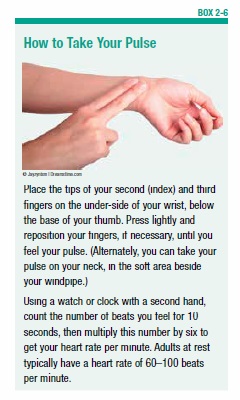
Your heart rate is essentially the number of times your heart beats in one minute, and you can check it by taking your pulse (see Box 2-6, “How to Take Your Pulse”). Alternately, you can purchase a heart rate monitor to wear during exercise (discussed in Chapter 9), so you don’t have to stop to take your pulse. Many of the exercise machines in gyms can monitor your heart rate for you. For example, pulse sensors are typically built into the hand grips of elliptical machines.
To determine the heart rate you should target for exercise, first you need to know how to calculate your maximum heart rate. A few different formulas can be used for this, but some scientists believe the following formula is the most accurate as adults get older. Regardless of what formula you use, keep in mind the number you get is merely an estimate—your actual maximum heart rate may be substantially above or below the number you calculate, but this calculation gets you in the ballpark.
- Multiply your age by 0.7
- Subtract that number from 208
So, if you are 70 years old, your maximum heart rate is around 159 beats per minute. The steps to calculate this are: 70 x 0.7 = 49. Then, 208 – 49 = 159. This maximum heart rate is the rate you should not exceed for any length of time, not the rate you want to target for your workout. You need this number in order to calculate your target heart rate, which is typically 50–85 percent of your maximum heart rate. So, if your maximum heart rate is 159, your target heart rate would be somewhere between 79–135. (To calculate that, multiply 159 x 0.50 and 159 and 0.85.)
The target heart rate zone covers a fairly broad range. How fit you are will determine which end of the range you should aim for. If your fitness level is currently low, you may aim to exercise around 50–60 percent of your maximum heart rate, but if you are fitter, you may be able to maintain a higher percentage, such as 65–75 percent of your maximum heart rate during exercise. (An exception would be during high-intensity interval training, in which you briefly may be at 85 percent or more of your maximum heart rate—enough to make carrying on a conversation difficult—with recovery intervals generally at 40–50 percent of maximum intensity).
In the first few weeks of starting exercise, aim for the lower end of the range for your target heart rate. If you check your heart rate during exercise and it’s above your target, you may be straining and may need to slow down a bit; if your heart rate is below your target zone, you may need to pick up your pace a little. You can gradually work toward the upper end of your target heart rate zone as you become fitter.
Certain high blood pressure medications lower the maximum heart rate and, in turn, the target heart rate. If you’re taking a blood pressure medication, ask your doctor if you need to use a lower target heart rate. If you have a pacemaker or an irregular heart rhythm (atrial fibrillation), the target heart rate method is not advised. Instead, you can use a rating of perceived exertion to estimate how hard you’re working, which is discussed in the next section.
Rating Perceived Exertion
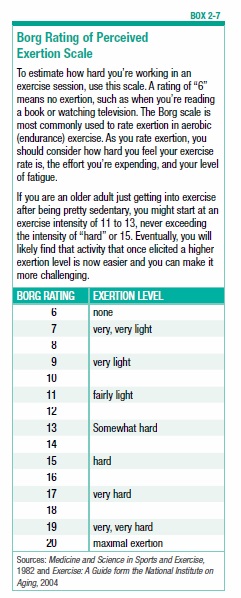
If you prefer to bypass the number crunching and pulse checking required to use the target heart rate method, you can simply estimate how hard you’re working on a numeric scale. The most widely used scale is the Borg Rating of Perceived Exertion (RPE). It ranks exertion on a scale of 6 to 20 (see Box 2-7, “Borg Rating of Perceived Exertion Scale”).
Talk Test
A simple talk test will give you an idea of whether you’re exercising in your target heart rate zone or not. If you can carry on a conversation without any difficulty, you may be exercising below your target zone. If you can carry on a conversation but need to stop speaking here or there to catch your breath, you are probably in your target heart rate zone. If talking is very difficult or impossible, you may be overdoing it and may need to ease up a bit. An exception would be if you are doing interval conditioning, in which there are short periods (such as one to six minutes) in which your effort is a little more than is comfortable, followed by an equal or longer recovery period in which your effort is easy and comfortable.
Counting Steps
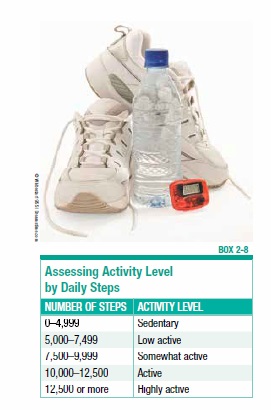
If your goal is to decrease how sedentary you are throughout the day and walk more, you can use a step counter (pedometer) to monitor your physical activity. (For a discussion on selecting a pedometer, see Chapter 9.) Before you increase your activity, wear a pedometer for a week to get an idea of your usual activity level. Once you know how active you typically are, you can set a goal to gradually increase your daily steps, such as by 500 steps per day, until you reach your desired activity level. Some people aim for 10,000 steps a day, which is about five miles. However, that number may be too high or too low for you. That’s why it’s important to check your starting point. See Box 2-8, “Assessing Activity Level by Daily Steps,” for a general guide to classifying your activity level based on step counts.
Strengthening Exercise
If you’ve never done any formal muscle-strengthening exercise or resistance training, such as lifting weights or using resistance bands, you may question why you should start now. As with many things as you get older, holding on to your muscle mass is a bit of a “use it or lose it” proposition. In our 30s, we start to lose muscle mass and strength. Adults who are physically inactive can lose up to 3–5 percent of their muscle mass per decade after age 30. This loss is steeper around middle age, especially around the time of menopause for women. Loss of muscular mass, strength, and ability related to aging is called sarcopenia.
Doing resistance exercise, especially when paired with a nutrient-rich diet with adequate protein, can significantly help reduce muscle loss and help improve muscle strength. It’s never too late to start. One study showed that older, sedentary men increased their muscle mass by 3.7 pounds and women increased muscle mass by 1.7 pounds with two months of strength training consisting of 30-minute sessions two or three days a week.
Regular resistance exercise also helps prevent osteoporosis because it promotes stronger, denser bones. In fact, resistance exercise seems to be the best form of activity for maintaining strong bones and increasing bone mineral density.
Most importantly, regular resistance exercise can impact the quality of your daily life. Although you may not care whether you have well-defined biceps, you likely do care about being able to carry a bag of groceries or a laundry basket, shovel snow, or move furniture around so you can vacuum. Muscular strength also can support your ability to participate in leisure activities, such as golf or tennis. Muscle strength can help you walk at a faster pace rather than slowing down with age, too. Additionally, because resistance exercise helps you decrease your body fat and control your weight, it also helps guard against heart disease and high blood pressure, as well as improve cholesterol. Resistance exercise can even help combat common health conditions such as arthritis and back pain.
Reps and Sets
Resistance exercise comes with its own set of terminology, including sets and repetitions. A repetition or “rep” is the number of times you perform a complete movement of a given exercise, such as bicep curls. A set is a group of the same kind of exercise, so you might do two sets of bicep curls in an exercise session. The American College of Sports Medicine recommends that older and frail adults do 10 to 15 repetitions per set. You can do eight to 10 different resistance exercises in a session, 2–3 days per week. To keep your muscles from becoming overly tired, you should rest for 2–3 minutes between sets and between different exercises.
To meet your goal of increasing muscle strength, resistance training should be progressive, which means that as you get stronger, you should gradually increase the resistance or level of difficulty and number of sets up to a maximum of three sets per exercise. For example, you might start with two sets of bicep curls with 12 repetitions using eight-pound weights, then progress to three sets of eight to 10 reps using eight-pound weights, gradually working up to 15 reps per set. Once you’re able to do 15 reps per set of bicep curls with eight-pound weights, you can increase the weights to 10 pounds and gradually increase the number of reps and sets in the same fashion as you did with the eight-pound weights. When you progressively overload muscles in this way, you’ll get increases in strength and perhaps mass.
The amount of time you spend in a resistance training session will vary, but avoid lengthy sessions (longer than 45 minutes) because you’ll become more fatigued and increase your risk of injury. Generally, 20–45 minute resistance training sessions are recommended for older adults.
Strengthen Your Core
If you’re concerned about how you look and feel as you get older, doing resistance exercise that promotes a strong core is essential. Although there are varying definitions of the “core,” it generally refers to the muscles in your abdomen, lower back, and hips.
These muscles help you stand, bend, twist, reach, stoop, and turn. When these muscles are strong, they help you stand up straight (rather than hunching over), and they promote good balance, helping prevent falls. A strong core also helps reduce the likelihood of injuring your low back.
When core muscles are weak, not only is physical activity more difficult, but so are daily activities, such as getting dressed, carrying groceries, or vacuuming. Signs of a weak core include poor posture (whether you’re sitting or standing), lower back pain, and muscle weakness in your arms and legs. Clues you may have poor posture include a head that’s commonly thrust forward, slouching, rounded shoulders, and excessive arching of your lower back with your stomach or abdomen protruding. An indirect test of core-strength is the
sit-to-stand chair test (see Box 2-9,
“30-Second Sit-to-Stand Test”).

Many of the same tools used for general strength training also are used in core training, such as free weights, resistance bands, and stability balls. This report covers sample core exercises in Appendix III, but you already may be familiar with some examples, such as side leg lifts, lunges, planks, and wall push-ups. One popular form of exercise, Pilates, has core strengthening as an essential component.
Exercise and Weight Management
For some people, one motivation to exercise is to help achieve and maintain a healthy body weight. Sedentary adults typically gain 17–20 pounds of weight (mostly fat) between 18 to 55 years of age, followed by additional gains of 2 to 4½ pounds over the next decade and declining body weight thereafter. The issue of obesity in older adults is a relatively new phenomenon. The best course of action for someone who becomes obese in middle-age and remains obese in older age should be evaluated with one’s physician, as exercise, optimal nutrition, and medical supervision are needed for an older adult to lose weight safely.
Although some people look to exercise as a route to weight loss, the effects of physical activity may be more subtle than producing a direct reduction in pounds when you step on the scale. When you are on a weight-reducing diet, a program of regular physical activity that includes resistance exercise can help reduce muscle loss, which is normally a component of weight loss. Retaining muscle not only is important for strength, but muscle also makes it easier to manage your weight. Here’s why: For every pound of muscle you have, you burn approximately six calories a day while each pound of fat burns only two calories a day.
Regular exercise also can help improve chronic disease risk factors, such as blood lipids, blood pressure, and insulin resistance. Aerobic training improves the body’s sensitivity to insulin. That means it takes less insulin to put glucose (derived from carbohydrates you’ve eaten) into your muscles for storage, and ultimately, less storage of excess glucose as body fat. What’s more, smaller surges in insulin levels after eating mean smaller fluctuations in blood sugar, which helps avoid spikes in hunger. If you’ve ever thought it would be so much easier to control your weight if you could just control your hunger, then there you have it: Regular exercise is key.
The first step in building your exercise regimen for weight control is to aim for 150 minutes of moderate-intensity aerobic activity each week. To reach your weight goal, you may need to increase your activity beyond that in conjunction with moderately decreasing the amount of calories you take in (by about 250–500 calories a day). By itself, physical activity has a modest effect on weight loss, especially if you’re doing less than 150 minutes of exercise a week; thus, reducing the amount of calories you take in also is important for those who have a lot of weight to lose. When it comes to maintaining weight loss and preventing weight regain over the long term, physical activity is crucial.
Calorie Burn of Activity
How many calories you burn is largely determined by how much energy your body requires to perform basic functions of life, such as breathing, conducting nerve signals, and circulating blood throughout your body, which is called resting energy expenditure or resting metabolism. These types of activities, which you typically aren’t consciously aware of, account for about 70 percent of the calories you burn in a day. Resting metabolism is impacted by several factors, such as your age, sex, genetics, hormonal changes, body size, and body composition—especially how much skeletal muscle tissue you have.
The other major component of how many calories you burn is how physically active you are, including daily activities like doing the dishes and cleaning the house, as well as structured exercise. Clearly, physical activity is the aspect of your metabolism you have the most control over. That’s why exercise is a key component of weight control. Besides resting energy expenditure and physical activity, you also burn a small amount of energy when your body digests and processes the food you eat.
Healthy Weight Targets
The most commonly used gauge of a healthy body weight is body mass index or BMI, which is an indirect way of estimating how much body fat you have. If you know your height and weight, you can calculate your own BMI. If you have Internet access, you can let a website do the math for you, such as the calculator at www.nhlbi.nih.gov/health/educational/lose_wt/BMI/bmicalc.htm. BMI is also easy to figure out with a standard calculator, as follows:
- Multiply your height in inches by itself.
- Example for someone 5 foot, 4 inches tall (64 inches):
64 x 64 = 4,096
- Divide your weight by the result of Step 1.
- Example for someone who is 140 pounds: 140 ÷ 4,096 = 0.034
- Multiply the number you got in Step 2 by 703 to get your BMI.
- Example: 0.034 x 703 = 24
So what does a BMI of 24 mean? Consult the chart in Box 2-10, “General Guide to Interpreting BMI,” which shows that a BMI of 24 means you’re still at a healthy weight for your height (BMI of 25-29.9 is considered overweight). However, the BMI formula doesn’t account for differences in age, sex, or lean body mass (muscle and bone). The BMI formula tends to overestimate body fat in trained, muscular athletes. For example, an athlete with a BMI of 29 may not actually be overweight, but rather, may have a significant amount of muscle mass, which is contributing to a higher weight on the scale. So, this may be a consideration when someone is very fit.
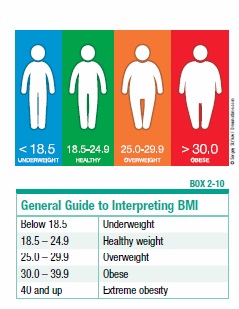
With aging, women lose both lean body mass and height, so some experts have questioned whether BMI is an accurate predictor of obesity in aging. However, a recent study of women up to 95 years of age did find that despite changes in height and lean body mass, BMI was still a good predictor of body fat in older women. Even so, some experts believe that as adults age into their 70s, a BMI in the “overweight” range may not be as risky as it is for a younger person, and may actually help guard against certain problems of aging, such as osteoporosis, and help decrease mortality risk.
Falling at the extreme ends of the BMI range—including extreme obesity and underweight—seems to pose the greatest risks for mortality. Your doctor can help you determine if weight loss would benefit you and can monitor you appropriately. If you’re taking medications, for high blood pressure or type 2 diabetes for example, they may need adjusting as you lose weight. Exercise and optimal nutrition will be needed to lose weight safely and to minimize loss of muscle and bone.
Preventing Injury
Most older adults can increase their physical activity at least to a moderate degree. If you’ve been inactive for a while, start at a low level of activity and work your way up slowly over time. For guidance on when to consult your doctor before starting an exercise program, see page 65 in Chapter 7.
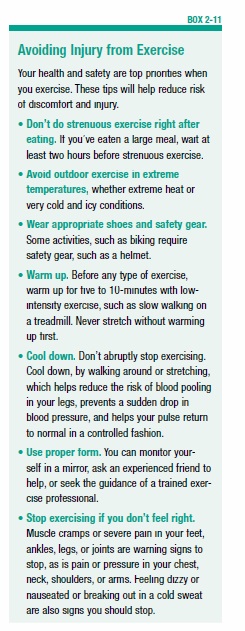
Some older adults avoid exercise and physical activity due to fear of injury. In reality, the risks of being sedentary are far greater than any small risks that might come with starting light-to-moderate activity. The main risk is that your muscles may be sore in the first few weeks of starting an exercise program. Although you likely won’t be able to avoid this completely, and it’s important to challenge yourself, one of the best ways to reduce muscle soreness is to gradually progress in your exercise program rather than trying to do too much at the start. Muscle soreness generally resolves by itself within a few days. See Box 2-11, “Avoiding Injury from Exercise,” for additional tips to avoid pain and physical impairment from exercise.
The post 2. Essential Exercise appeared first on University Health News.
Read Original Article: 2. Essential Exercise »
Powered by WPeMatico
